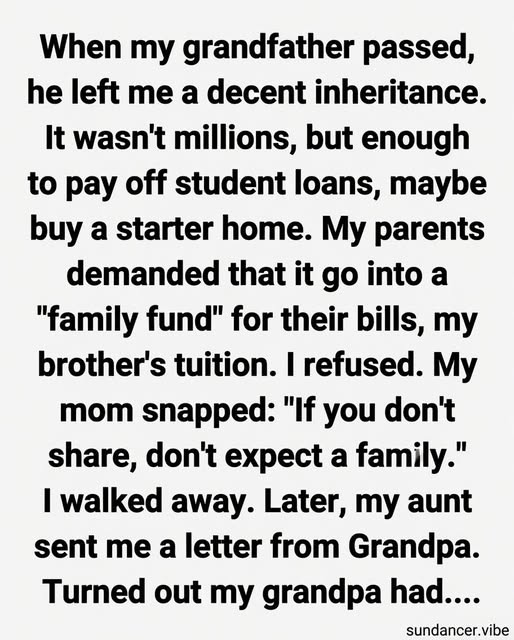
When my grandfather died, the silence he left behind felt heavier than anything he had ever said. He had never been a loud man. His presence was steady, grounding—the kind of person you don’t notice filling a room until the room suddenly feels empty without him.
Grief didn’t arrive all at once. It slipped in through ordinary moments. The chair he used to sit in. The way Sundays felt different without his voice. The absence of small routines I hadn’t even realized mattered.
Then came the letter.
It wasn’t from him—not directly—but from the estate attorney. Inside was a formal notice explaining that I had been left an inheritance. I read it twice, then a third time, trying to make sense of it. It wasn’t an enormous amount, but it was enough to change things in a practical way. Enough to clear my debts. Enough to make stability feel real instead of hypothetical.
What surprised me most wasn’t the money.
It was that he had chosen me.
My grandfather had never talked openly about finances. He lived simply, carefully. Nothing about him suggested he was planning to single anyone out. If anything, I would have assumed everything would be divided quietly and evenly.
But it wasn’t.
And that’s where everything began to unravel.
At first, my parents reacted with mild curiosity. They asked questions, tried to understand the details. But within days, something shifted. The conversations changed tone. What started as surprise turned into concern, then into something sharper.
“Are you sure that’s how it’s supposed to be?” my mother asked one evening.
“Yes,” I said. “That’s what the letter says.”
She nodded slowly, but I could see something working behind her expression.
A few days later, she brought it up again—this time differently.
“It might make more sense,” she said, “to think about how this could help everyone.”
I didn’t respond immediately. I thought she meant something small, temporary.
But she continued.
“Your brother has tuition. We still have the mortgage. And you know how things come up. It’s not really fair for one person to hold onto all of that when it could support the whole family.”
The word fair lingered in the air.
Before I could fully process it, my father joined in.
“We’re not saying you shouldn’t benefit,” he added. “Just that it should be shared. That’s what families do.”
It sounded reasonable at first.
Until it didn’t.
I tried to explain my perspective calmly. I told them I planned to use the money responsibly—to pay off loans, to create some stability for myself. I wasn’t talking about luxury or indulgence. Just a chance to breathe a little easier.
But every explanation seemed to shift meaning as soon as it reached them.
Responsibility became selfishness.
Planning became greed.
Independence became rejection.
The conversations grew more frequent, more structured. They stopped being casual discussions and started feeling like negotiations I hadn’t agreed to participate in. My father began bringing documents—printed plans outlining how the money could be divided, how it could be transferred into shared accounts, how it could “benefit everyone.”
Each time, I said no.
Not angrily. Not dramatically.
Just clearly.
And each time, the tension grew.
My brother stayed quiet through most of it. He looked uncomfortable, like he understood something wasn’t right but didn’t want to step into the middle of it. I couldn’t blame him. The pressure wasn’t directed at him.
It was all aimed at me.
The breaking point came on an ordinary evening that didn’t feel like it should change everything—but did.
We were sitting in the living room again, the same conversation circling for what felt like the hundredth time. I had just refused, again, when my mother’s expression shifted.
It wasn’t anger.
It was something colder.
“If you don’t share it,” she said quietly, “don’t expect to be part of this family anymore.”
The room went still.
I waited for someone to soften it, to turn it into something said in frustration.
No one did.
My father didn’t speak.
My brother looked down.
And my mother held my gaze like she meant every word.
That was the moment something inside me settled.
Not in anger.
In clarity.
I didn’t argue. I didn’t try to convince them. I didn’t raise my voice.
I just stood up, gathered my things, and left.
Cutting off contact wasn’t a single decision—it was a series of them. I stopped answering calls. I blocked numbers. I created distance where there had once been constant connection.
It hurt.
More than I expected.
There were moments I questioned everything. Late nights when I wondered if I had overreacted, if I had chosen money over family. The doubt didn’t disappear quickly. It lingered, quiet but persistent.
But every time I replayed that moment—the ultimatum, the condition attached to belonging—I came back to the same truth.
I hadn’t been the one who made love conditional.
They had.
So I built a life without them.
I paid off my debts. I started saving. I created stability in ways I hadn’t been able to before. On the surface, things improved. But underneath, there was always something missing—a space where family used to be.
Months passed before anything changed.
Then one day, a letter arrived.
This one was handwritten.
It was from my aunt—my grandfather’s sister. We weren’t especially close, but I recognized her careful, deliberate handwriting immediately.
Inside was a short note and a document.
She explained that my grandfather had left additional instructions—something he wanted revealed only under certain circumstances.
My hands slowed as I unfolded the pages.
And then I read it.
“This gift is for you alone.”
The words were simple. Direct.
There was no ambiguity.
It continued, making it clear that no one else had any claim to the inheritance, regardless of their expectations or needs.
And then there was the line that stopped me completely.
“If anyone attempts to pressure or coerce you into sharing this inheritance, they forfeit any claim they might otherwise have had.”
I read it again.
And again.
He had known.
Not vaguely. Not generally.
Specifically.
He had anticipated exactly what would happen—the conversations, the pressure, the attempt to turn something personal into something collective.
And he had protected me.
Not just financially.
But emotionally.
I didn’t realize how much I needed that until that moment.
I cried—not because of the money, but because of the understanding behind it. He had seen something I hadn’t fully recognized at the time. He had trusted me to handle it, but he hadn’t left me unprotected.
For the first time since everything happened, I felt something settle inside me.
Not just relief.
Validation.
The decision I had made—the one that had felt so heavy, so uncertain—suddenly felt grounded in something deeper than reaction. It wasn’t just about resisting pressure.
It was about honoring something he had already understood.
But clarity didn’t make everything simple.
When my parents reached out again, their tone had changed—but only partially.
They spoke about how much the situation had hurt them. About how my distance had affected the family. About how things had “gone too far.”
There was regret in their voices.
But there was also deflection.
They framed it as a misunderstanding, as something that had spiraled rather than something they had driven. They didn’t fully acknowledge the ultimatum, the pressure, the expectation that I would give in.
And that made everything more complicated.
Because they weren’t villains.
They were my parents.
People shaped by their own beliefs, their own experiences, their own ideas of what family meant. To them, sharing wasn’t control—it was obligation. To them, my refusal wasn’t independence—it was rejection.
Understanding that didn’t excuse what they had done.
But it changed how I saw it.
The situation wasn’t just about money.
It was about values.
About boundaries.
About the difference between support and entitlement.
In the end, I didn’t find a clean resolution.
There was no moment where everything was fixed, no conversation that tied everything together neatly.
What I found instead was balance.
I kept the inheritance.
I honored my grandfather’s wishes.
And I kept my boundaries.
But I also left space—carefully, slowly—for the possibility that relationships could evolve. Not return to what they were, but become something different. Something healthier, if effort existed on both sides.
Because the truth was more complicated than I wanted it to be.
I had been right to stand my ground.
And still, there was grief in what it cost.
Maybe that was the real lesson.
Not just that love sometimes requires boundaries—but that even the right boundaries can come with loss.
And that understanding people doesn’t always mean agreeing with them.
Sometimes, it just means seeing them clearly—and choosing, anyway, where you stand.