Helping My 82-Year-Old Neighbor Led to a Knock at My Door from the Sheriff
By the time I reached my third trimester, life had narrowed into something that felt less like living and more like enduring. At 34 weeks pregnant, every step carried weight—not just the physical strain of my changing body, but the crushing pressure of everything that had gone wrong in such a short time. My ex had vanished without warning, leaving behind no support, no explanation, and no sense of closure. The silence he left behind was louder than any argument we’d ever had.
On the kitchen table, a stack of unopened envelopes sat like a quiet threat. Foreclosure notices. Final warnings. Deadlines that had come and gone. I had stopped opening them days earlier, unable to face the reality they contained. Each one represented a piece of my life slipping out of my control, and I felt powerless to stop it.
Outside, however, the world moved on as if nothing had changed. The sun rose each morning, bright and indifferent. Birds still sang. Lawns still needed mowing. People still waved to each other across driveways. It was in that strange contrast—my internal chaos against the calm rhythm of the neighborhood—that I noticed Mrs. Higgins.
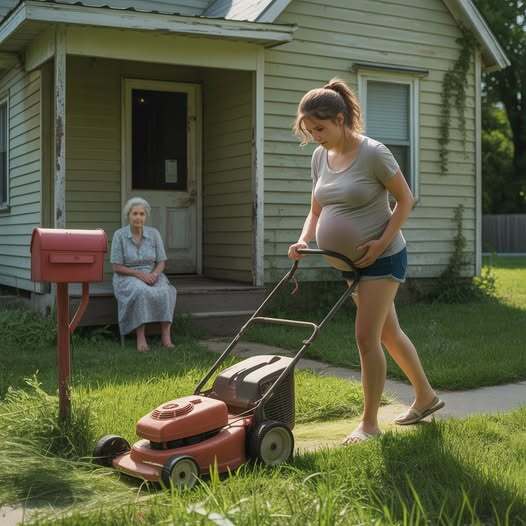
She was 82 years old, a widow who had lived next door for as long as I could remember. Quiet, polite, and fiercely independent, she rarely asked for help. That afternoon, though, something was different. The heat was intense, pushing well into the mid-90s, and there she was, slowly guiding her old lawn mower across the yard.
Her movements were labored. She would push for a few steps, then stop, catching her breath before continuing again. It was clear she was determined to finish the job, even if her body protested with every inch.
I stood at my window for a moment, watching her. A part of me hesitated. I was exhausted. My back ached constantly, my feet were swollen, and even walking across the room sometimes felt like too much. But another part of me—the part that hadn’t been completely buried under stress and fear—knew I couldn’t just stand there.
Before I could talk myself out of it, I stepped outside.
The heat hit me immediately, thick and suffocating. I walked over to her without saying much, gently placing my hands on the mower handle.
“Let me finish this for you,” I said softly.
She looked at me, surprised at first, then gave a small nod. There was no protest, no pride getting in the way—just a quiet acceptance.
“Thank you,” she said.
That was all.
I took over, moving slowly but steadily across the yard. The work wasn’t easy, especially in my condition, but it felt… grounding. For a brief moment, my problems faded into the background. There was something simple and honest about helping someone else, something that didn’t require overthinking or planning.
When I finished, she thanked me again. We exchanged a few polite words, nothing extraordinary. No grand conversation. No hint that anything significant had just happened.
To me, it was just a small act of kindness on a difficult day.
I went inside, drank a glass of water, and returned to my routine of quiet worry.
I had no idea that moment would change everything.
The next morning began like any other. I woke up early, unable to sleep properly as usual. My mind immediately returned to the same familiar cycle—bills, uncertainty, fear about the future.
Then came the knock.
It was firm, deliberate, and unexpected.
My heart skipped. A thousand possibilities rushed through my mind, none of them good. For a brief moment, I considered not answering. But the knocking came again, louder this time.
I made my way to the door, my pulse quickening.
When I opened it, I froze.
A sheriff stood on my porch.
Every worst-case scenario I had imagined seemed to converge in that instant. My mind raced—had something happened? Was I in trouble? Had someone accused me of something?
“I… is everything okay?” I asked, my voice unsteady.
He removed his hat slightly, his expression calm but serious.
“Are you the neighbor who lives next to Mrs. Margaret Higgins?” he asked.
“Yes,” I replied, my stomach tightening.
He paused for a moment before speaking again.
“I’m sorry to inform you… she passed away last night. Peacefully, in her sleep.”
The words didn’t register immediately.
Passed away.
Mrs. Higgins.
Just yesterday, she had been standing in her yard. Just yesterday, she had thanked me.
I felt a strange emptiness wash over me, as if my mind refused to fully process what I had just heard.
“I… I don’t understand,” I murmured.
The sheriff’s tone softened.
“There’s no suspicion of anything unusual,” he said quickly, as if sensing my fear. “She died of natural causes. I’m not here because you’re in any kind of trouble.”
I let out a breath I didn’t realize I had been holding.
But before I could fully relax, he gestured toward my mailbox.
“She left something for you,” he said. “I was asked to make sure you received it.”
My confusion deepened.
“For me?”
He nodded.
“Go ahead and check your mailbox. Take your time.”
With trembling hands, I walked to the mailbox.
Inside was a thick envelope.
My name was written on the front in careful handwriting.
I opened it slowly, my heart pounding.
The first thing I saw was a note.
Short. Simple.
“You’re a good girl. Don’t forget that. – Margaret Higgins.”
My throat tightened.
I swallowed hard and continued.
Inside were legal documents—official, stamped, unmistakable.
It took me a moment to understand what I was looking at.
Then it hit me.
A will.
Her will.
And within it, a section specifically naming me.
The number that followed didn’t feel real.
$250,000.
I blinked, convinced I had misread it.
I looked again.
It was still there.
Clear. Undeniable.
My knees felt weak, and I had to steady myself against the mailbox.
“This… this can’t be right,” I whispered.
The sheriff stepped closer, his expression reassuring.
“It is,” he said. “She updated her will recently. Everything was done properly and legally. There’s no mistake.”
I shook my head, overwhelmed.
“But… why me?”
He gave a small, knowing look.
“She paid attention,” he said. “More than people realized.”
In the days that followed, I learned more about Mrs. Higgins than I ever had while she was alive.
She had no immediate family nearby. A few distant relatives existed, but they had little involvement in her life. Over time, she had grown accustomed to observing the people around her instead—neighbors, passersby, everyday interactions.
She noticed things.
She noticed who was kind.
Who was respectful.
Who showed up when it mattered.
Apparently, she had been watching me too.
She had seen the pregnancy. The absence of support. The growing pile of notices. The quiet struggle I thought no one noticed.
And she had made a decision.
Not out of obligation.
Not out of expectation.
But out of intention.
There was a brief legal challenge from distant relatives who believed they were entitled to more. But the court upheld her wishes without hesitation. The documentation was clear, her mental state had been verified, and her decisions were deliberate.
In the end, what she wanted stood firm.
And just like that, everything began to change.
The foreclosure was stopped.
The debts were paid.
For the first time in months, I could breathe.
A few weeks later, I gave birth to a healthy baby girl.
Holding her in my arms for the first time, I felt something I hadn’t felt in a long time—hope.
Real, steady, undeniable hope.
I named her Margaret.
It felt right.
Not just as a tribute, but as a reminder.
Looking back now, it’s easy to focus on the outcome—the money, the stability, the fresh start. But that’s not what stays with me the most.
What stays with me is the moment before all of it.
The heat.
The hesitation.
The choice to step outside anyway.
At the time, it didn’t feel significant. It didn’t feel like something that would ripple outward and change the course of my life.
It just felt like the right thing to do.
And maybe that’s the point.
We rarely know which moments matter.
We don’t see the full picture.
We don’t know who’s watching, who’s noticing, or how far a simple act might reach.
All we have are those small decisions.
Those quiet opportunities to choose kindness, even when we feel like we have nothing left to give.
Mrs. Higgins reminded me that those moments are never as small as they seem.
Sometimes, they carry more weight than we could ever imagine.
And sometimes, they come back to us in ways that don’t just change our circumstances—
but restore our faith in what’s possible.