I used to believe that kindness was simple.
You see someone struggling, you help if you can, and you move on with your day knowing you did something good. No complications, no consequences—just a small moment of humanity in an otherwise busy world.
That belief shattered the day I met her.
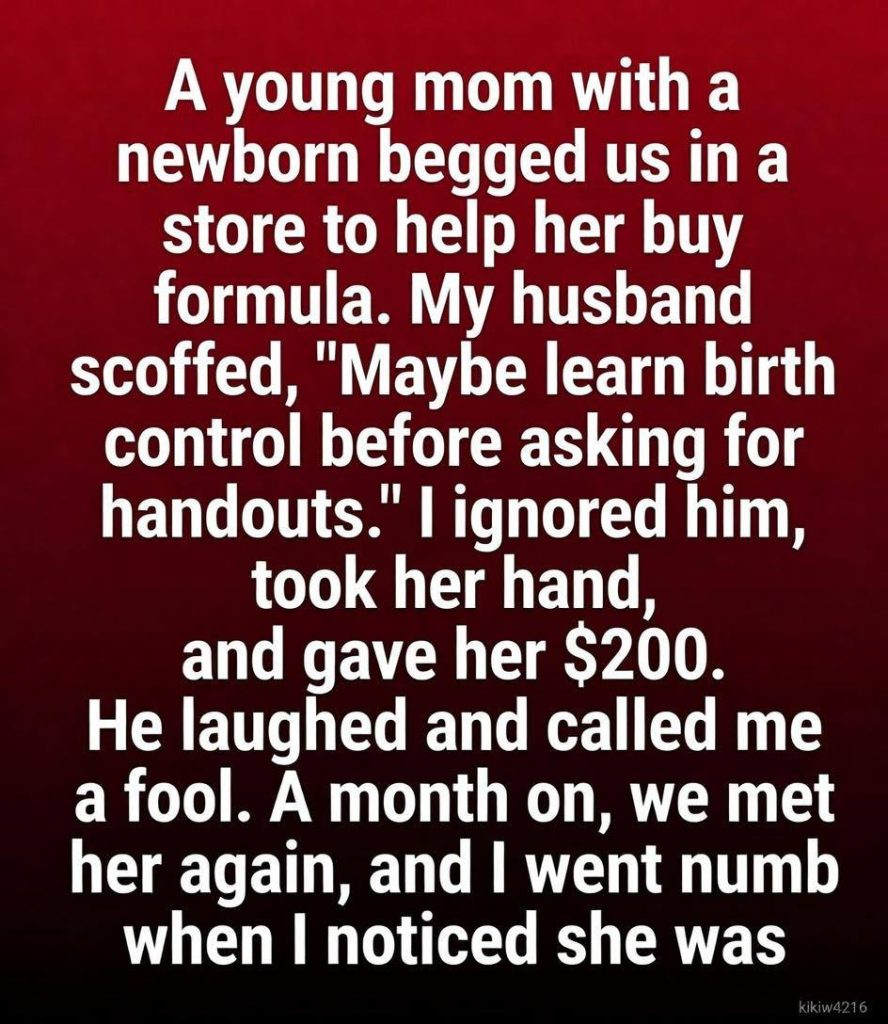
It was an ordinary afternoon at the grocery store. The kind of day where nothing feels significant—just a routine stop between work and home. My cart was half full, my mind already drifting toward dinner plans, when I noticed her standing near the baby aisle.
She looked exhausted.
Not the kind of tired that comes from a bad night’s sleep, but the deep, bone-heavy exhaustion of someone who hasn’t rested in weeks. She held a newborn against her chest, gently rocking as if the motion alone might keep both of them from falling apart.
At first, I hesitated. People ask for help in different ways, and sometimes it’s hard to tell what’s genuine.
But then she spoke.
“Excuse me… I’m so sorry to bother you. I just—I don’t have enough for formula. Could you help me, even a little?”
Her voice trembled, but she held eye contact. There was no performance in it. No manipulation. Just quiet desperation.
Before I could respond, my husband laughed.
Not loudly, but enough.
“Maybe learn birth control before asking strangers for handouts,” he muttered, shaking his head as if the entire situation annoyed him.
I remember the way my stomach dropped—not because of her, but because of him.
I turned to him, stunned. “That’s not okay.”
He shrugged, already bored. “It’s not our problem.”
Maybe it wasn’t.
But it felt like it was mine.
I reached for her hand without overthinking it. It was cold—colder than it should have been.
“How much do you need?” I asked.
She hesitated, embarrassed. “I… I’m short about $60.”
Instead, I pulled out $200.
Her eyes widened immediately. “No, I can’t—”
“Yes, you can,” I said gently. “Take it. Get what you need.”
For a second, I thought she might cry. Instead, she nodded, whispering thank you over and over again, like the words themselves were the only thing holding her together.
Behind me, my husband scoffed.
“You’re unbelievable,” he said as we walked away. “Throwing money at strangers like that.”
I didn’t argue.
At the time, I thought that moment said something about him.
I had no idea it said everything.
The weeks that followed felt normal—at least on the surface.
My husband continued his usual routine: long workdays, occasional “business trips,” late-night calls he stepped outside to take. None of it seemed new. We had been married fifteen years. Patterns blur after that long. You stop questioning things that feel familiar.
But he kept bringing up the woman.
“You still thinking about your charity case?” he’d tease over dinner.
I’d roll my eyes. “It wasn’t charity. She needed help.”
“Or she needed a plan,” he’d reply, smirking.
I should have noticed the edge in his tone.
The way he seemed almost… invested.
Instead, I brushed it off. I told myself he was just being cynical, the way he always was.
I told myself a lot of things.
A month later, we went back to the same store.
I didn’t think twice about it.
Not until I saw her again.
She was standing in nearly the same spot, the baby still cradled in her arms—but something was different this time. She looked slightly stronger. Still tired, but steadier.
And then I saw it.
A gold bracelet on her wrist.
My breath caught.
I knew that bracelet.
I had seen it countless times before—on my husband.
He told me he lost it during a business trip the previous year. Said it slipped off somewhere between meetings, and he never found it again.
I believed him.
Of course I did.
Now it was wrapped around her wrist.
The world didn’t stop.
That’s the strange part.
People kept moving. Shopping carts rolled past. A child laughed somewhere near the checkout line. Life continued exactly as it should.
Except mine didn’t.
She looked up and saw me.
For a split second, something flickered across her face.
Recognition.
Fear.
Guilt.
It hit me all at once.
Not like a slow realization, but like a wave crashing straight through me—violent, undeniable, and impossible to ignore.
I stepped closer.
“Do you remember me?” I asked, my voice quieter than I expected.
She nodded.
And that was all it took.
I didn’t need a confession.
I didn’t need proof.
Every unanswered question from the past year suddenly had an answer.
The late nights.
The extra cash withdrawals.
The way he avoided looking at her the first time.
The bracelet.
The baby.
My husband.
Her silence filled in the gaps I had refused to see.
“I’m sorry,” she whispered.
Two words.
They confirmed everything.
I don’t remember leaving the store.
I don’t remember driving home.
I only remember the feeling.
Numb.
Not sadness.
Not anger.
Just… nothing.
Like my body had shut down everything unnecessary just to process the truth.
Fifteen years of marriage, reduced to a series of moments I suddenly couldn’t trust.
Every memory felt unstable.
Every smile, every promise, every “I love you.”
Was any of it real?
When he walked through the door that evening, everything changed.
He was smiling.
Whistling, even.
Like it was just another normal day.
I didn’t say anything at first.
I simply placed the bracelet on the kitchen table.
The same bracelet he had “lost.”
The same bracelet I had seen on her wrist hours earlier.
His expression shifted instantly.
Color drained from his face.
Silence filled the room.
“Where did you get that?” he asked.
I held his gaze.
“You tell me.”
The truth didn’t come all at once.
At first, it was denial.
Then deflection.
Then blame.
“You’ve been distant,” he said at one point. “Always focused on work, on the house—”
I almost laughed.
Not because it was funny, but because it was predictable.
Eventually, the story came out.
The affair started during a conference.
“It didn’t mean anything,” he insisted.
Until it did.
Until she got pregnant.
Until he realized he couldn’t walk away without consequences.
So he didn’t.
He stayed with me.
And supported her in secret.
Two lives.
Two realities.
And somehow, he thought he could keep them separate forever.
“The money you gave her…” he said at one point, shaking his head.
“What about it?” I asked.
He hesitated.
“It helped.”
Something inside me snapped.
Not loudly.
Not dramatically.
Just a quiet, irreversible break.
I had helped support his lie.
I had unknowingly contributed to the life he built behind my back.
And he had the nerve to call me a fool for it.
The days after that were strangely calm.
Not because things were okay—but because I was done pretending they could be.
I packed his things.
One box at a time.
Fifteen years reduced to cardboard and tape.
He begged.
Promised therapy.
Transparency.
Change.
But the truth is, some things don’t break suddenly.
They erode.
Slowly.
Quietly.
Until one day, there’s nothing left worth saving.
She reached out once.
Through someone we both knew.
She wanted to return the $200.
I told her to keep it.
Not because I forgave everything—but because that moment wasn’t about him.
It never was.
She said she was leaving.
Going back to her parents.
Raising the baby alone.
And for the first time, I didn’t feel anger toward her.
Just… understanding.
We were both caught in something we didn’t fully choose.
The difference was, I walked away.
Months later, my life looks completely different.
Quieter.
Simpler.
More honest.
I still go to that store sometimes.
Though I avoid the baby aisle.
Not because it hurts—but because it reminds me how close I came to never knowing the truth.
I started volunteering.
Helping women in situations like hers—but in real, structured ways. Not just handing out money, but offering support that actually lasts.
It feels… right.
Like I’m finally using my kindness with clarity.
My ex-husband still messages me occasionally.
Asking if we can talk.
If we can try again.
I don’t respond.
Some chapters don’t need revisiting.
They just need closing.
If there’s one thing I’ve learned, it’s this:
Kindness isn’t weakness.
But blind trust can be.
And sometimes, the most painful truths come wrapped in the smallest, most unexpected moments.
Like $200 in a grocery store.
Like a bracelet you thought was lost.
Like a stranger who turns out not to be a stranger at all.
In the end, I didn’t lose everything.
I lost the illusion.
And that turned out to be the most important thing I could ever let go of.