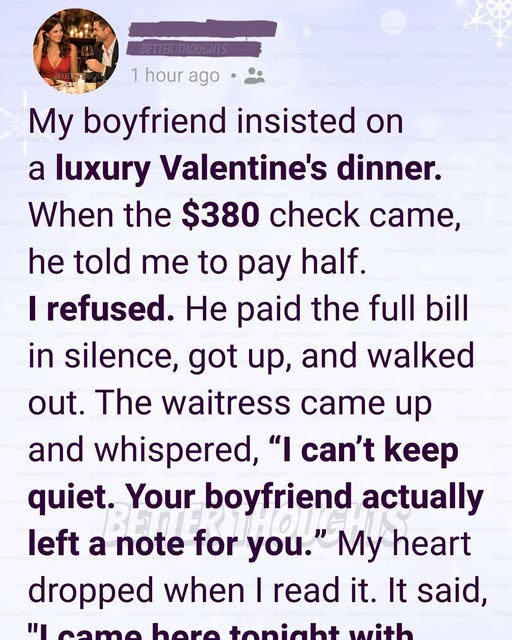
Valentine’s Day has a way of amplifying expectations. It turns ordinary evenings into symbolic moments, where gestures carry more weight and intentions feel heightened. For many couples, it becomes a chance to celebrate connection, to pause and acknowledge the bond they’ve built over time. For her, that evening was supposed to be exactly that—a continuation of seven years of shared history, possibly even the beginning of something new.
He had planned everything.
From the moment they arrived at the restaurant, it was clear this wasn’t just another dinner. The setting was elegant, carefully chosen. The lighting was soft, the atmosphere intimate, the kind of place where conversations slow down and moments feel intentional. He had insisted on ordering the wine, selecting one far more expensive than anything they would normally choose. Every detail seemed deliberate, almost rehearsed.
He kept repeating the same phrase throughout the evening.
“Tonight is going to be special.”
At the time, it felt reassuring. Now, in hindsight, it felt calculated.
She didn’t question it then. Why would she? After seven years together, trust had become second nature. She believed in the rhythm they had built, in the familiarity that comes from knowing someone deeply. There was no reason to suspect that this night carried anything other than what it appeared to be.
Until the bill arrived.
The shift was subtle at first, almost imperceptible. The server placed the check gently on the table and stepped away. For a moment, neither of them reached for it. Then he looked at her, his expression steady but expectant.
“Let’s split it,” he said.
The words themselves weren’t unusual. In many relationships, sharing expenses is normal, even encouraged. But context matters. And in that moment, the context felt off.
She hesitated—not out of reluctance, but out of confusion.
“This just feels strange,” she said carefully. “You planned this whole night. Why would I pay half of something you invited me to?”
It wasn’t a refusal. It was a question.
But the question changed everything.
His expression hardened slightly, a subtle shift that might have gone unnoticed in another moment.
“This is about partnership,” he replied. “We’re equals, aren’t we?”
She nodded. “Of course we are. But equality doesn’t mean splitting every single thing—especially not something like this.”
The conversation wasn’t heated. There were no raised voices, no dramatic gestures. But the tone had shifted. What had been warm and easy just minutes before now felt tense, fragile.
For a few seconds, they sat in silence.
Then, without another word, he signaled the server.
He took out his card and paid the full bill.
No explanation. No discussion.
He stood up from the table.
“I’ll see you around,” he said flatly.
And then he walked away.
No hesitation. No glance back.
She sat there, frozen.
The world around her continued as if nothing had happened—people talking, glasses clinking, soft music playing in the background. But for her, everything had stopped. Her mind struggled to catch up with what had just unfolded.
Was this an argument?
A misunderstanding?
Or something else entirely?
The embarrassment crept in slowly. She became aware of the space around her, the other diners, the quiet awareness that something had just gone wrong in a very public setting.
Then the server approached again.
There was something different in her expression—hesitation, discomfort.
“I’m sorry,” she said softly. “He asked me to give you this.”
She handed over a folded note.
Her hands trembled slightly as she opened it.
The words inside were precise, deliberate.
He had come to that dinner with a ring.
He had planned to propose.
But first, he needed to test her.
And according to him, she had failed.
The reasoning was clear in his message: her hesitation about splitting the bill had revealed something about her character. In his eyes, it meant she wasn’t ready for true partnership. It meant she valued money over their future.
It meant she wasn’t the person he thought she was.
The conclusion was final.
The relationship was over.
She read the note again, slower this time, trying to understand not just the words, but the intention behind them.
A test.
After seven years.
The shock came first. Then confusion. Then something deeper—something sharper.
Clarity.
Because beneath the emotional weight of the moment, a realization began to take shape.
This wasn’t about the bill.
It was about control.
Healthy relationships are built on communication. They require difficult conversations, especially when it comes to topics like money, expectations, and long-term goals. If he had concerns about financial partnership, there were countless opportunities over seven years to discuss them openly.
He could have said, “I think we should start talking about how we’d handle finances if we get married.”
He could have asked, “What does equality look like to you in a relationship?”
He could have created space for dialogue.
Instead, he created a scenario.
A controlled environment with a predetermined outcome.
He didn’t ask for her perspective—he measured it.
He didn’t seek understanding—he sought confirmation.
And when her response didn’t match his expectations, he didn’t communicate.
He exited.
That’s not partnership.
That’s evaluation.
The more she thought about it, the clearer it became.
If someone is willing to test you once, they are willing to test you again.
If someone believes love must be proven under pressure, they will continue creating pressure.
If someone equates disagreement with failure, there will always be another opportunity to fail.
And perhaps the most unsettling thought of all:
If this was the test before marriage, what would the tests look like after?
Marriage is not a series of evaluations.
It is a commitment to navigate differences, misunderstandings, and challenges together—not to weaponize them.
The ring he claimed to have brought that night wasn’t a symbol of unconditional commitment.
It was conditional.
It represented approval granted only after meeting unspoken criteria.
And that changes everything.
Because a proposal should not be a reward for passing a test.
It should be an invitation to build something together—imperfectly, honestly, and openly.
Sitting there, alone at the table, she felt the weight of seven years pressing down on her.
Memories. Conversations. Shared experiences.
All of it now reframed by a single question:
How well had she really known him?
But alongside the grief, something else emerged.
Self-awareness.
She realized that her instinct to question the situation hadn’t been wrong.
It had been honest.
And honesty is not failure.
In that moment, she had expressed confusion, not selfishness. She had sought clarity, not avoided responsibility.
The fact that this was interpreted as a flaw said more about him than it did about her.
Many people, in that situation, might have reacted differently afterward.
They might have called him, apologized, tried to fix things.
They might have convinced themselves that they had made a mistake.
But she didn’t.
Because once you recognize manipulation, it becomes difficult to ignore.
And once you understand that love is being used as leverage, it becomes even harder to accept.
Walking away from seven years is not easy.
There is history there. Investment. Emotion.
But staying in something built on silent expectations and hidden judgments is harder.
Because it requires constant adjustment—guessing what the other person wants, anticipating reactions, trying to pass tests you don’t even know exist.
That’s not stability.
That’s uncertainty disguised as structure.
In the days that followed, she began to process what had happened—not just emotionally, but intellectually.
She began to redefine what she wanted from a relationship.
Not grand gestures without explanation.
Not symbolic tests disguised as romance.
But clarity.
Directness.
Mutual respect.
She realized that real partnership isn’t about splitting every bill evenly or proving equality through financial decisions.
It’s about alignment—shared values, open communication, and the ability to navigate differences without turning them into ultimatums.
It’s about being able to ask questions without being punished for them.
It’s about feeling safe enough to be honest.
And perhaps most importantly, it’s about knowing that love is not something you have to earn through performance.
It is something that is given—and maintained—through understanding.
That Valentine’s Day didn’t end the way she expected.
There was no proposal.
No celebration.
No continuation of what she thought her future would look like.
But it did give her something else.
Perspective.
Because sometimes, the most painful endings reveal the most important truths.
And sometimes, what feels like rejection…
is actually protection.