Every family has its rituals—the small, repeated moments that quietly hold everything together. For us, it was Sunday dinner.
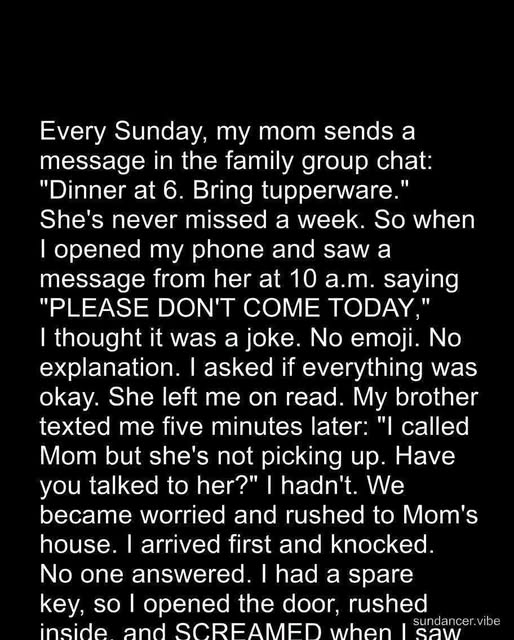
It never needed to be discussed or planned in detail. Like clockwork, sometime in the early afternoon, my mom would send the same message: “Dinner at 6. Bring tupperware.” It was simple, predictable, and comforting in a way that only consistency can be. No matter how chaotic the week had been, no matter how distant we felt from one another in the rush of daily life, Sunday evening brought us back to the same table.
It wasn’t just about the food. It was about grounding ourselves again. Resetting. Remembering that we belonged to something steady.
So when that message didn’t arrive as expected, the absence itself felt loud.
Instead, what came through was something entirely different.
“PLEASE DON’T COME TODAY.”
No explanation. No warmth. No familiarity.
Just that.
At first, I didn’t take it seriously. It felt too abrupt, too unlike her. My mom wasn’t dramatic, and she certainly wasn’t the type to cancel Sunday dinner without a reason—let alone one she wouldn’t explain. I stared at the message, rereading it, trying to fit it into some version of her personality that made sense.
Maybe she wasn’t feeling well. Maybe something had come up. Maybe she just needed a quiet day.
But even as I tried to rationalize it, something deeper unsettled me.
It didn’t feel like her.
I texted back immediately.
“Is everything okay?”
No reply.
A few minutes later, my phone buzzed again—this time from my brother.
“I called Mom. She’s not answering. Did you talk to her?”
I hadn’t.
There was a pause in our conversation after that. Not because we had nothing to say, but because neither of us wanted to be the one to voice what we were both starting to think.
Something wasn’t right.
I didn’t announce my decision to go. I didn’t need to. I grabbed my keys and left, my thoughts racing faster than the road beneath me. Every possible explanation cycled through my mind, each one less convincing than the last.
By the time I pulled into her driveway, the unease had settled into something heavier—something closer to fear.
From the outside, nothing looked different. The house was exactly as it had always been. The same quiet street. The same neatly trimmed yard. The same windows reflecting the dull afternoon light.
But the stillness felt wrong.
Too complete.
Too silent.
I knocked.
Once. Then again, louder.
No answer.
I hesitated only briefly before reaching for the spare key she had given me years ago. It had always been there “just in case.” I had never really thought about what that case might be.
Until now.
The door opened easily.
The first thing I noticed was how normal everything looked.
The living room was tidy, exactly as she always kept it. The cushions were arranged neatly. The air smelled faintly of something familiar—clean laundry, maybe, or the lingering trace of something she had cooked earlier.
“Mom?” I called out.
My voice echoed slightly, swallowed by the quiet.
No response.
I stepped further inside, my senses sharpening with each step. There was no movement. No sound. Just the low, almost oppressive stillness of a house that felt occupied—but wasn’t responding.
Then I saw the kitchen.
And something shifted.
The table was set.
Not partially. Not casually. Completely.
Plates arranged in their usual places. Glasses aligned. Napkins folded with the same care she always put into them. Serving dishes sat ready, empty but waiting.
It looked like every other Sunday.
Except we had been told not to come.
A tightness formed in my chest.
Why would she prepare dinner… and then tell us to stay away?
The front door opened behind me, and I turned to see my brother stepping inside, his expression mirroring my own unease.
“Did you find her?” he asked quickly.
I shook my head.
We moved through the house together, calling out her name, checking each room with growing urgency. The bedroom was empty. The bathroom untouched. The backyard quiet.
Nothing.
It was as if she had disappeared.
We circled back toward the kitchen, both of us trying to make sense of what we were seeing, when something small caught my attention.
A note.
It sat on the counter, slightly out of place against the otherwise perfect order of the room.
I picked it up, my hands unsteady.
It was her handwriting.
“I’m sorry.”
Two words.
That was all.
My brother read it over my shoulder. “Sorry for what?” he asked, his voice tight with confusion.
I didn’t have an answer.
Before I could even begin to form one, we both heard it.
A sound.
Faint. Uneven.
Coming from down the hallway.
We froze, instinctively turning toward it.
“Did you hear that?” he whispered.
I nodded.
Slowly, we moved toward the sound, each step measured, careful. The hallway seemed longer than usual, stretched by tension. The door to her bedroom was slightly open.
The sound was coming from inside.
I reached for the door and pushed it open gently.
And there she was.
Sitting on the edge of the bed.
Alive.
But not okay.
She looked different—not in a way that could be easily defined, but in something deeper. Her posture was smaller, her shoulders drawn inward. Her hands were clasped tightly together, as if holding herself in place. Her eyes, when they lifted to meet mine, carried something I had never seen before.
Fear.
“Mom?” I said softly.
The moment she saw us, her composure broke.
“I told you not to come,” she said, her voice trembling.
We crossed the room quickly, instinct overriding everything else.
“What’s going on?” my brother asked. “You scared us.”
She shook her head, tears beginning to spill over. “I didn’t want you to see me like this.”
“Like what?” I asked, kneeling in front of her.
She hesitated.
And in that hesitation, everything shifted.
Because whatever she was about to say—it was something she had been carrying alone.
“I’ve been going to the doctor,” she said quietly.
The words landed heavily.
“For a while now.”
Neither of us spoke.
“I didn’t tell you,” she continued, her voice breaking, “because I thought I could handle it. I didn’t want to worry you. I didn’t want to make everything… heavy.”
Her hands tightened together.
“But today,” she said, barely above a whisper, “I got the results.”
The room felt like it stopped moving.
“What results?” my brother asked, his voice unsteady.
She looked at us then—really looked.
And in her eyes, there was no more hiding.
“It’s cancer.”
The word hung in the air, impossible to soften, impossible to misunderstand.
Everything inside me seemed to pause.
“No,” I said immediately, the denial automatic. “There has to be something else. A mistake.”
She shook her head gently.
“There isn’t.”
Silence filled the space between us, heavy and absolute.
And suddenly, everything made sense.
The message. The empty house. The note.
She hadn’t been pushing us away.
She had been trying to protect us.
“I didn’t want you to come because I didn’t know how to tell you,” she admitted. “I didn’t want Sunday dinner to become… this.”
Her voice broke completely then, and the strength we had always associated with her slipped away, revealing something raw and deeply human beneath it.
I reached for her hand.
“You don’t have to do this alone,” I said.
My brother nodded, his voice firm despite the emotion behind it. “We’re here. We’re not going anywhere.”
She looked at both of us, something shifting in her expression.
“I was scared,” she said. “Not just of the diagnosis. Of what it would do to you. To all of us.”
I squeezed her hand gently.
“Sunday dinner was never about the food,” I said.
She blinked, surprised.
“It was about being together,” I continued. “That doesn’t change.”
“If anything,” my brother added, “it matters more now.”
For a moment, she just looked at us.
Then, slowly, she nodded.
That evening, we stayed.
We finished what she had started—not because we were hungry, but because it mattered. Because it was ours. We moved through the motions together, quietly, carefully, each action carrying more meaning than it ever had before.
At six, we sat down.
Just like always.
But everything had changed.
The conversations were softer. The laughter came more slowly, but it felt deeper. Every word mattered. Every glance lingered.
Because now, we understood something we had taken for granted.
Time is not guaranteed.
Strength is not the absence of fear.
And love is not something you protect people from—it’s something you let them carry with you.
That night didn’t solve anything. It didn’t make the future clearer or easier.
But it changed us.
We stopped assuming there would always be another Sunday.
We started showing up differently—not just physically, but emotionally. We listened more. We spoke more honestly. We held onto each other with a kind of awareness we hadn’t had before.
And every Sunday after that, the message returned.
“Dinner at 6. Bring tupperware.”
The words didn’t change.
But their meaning did.
They became a reminder.
That love doesn’t disappear when life becomes difficult.
That family isn’t defined by perfect moments, but by the willingness to stay through imperfect ones.
And that sometimes, the messages we fear the most…
are the ones that lead us exactly where we need to be.