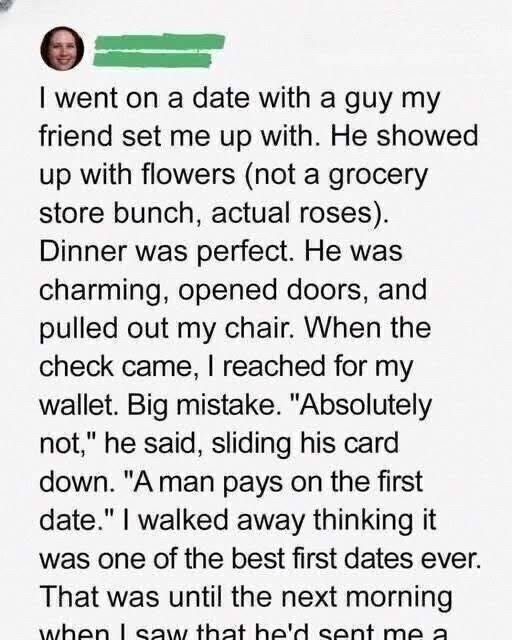
When my best friend Mia first suggested the idea of a blind date, I didn’t feel excitement—I felt resistance. Not dramatic resistance, not the kind that sparks arguments or long debates, but a quiet, internal reluctance shaped by experience. Blind dates, in my mind, were unpredictable social experiments dressed up as romantic opportunities. They often relied on someone else’s perception of compatibility, which rarely aligned perfectly with reality. Still, Mia was persistent. She described him in glowing terms: kind, attentive, thoughtful, emotionally aware. She insisted he was different, someone who would restore my faith in dating. I listened, nodded, and deflected—until eventually, I ran out of ways to say no without sounding unreasonable. So I agreed, not because I was convinced, but because I was tired of resisting.
I told myself it would be simple: show up, be polite, have dinner, leave. Nothing more. I didn’t expect magic. I certainly didn’t expect the evening to become one of the most unsettling experiences I would ever have.
The restaurant itself felt like something out of a carefully staged film scene. Soft golden lighting washed over dark wooden tables. The background music was gentle, unobtrusive, designed to fill silence without demanding attention. There was an intimacy to the space, the kind that encourages conversation and quiet connection. I arrived early, partly out of habit, partly to steady my nerves. Sitting there, I rehearsed small talk in my head, preparing for the usual polite exchanges that define first meetings.
When Eric walked in, I noticed him immediately—not because he demanded attention, but because he carried himself with a calm, self-assured presence. In his hand was a bouquet of roses. Not a single flower, not a casual gesture, but a full arrangement that felt almost old-fashioned. When he approached the table, his smile was warm and unforced. He greeted me by name, his voice steady, his tone respectful. Within minutes, my skepticism began to soften.
He pulled out my chair before I sat down. He asked thoughtful questions and listened carefully to the answers. Not the kind of listening where someone waits for their turn to speak, but genuine attention—he remembered details, followed up on things I said, and responded in ways that made it clear he was fully present. At one point, he handed me a small engraved keychain with my initials. It was specific enough to feel intentional, personal without being intrusive. I remember feeling surprised—not overwhelmed, not uncomfortable, just caught off guard in a way that felt… pleasant.
The conversation flowed easily. We talked about work, family, hobbies, small frustrations, and future hopes. There were no awkward silences, no forced laughter. He made me laugh naturally, and when I laughed, he seemed genuinely pleased—not performative, not exaggerated, just quietly appreciative. Hours passed without me noticing. By the end of the evening, something unexpected had happened: I felt hopeful.
As I walked home, I replayed moments from the night in my mind. His attentiveness. His manners. The ease of conversation. I caught myself smiling, something I hadn’t done after a date in a long time. For once, dating hadn’t felt exhausting. It hadn’t felt like a performance. It had felt… simple.
That illusion didn’t even last twenty-four hours.
The next morning, my phone buzzed with a notification. An email. The subject line read: “Invoice from Eric.”
At first, I assumed it was a joke. Maybe a playful follow-up, something lighthearted referencing the dinner. I opened it without concern.
What I saw made my stomach drop.
It was a detailed, itemized bill.
Dinner was listed, of course—but that wasn’t the part that unsettled me. Beneath it were entries that didn’t belong in any normal context. “Bouquet of roses.” “Personalized gift.” “Engaging conversation.” “Active listening.” “Emotional presence.” Each line had a price next to it. Each moment from the evening had been converted into a transaction.
There was even a charge for a hug.
At the bottom, a total. Beneath that, a note requesting payment within forty-eight hours. And beneath that, a vague but unmistakable implication of consequences if the payment was not made.
I read it once. Then again. Then a third time, slower, as if clarity might emerge if I examined it carefully enough.
It didn’t.
The same words remained. The same meaning.
What I had experienced as generosity had been recorded as expense. What I had interpreted as kindness had been calculated as investment. The entire evening—every gesture, every smile, every moment of attention—had not been freely given. It had been measured, priced, and expected to be repaid.
A quiet sense of fear began to settle in. Not panic, not immediate alarm, but something more subtle and more unsettling—a realization that I had misread the situation entirely.
I called Mia immediately.
At first, she thought I was joking. Then she heard my voice. I read the invoice out loud, my tone shifting from disbelief to something closer to unease. By the time I finished, there was a long pause on the other end of the line.
Her response was immediate: “Block him.”
No hesitation. No attempt to rationalize. No suggestion to clarify or respond politely. Just a clear, firm directive rooted in concern.
Her boyfriend, Chris, took a different approach—one that introduced a moment of relief into an otherwise unsettling situation. He suggested responding with a parody invoice. A list of charges directed back at Eric: “Unsolicited entitlement.” “Emotional manipulation.” “Audacity.” “Delusion.” Each with exaggerated prices, each designed to highlight the absurdity of the original message.
Against my better judgment—but perhaps because I needed to reclaim some sense of control—I sent it.
Eric’s response was immediate.
And it was nothing like the composed, respectful demeanor he had shown the night before.
The messages came quickly, one after another, increasingly defensive, increasingly erratic. He accused me of disrespect. Of misunderstanding. Of failing to appreciate his “effort.” The tone shifted from justification to agitation, from agitation to something more unstable. It wasn’t just anger—it was entitlement unraveling.
That was the moment everything became clear.
This wasn’t a misunderstanding. It wasn’t a joke that had gone too far. It was a mindset. A belief system in which kindness is currency, attention is labor, and connection is something that can be billed and collected.
I blocked him.
Not out of anger, not out of fear alone, but out of clarity.
In the days that followed, the shock slowly gave way to reflection. At first, I told the story as something absurd, something almost humorous in its extremity. Friends laughed. They couldn’t believe it. It became one of those stories that sounds exaggerated even when it’s true.
But beneath the humor, there was something more serious.
I began to think about the evening again, this time with a different lens.
The flowers. The gift. The attentiveness.
At the time, they had felt generous. Now, they felt strategic.
Not in an obvious way—there had been no overt pressure, no visible expectation—but in hindsight, there was a pattern. Each gesture had been slightly more than necessary. Slightly more intense than the moment required. At the time, I interpreted that as enthusiasm. Now, I recognized it as something else: investment with expectation.
That was the most unsettling realization of all.
Manipulation doesn’t always look like manipulation. It doesn’t always feel uncomfortable in the moment. Sometimes, it feels flattering. Sometimes, it feels like effort, like care, like interest. And that’s what makes it dangerous.
Because by the time the expectation reveals itself, you’ve already accepted the premise.
The experience changed the way I think about boundaries.
Before, I saw boundaries as something reactive—lines you draw when someone crosses them. Now, I understand them as something proactive. Filters, not walls. Tools for recognizing patterns before they escalate.
I also began to think differently about generosity.
Real generosity doesn’t keep score. It doesn’t create silent contracts. It doesn’t turn shared moments into debts. It exists without expectation, without calculation, without the need for return.
What I experienced that night wasn’t generosity. It was a transaction disguised as kindness.
And once you see that distinction, it becomes impossible to ignore.
Over time, the discomfort faded, but the lesson remained.
I didn’t become cynical. I didn’t stop believing in connection or kindness or the possibility of meaningful relationships. But I became more aware. More attentive to the difference between genuine interest and performative effort. More willing to trust my instincts, even when everything appears polished on the surface.
Because that’s the thing about red flags—they’re not always obvious.
Sometimes, they’re hidden inside grand gestures. Sometimes, they’re wrapped in charm. Sometimes, they look like exactly what you thought you wanted.
Until they don’t.
Looking back, I don’t regret going on that date.
Not because it was enjoyable—it wasn’t, not in retrospect—but because it clarified something important. It showed me the value of self-respect in a way that no comfortable experience ever could. It reinforced the idea that walking away is not a loss—it’s a decision.
A decision to protect your time, your energy, your emotional space.
In the end, the most powerful moment wasn’t the dinner, or the invoice, or even the confrontation.
It was the moment I chose not to engage.
Not to argue. Not to justify. Not to negotiate.
Just to walk away.
Because some things don’t deserve a response.
And self-worth is one of them.
What began as a simple blind date became something else entirely—not a story about romance, but a lesson about boundaries, perception, and the quiet strength of recognizing when something isn’t right, even if it initially feels perfect.
And perhaps that’s the most important takeaway of all:
Kindness is not an invoice.
Connection is not a contract.
And the right people will never ask you to pay for being present.