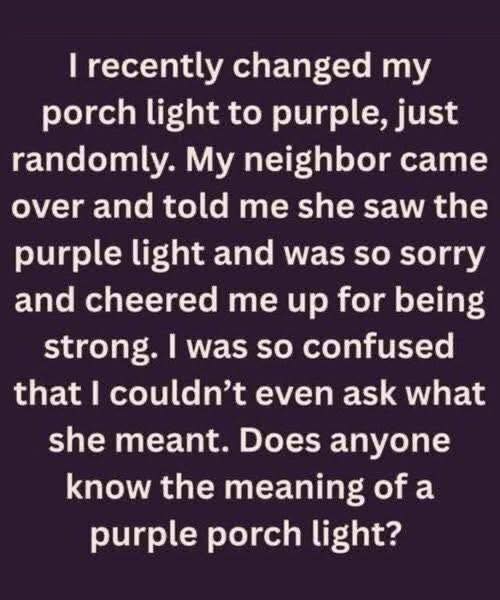
If you’ve ever walked through a neighborhood in the evening and noticed a soft purple glow shining from a porch, you’ve probably paused—if only for a moment. It’s not a typical color for outdoor lighting. Most homes stick to warm whites or yellows, creating a familiar, comforting atmosphere. Purple, however, feels different. It stands out, but not in a loud or intrusive way. Instead, it carries a quiet presence—subtle, calm, and somehow meaningful.
That feeling isn’t accidental.
For many households, a purple porch light is more than a decorative choice. It’s a message—one that doesn’t rely on words, signs, or explanations. It’s a silent signal of awareness, compassion, and support for issues that are often difficult to talk about openly.
The Most Recognized Meaning: Awareness and Support
One of the most widely understood reasons behind purple porch lights is their connection to Domestic Violence Awareness Month.
During October, many people intentionally switch their porch lights to purple to show solidarity with survivors of domestic violence. The gesture may seem small, but its meaning runs deep. Domestic abuse is often hidden—taking place behind closed doors, out of sight, and surrounded by silence. Because of this, awareness becomes one of the most powerful tools in addressing it.
A purple light helps break that silence without confrontation. It doesn’t demand attention, but it invites curiosity. A neighbor might ask about it. A visitor might notice. A conversation might begin.
And sometimes, that’s where change starts.
For survivors, seeing that light can mean something even more personal. It can signal that they are not alone, that someone nearby understands—or at least acknowledges—the reality of what they’ve been through. In a world where many feel isolated in their experiences, even a small sign of support can carry emotional weight.
Why Purple?
Color has always been a powerful form of communication. Purple, in particular, carries layered meaning.
Historically, it has been associated with depth, strength, and transformation. It blends the calm stability of blue with the energy of red, creating a balance that reflects both resilience and compassion. These qualities make it especially fitting for causes that involve healing, awareness, and emotional strength.
Over time, purple has become widely recognized as a symbol for causes that require empathy and understanding—especially those that are often overlooked or misunderstood.
More Than Just One Cause
While domestic violence awareness is the most common association, purple porch lights can represent other forms of support as well.
In some communities, they are used to bring attention to:
- Mental health awareness – encouraging openness around struggles that are often hidden
- Epilepsy awareness – particularly during awareness campaigns that use purple as a symbol
- Alzheimer’s and dementia awareness – honoring individuals and families affected
- Support for survivors of trauma or loss – in a broader, more personal sense
Because of this, the meaning of a purple porch light isn’t always identical from house to house. But the underlying message tends to remain consistent: compassion, awareness, and solidarity.
A Quiet but Powerful Form of Communication
What makes purple porch lights so impactful is their subtlety.
They don’t rely on slogans or explanations. They don’t create pressure or demand engagement. Instead, they exist quietly—visible to anyone who passes by, but open to interpretation.
In a way, that makes them more approachable.
Not everyone feels comfortable talking openly about difficult topics. Not every household is ready to have those conversations out loud. But changing a light bulb is simple. It’s a way to participate, to show support, without needing to explain everything behind it.
And when many homes do the same, the effect grows.
A single purple light might go unnoticed. But a street filled with them creates a shared message—a sense of community awareness that extends beyond individual homes.
When the Light Stays On Year-Round
Although many people use purple lights specifically in October, others choose to keep them on all year.
For some, it’s a personal decision. They may have experienced domestic violence, supported someone who has, or simply feel strongly about maintaining awareness beyond a single month.
For others, it reflects a broader commitment—to kindness, to empathy, to recognizing struggles that aren’t always visible.
Keeping the light on year-round turns a temporary gesture into something more lasting. It becomes part of the home’s identity, a quiet but consistent reminder that these issues don’t disappear when awareness campaigns end.
The Role of Visibility
One of the biggest challenges with issues like domestic violence or mental health struggles is that they are often invisible.
Unlike other problems, they don’t always have outward signs. They exist behind closed doors, within private moments, and in experiences people may never speak about.
That’s why visibility matters.
Not in a way that forces exposure—but in a way that gently acknowledges reality.
Purple porch lights help create that visibility. They bring something hidden into shared awareness without violating privacy. They allow people to feel seen without being singled out.
A Small Action With Meaning
It’s easy to underestimate small gestures. Changing a light bulb doesn’t feel like a major act. It doesn’t solve a problem directly or create immediate change.
But collective actions rarely begin with something large.
They begin with small, repeatable choices—ones that are easy for people to adopt and share.
Purple porch lights are one of those choices.
They don’t fix everything. But they contribute to a larger culture of awareness. They create space for conversation. They signal support. And sometimes, they offer comfort to someone who needs it.
The Next Time You See One
If you notice a purple porch light, you might see it a little differently now.
It may still look simple—a soft glow against the night. But behind that glow is often intention. A quiet message. A decision to acknowledge something that isn’t always easy to talk about.
It’s a reminder that not all support has to be loud.
Sometimes, it can be as simple as a light left on—visible, steady, and quietly saying: you’re not alone.