The modern political landscape has undergone a profound transformation over the past two decades, shaped not only by policy debates and institutional decisions but increasingly by the relentless गति of digital communication. Social media platforms have evolved into central arenas where political figures craft their public personas, engage with supporters, and challenge opponents in real time. Within this environment, even a single post—whether a statement, a video, or a meme—can reverberate across the globe within minutes, influencing public discourse and media coverage alike.
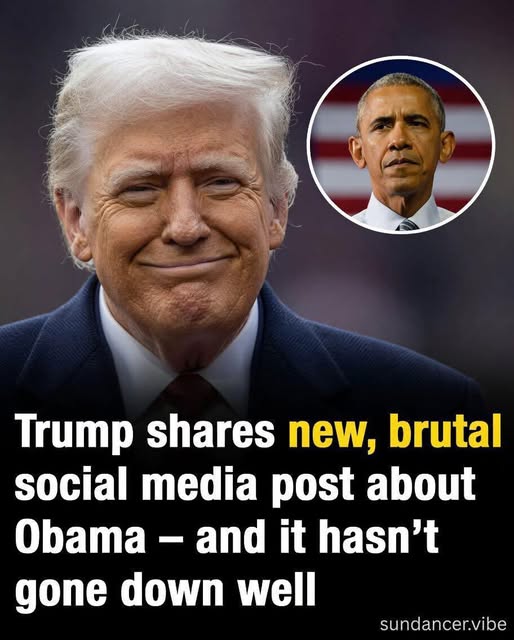
A recent example of this phenomenon emerged when Donald Trump shared a meme referencing Barack Obama and a past moment of skepticism about Trump’s political future. At first glance, the meme appears relatively straightforward: a juxtaposition of expressions and a caption suggesting vindication. Yet the reaction it sparked reveals far more than a simple exchange of political barbs. It underscores the ways in which political narratives are constructed, revisited, and amplified in the digital age.
The Power of Symbolic Rivalries
The relationship between Trump and Obama has long held symbolic significance in American politics. It is not merely a rivalry between two individuals but a contrast between differing approaches to leadership, communication styles, and visions of national identity. Obama’s presidency was often characterized by a measured tone and emphasis on institutional norms, while Trump’s rise was marked by an unconventional, direct, and frequently combative communication style—particularly on social media.
One moment frequently cited in discussions of their dynamic is the White House Correspondents’ Dinner 2011, during which Obama made remarks about Trump that were widely interpreted as pointed and memorable. Over time, this moment has taken on a near-mythical status in political storytelling, often framed as a turning point that contributed—symbolically if not causally—to Trump’s eventual presidential run.
By resharing content that references Obama’s past doubts, Trump engages in a broader pattern common in modern politics: the selective revisiting of history. These moments are not merely recalled; they are reframed to support a narrative of personal triumph and resilience. In doing so, they resonate strongly with audiences who view political success as a validation of persistence against criticism.
Social Media as a Political Battleground
The significance of this episode lies not only in the individuals involved but also in the medium through which it unfolds. Platforms like Truth Social, along with others such as X (formerly Twitter) and Facebook, have fundamentally altered how political communication operates.
In the past, political messaging was largely mediated by journalists, editors, and institutional channels. Today, leaders can communicate directly with millions of followers, bypassing traditional gatekeepers. This shift offers both opportunities and challenges. On one hand, it allows for immediacy and authenticity; on the other, it increases the risk of misinformation, oversimplification, and emotional escalation.
Memes, in particular, represent a unique form of communication within this ecosystem. They are inherently concise, visual, and often humorous, making them highly shareable. Yet their simplicity can also obscure complexity, reducing nuanced political issues to easily digestible—and sometimes misleading—images and captions.
The Role of AI-Generated Content
Adding another layer to this evolving landscape is the rise of artificial intelligence in content creation. AI-generated images and videos have become increasingly sophisticated, blurring the line between reality and fabrication. In political contexts, this raises important questions about authenticity, accountability, and trust.
When political figures share or engage with AI-generated content, the implications can be significant. Supporters may interpret such content as creative expression or satire, while critics may view it as deceptive or irresponsible. The ambiguity inherent in these technologies complicates efforts to establish a shared understanding of what is real and what is manipulated.
This challenge is not limited to any single individual or political movement. It reflects a broader shift in how information is produced and consumed, one that requires new forms of media literacy and critical thinking from audiences.
Sensationalism and the Information Ecosystem
Another notable aspect of the current media environment is the tendency for sensational or unverified claims to accompany viral content. References to dramatic घटनाएं—such as alleged conflicts with prominent global figures or exaggerated interpretations of events—can amplify engagement even when they lack credible evidence.
This dynamic is driven in part by the algorithms that govern social media platforms. Content that provokes strong emotional reactions—whether outrage, amusement, or indignation—is more likely to be shared and promoted. As a result, narratives that emphasize conflict and spectacle often gain more visibility than those that prioritize accuracy and nuance.
For audiences, this creates a complex landscape in which distinguishing fact from embellishment becomes increasingly challenging. Different groups may interpret the same घटना in entirely different ways, depending on which sources they trust and which elements of the narrative they accept.
Political Communication as Performance
The use of memes and other informal content by political leaders also raises questions about the evolving nature of leadership itself. Traditionally, political communication was अपेक्षित to maintain a certain level of formality and decorum. Today, however, the boundaries between governance and entertainment have become increasingly blurred.
For some observers, this shift represents a decline in seriousness, suggesting that important मुद्दे are being overshadowed by personal rivalries and performative gestures. For others, it reflects a more authentic and relatable form of engagement, one that resonates with audiences accustomed to the भाषा and शैली of social media.
In this context, ambiguity can serve as a strategic advantage. A meme can function simultaneously as humor, critique, and self-promotion, allowing political figures to engage multiple audiences at once. This flexibility can make such content particularly effective, even as it complicates efforts to interpret intent.
Polarization and Its Consequences
One of the most significant implications of these trends is their impact on political polarization. When high-profile figures engage in public exchanges—whether through direct statements or symbolic content—they contribute to a broader वातावरण of division.
Supporters often rally around their preferred narratives, जबकि opponents respond with criticism, creating a feedback loop that reinforces existing beliefs. Social media algorithms, which prioritize engagement, tend to amplify this cycle, ensuring that the most emotionally charged content reaches the widest audience.
Over time, this can shift the focus of political discourse away from substantive policy discussions and toward ongoing personal conflicts. Issues such as healthcare, economic policy, and international relations may receive less attention than viral moments and symbolic victories.
This shift has implications not only for political leaders but also for नागरिक, who must navigate an increasingly fragmented information landscape. Forming informed opinions becomes more challenging when narratives are लगातार shaped by competing interpretations and selective framing.
Revisiting the Past to Shape the Present
The recurring references to past interactions between Trump and Obama highlight another महत्वपूर्ण aspect of modern politics: the strategic use of memory. By revisiting earlier moments and presenting them in a new light, political figures can reshape public perceptions of their इतिहास.
This process is not unique to any one व्यक्ति or पार्टी. It is a common feature of political storytelling, जिसमें past events are चयनित and interpreted in ways that support वर्तमान objectives. In the digital age, however, this process is accelerated and amplified, as content can be quickly rediscovered, repurposed, and shared with नए audiences.
The result is a राजनीतिक environment in which the past is never truly settled. Instead, it remains a dynamic resource, continually reinterpreted in response to changing परिस्थितियां.
The Role of the Audience
While much attention is focused on the actions of political leaders, the role of the audience is equally महत्वपूर्ण. सोशल मीडिया users are not passive recipients of information; they actively participate in its dissemination and interpretation.
By liking, sharing, and commenting on content, users contribute to its visibility and influence. In this sense, the viral spread of a meme or post is not solely the result of its creator’s intent but also of the collective behavior of the audience.
This सहभागिता can be empowering, allowing individuals to engage with राजनीतिक discourse in new ways. At the same time, it places greater responsibility on users to evaluate the credibility of the information they encounter and share.
The Future of Political Discourse
Episodes like the recent meme shared by Trump illustrate the ongoing transformation of political communication. They demonstrate how personal history, media strategy, and technological innovation intersect to shape public discourse.
As technology continues to evolve, these dynamics are likely to become even more pronounced. Advances in artificial intelligence, बदलते social media platforms, and shifting audience expectations will continue to redefine how राजनीतिक messages are created and consumed.
The central question is whether these changes will ultimately strengthen or weaken democratic engagement. On one hand, greater accessibility and direct communication can enhance participation and transparency. On the other, the emphasis on spectacle and immediacy may undermine thoughtful deliberation and informed decision-making.
Conclusion
The viral moment involving Donald Trump and Barack Obama is more than a fleeting घटना in the news cycle. It is a reflection of deeper trends that are reshaping the राजनीतिक landscape. From the use of memes and AI-generated content to the पुनर्व्याख्या of past घटनाएं and the amplification of polarization, these developments highlight the complexities of communication in the digital age.
As audiences and leaders alike navigate this environment, the challenge will be to balance the benefits of नई technologies with the need for accuracy, nuance, and meaningful engagement. The भविष्य of politics may well depend on how successfully this balance is achieved—whether the focus remains on performance and perception or returns, at least in part, to the substantive issues that underpin governance itself.