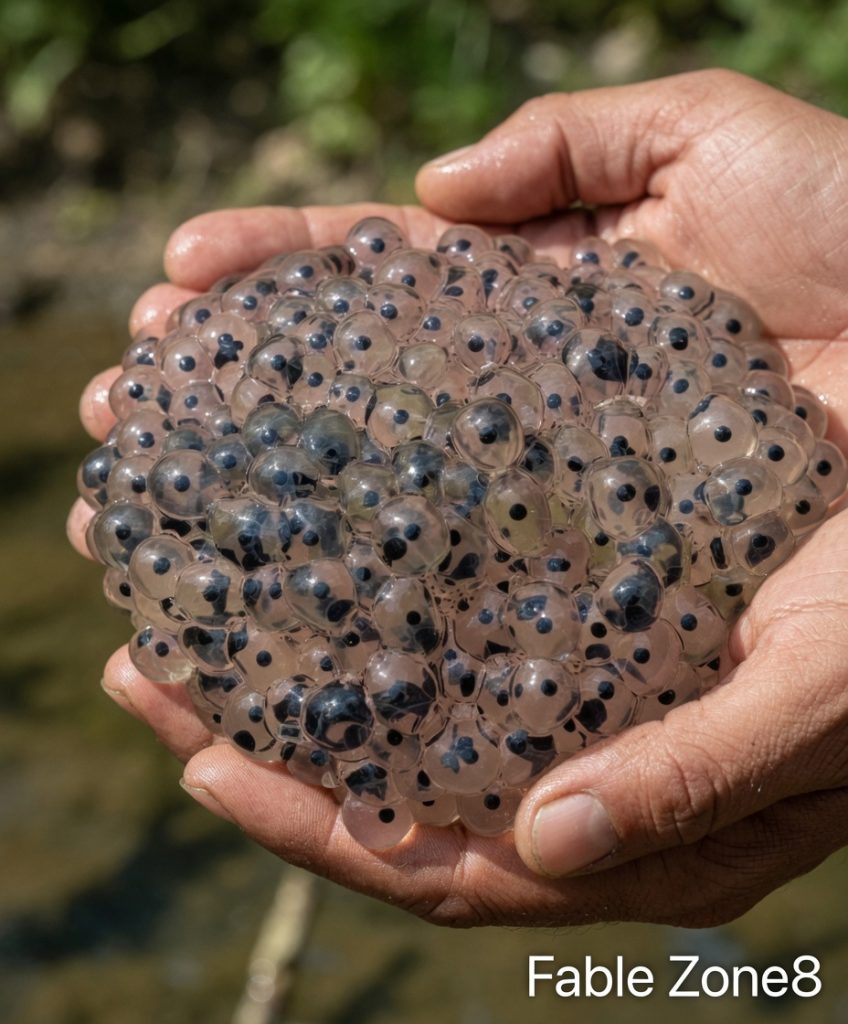
Few natural sights strike the human imagination quite like a cluster of amphibian eggs glistening in the palm of a hand—tiny, translucent spheres packed tightly together, each one centered by a dark, pupil-like core that seems to stare back. Often dubbed “eyeball eggs” across the internet, these unusual formations appear almost artificial, as though they belong in a science fiction film or an exotic dessert display. In reality, they are a perfectly natural and essential stage in the reproductive cycle of many frog species, particularly those belonging to the group commonly known as leopard frogs. Each sphere is a delicate yet highly functional life-support system, containing a developing embryo encased in a gelatinous matrix that both protects and nurtures it. The eerie resemblance to eyeballs comes from the early pigmentation of the embryo, which concentrates in a dark mass that will later develop into critical structures such as the brain and eyes. What might initially evoke curiosity or even discomfort quickly transforms into awe when one realizes the complexity and purpose embedded within these tiny, glistening orbs.
The structure of these egg masses represents a remarkable example of evolutionary efficiency. Each egg is surrounded by a thick, jelly-like coating composed primarily of water, specialized proteins, and mucopolysaccharides. This gelatinous layer serves multiple protective roles at once: it retains moisture, shields the embryo from harmful ultraviolet radiation, and creates a barrier against bacteria, fungi, and certain predators. The slippery texture makes the eggs difficult to grasp or consume, offering an additional layer of defense. When grouped together in dense clusters, these eggs benefit from collective protection—predators may eat some, but the sheer number ensures that many survive. The transparency of the jelly is not accidental either; it allows sunlight to penetrate, aiding in embryonic development, while also facilitating the diffusion of oxygen and the release of waste. This elegant combination of simplicity and sophistication highlights how natural selection has fine-tuned even the earliest stages of life for survival in unpredictable aquatic environments.
These mesmerizing clusters are typically found in shallow freshwater habitats such as ponds, marshes, and seasonal wetlands known as vernal pools. Such environments are carefully chosen by amphibians because they often lack fish, which are major predators of eggs and tadpoles. During breeding season—usually in early spring—male frogs gather and call to attract females, filling the air with a chorus that signals the start of reproduction. When a female selects a mate, the pair enters a process called amplexus, during which the male fertilizes the eggs externally as the female releases them into the water. The result is a gelatinous mass containing hundreds or even thousands of fertilized eggs, either attached to vegetation or floating freely. Lighting conditions, water clarity, and even the angle of observation can influence how these masses appear, sometimes giving them a pinkish or glowing hue that enhances their surreal appearance. Despite their fragile look, these clusters are well adapted to their environment, balancing visibility, protection, and developmental efficiency.
Inside each tiny sphere, an extraordinary transformation unfolds. The fertilized egg begins dividing almost immediately, forming increasingly complex structures in a matter of days. One of the earliest visible features is the darkened region that gives rise to the brain and nervous system, which is why the embryo appears as a black “pupil” within the clear orb. As development progresses, the embryo elongates and begins to take on the recognizable shape of a tadpole, complete with a tail and primitive gills. The jelly surrounding the embryo remains permeable, allowing oxygen to diffuse inward and metabolic waste to escape outward. Temperature plays a crucial role in determining the speed of development—warmer water accelerates growth, while cooler conditions slow it down. In some species, embryos can even respond to environmental threats, hatching early if vibrations or chemical signals indicate the presence of predators. This responsiveness underscores the dynamic nature of life even at its earliest stages.
Once the embryos reach a sufficient stage of development, they hatch into free-swimming tadpoles, beginning a new phase of their life cycle. At this stage, they rely initially on stored yolk for nutrition before transitioning to feeding on algae and organic debris in the water. Over time, they undergo one of the most dramatic transformations in the animal kingdom: metamorphosis. Hind legs emerge first, followed by front legs, while the tail gradually shrinks and lungs develop to replace gills. This transition allows the organism to move from an entirely aquatic existence to a semi-terrestrial one, bridging two distinct ecological worlds. The success of this process depends heavily on environmental conditions, including water quality, temperature, and the availability of food. Many tadpoles do not survive to adulthood, falling prey to predators or environmental stressors, but those that do carry forward the cycle, eventually returning to water to reproduce and lay their own clusters of eggs.
Beyond their biological function, these “eyeball eggs” hold significant ecological and educational value. Amphibians are widely regarded as indicator species, meaning their presence and reproductive success can reveal much about the health of an ecosystem. Declines in egg mass numbers often signal problems such as pollution, habitat destruction, or disease outbreaks. As such, monitoring these clusters provides valuable data for conservation efforts. At the same time, their unusual appearance has made them a source of fascination for people around the world, sparking curiosity and encouraging closer engagement with nature. Whether encountered in the wild or seen in photographs, these gelatinous spheres invite us to look more closely at the hidden processes of life unfolding around us. They remind us that even the most ordinary pond can harbor extraordinary wonders, and that within each tiny orb lies the potential for transformation, survival, and the continuation of a life cycle that has endured for millions of years.