I still remember the exact moment everything shifted—though at the time, it didn’t feel like anything extraordinary. It was just another dusty afternoon, the kind that settles quietly into your memory until something happens that makes you replay it again and again. My dad had finally decided it was time to clean out the garage, a space that had slowly transformed into a chaotic archive of forgotten tools, half-finished projects, and boxes no one had opened in years.
He asked me to help, and I brought a friend along, mostly for the company. None of us expected to find anything worth remembering. If anything, we were preparing ourselves for hours of sorting through junk, sneezing from dust, and arguing over what to keep or throw away.
The garage smelled like time—like old wood, motor oil, and cardboard that had absorbed years of silence. Light filtered in through a single window, catching floating dust particles that seemed to hover in place, undisturbed. The deeper we dug into the clutter, the more it felt like we were peeling back layers of forgotten history.
And then I saw it.
It was tucked away in the far corner, hidden beneath a heavy, dust-covered tarp. At first, I almost ignored it. It looked like just another pile of discarded materials—something that had long since lost its purpose. But something about the shape beneath the fabric caught my attention.
I pulled the tarp back.
What lay underneath didn’t make sense.
At first glance, it looked like some kind of broken mechanical object. A piece of industrial equipment, maybe. But as I leaned closer, the details began to emerge—and with them, a growing sense of unease.
It wasn’t broken.
It was deliberate.
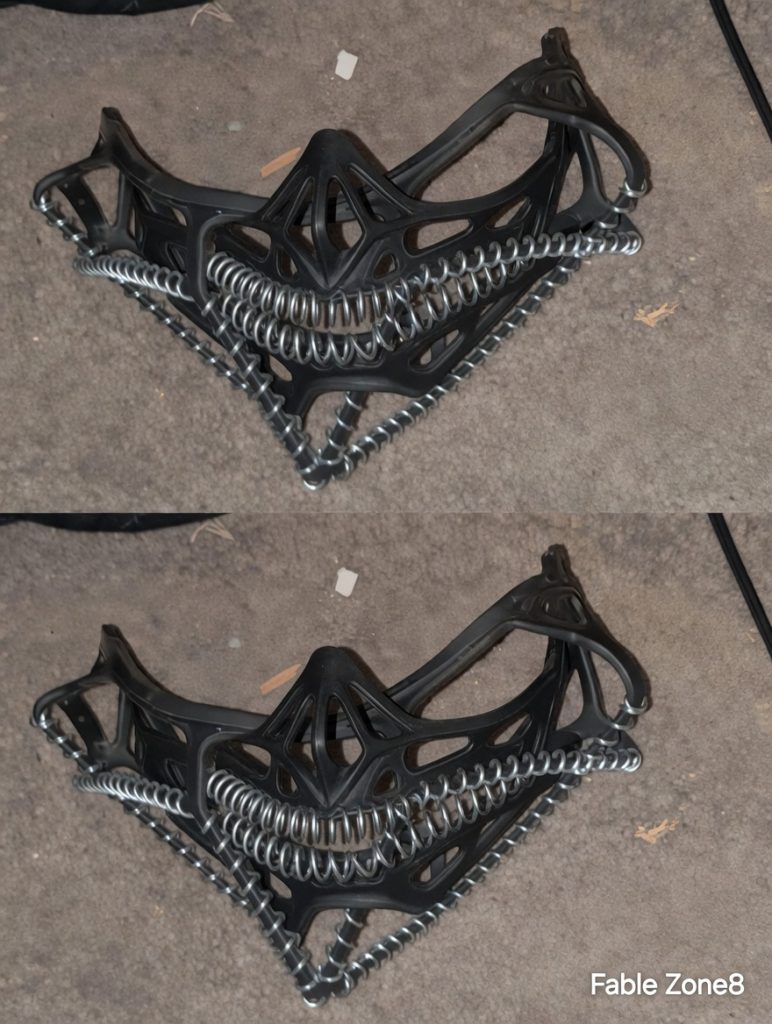
The object resembled a lower face mask—a jaw guard—but unlike anything I had ever seen before. Its structure was composed of a black, skeletal lattice that curved naturally along the shape of a human face. Angular cutouts formed a complex pattern, making it appear lightweight while still feeling solid and intentional.
Running along the edges were rows of small metallic coils.
They caught the light in a way that made them seem almost alive.
I picked it up carefully, half expecting it to fall apart in my hands. Instead, it felt balanced—precisely engineered. When I gently pressed the sides, the coils responded with a faint metallic whisper, as though they were meant to move, to react.
My friend and I exchanged a look.
Neither of us said anything at first.
Because neither of us knew what to say.
It didn’t belong there. Not in that garage. Not among rusted tools and forgotten boxes. It felt like something from a different world—something that had somehow slipped into ours unnoticed.
We turned it over, examining every detail. The inner surface was smoother, shaped in a way that suggested it was meant to be worn. There were subtle grooves along the edges, tiny mounting points near where the temples would be, as if it had once been part of a larger system.
“This is not normal,” my friend finally said.
I nodded.
But I didn’t call out to my dad.
Not yet.
There was something about the object that made me hesitate. A strange, unspoken feeling that once I brought it into the open, things would change in a way I couldn’t undo.
So we set it aside on the workbench and kept cleaning.
At least, we tried to.
Every few minutes, my eyes drifted back to it.
And each time, I noticed something new.
The precision of the design. The way the coils aligned perfectly along the structure. The absence of wear and tear, despite the dust that had settled over it. It hadn’t been thrown away—it had been stored.
Forgotten, maybe.
But not discarded.
My mind began to fill in the blanks.
Was it a prop? Something from a film project that never happened?
Or something more… experimental?
The idea felt ridiculous.
And yet, I couldn’t shake it.
Later that evening, after my friend had left and the garage was finally starting to look organized again, I brought the object inside.
I placed it on the kitchen table under the light.
My dad turned around.
And froze.
It was subtle, but unmistakable. His expression shifted in a way I had never seen before—surprise, recognition, and something else… something deeper.
“Where did you find that?” he asked quietly.
“In the garage,” I said. “Under a tarp.”
He stared at it for a long moment before letting out a slow breath.
“I was wondering when that would turn up again.”
That was when everything began to unravel.
He told me he hadn’t built it.
He hadn’t even bought it intentionally.
Years ago, he had purchased an abandoned storage unit at an auction—the kind people bid on without knowing what’s inside, hoping to find something valuable. Most of what he found had been ordinary: tools, old papers, miscellaneous items.
But hidden inside a locked metal case was this.
No labels.
No instructions.
No explanation.
Just the object, carefully wrapped and preserved.
He had brought it home out of curiosity, intending to figure out what it was.
But life got in the way.
Time passed.
And eventually, it ended up in the garage, where it waited.
Until now.
As he spoke, I felt a strange mixture of emotions—relief that there was an explanation, and disappointment that it wasn’t more definitive.
“So you don’t know what it is?” I asked.
He shook his head.
“Not exactly.”
Then he hesitated.
And reached for something else.
An old notebook.
The pages were yellowed, the ink faded, but the writing was still legible.
At the top of one page, a title:
“Project K-4216.”
The sketches inside matched the object perfectly.
Detailed diagrams of the lattice structure.
Annotations about the metallic coils.
Notes describing “micro-vibration feedback,” “resonance modulation,” and “wearable augmentation.”
I felt my chest tighten as I read.
This wasn’t random.
This was intentional.
According to the notes, the jaw guard had been designed as more than just protective gear. It was meant to interact with the wearer—to respond to movement, to alter sound, to create a subtle shift in perception.
A tool.
Or maybe something closer to an experiment.
“Do you think it actually works?” I asked.
My dad didn’t answer immediately.
Instead, he looked at the object again, as if seeing it for the first time all over again.
“I don’t know,” he said finally. “But I never tried it.”
The room fell silent.
And in that silence, a decision formed.
The next morning, I couldn’t resist.
I brought the jaw guard back to the garage, found some adjustable straps, and carefully fitted it to my face.
It felt… right.
Too right.
The structure aligned perfectly with my jaw, as though it had been designed specifically for me. The coils pressed lightly against my skin, cool at first, then gradually warming.
I took a breath.
And spoke.
The sound that came out wasn’t exactly my voice.
It was deeper. Sharper. Carrying a subtle resonance that seemed to linger in the air for just a moment longer than it should have.
Not artificial.
But altered.
I turned toward the mirror.
And for a second, I didn’t recognize myself.
The black lattice transformed my face into something else—something that existed somewhere between human and machine. Familiar, but distant.
My dad stood in the doorway, watching.
He didn’t say anything.
But I could see it in his expression.
He understood.
This wasn’t just an object anymore.
It was a possibility.
In the days that followed, we didn’t hide it away again.
Instead, we leaned into the mystery.
We documented everything—photographs, measurements, notes. We even began exploring the idea of scanning it, recreating it using modern tools, trying to understand the mind behind its design.
But more than that, it changed something between us.
It gave us a shared curiosity.
A project.
A connection that extended beyond the ordinary routines of daily life.
The garage was no longer just a storage space.
It had become something else entirely.
A place where the past and the future intersected in ways we didn’t fully understand.
The jaw guard now sits on a shelf in my room.
Not hidden.
Not forgotten.
A reminder.
That sometimes, the most extraordinary discoveries don’t come from distant places or grand adventures.
They come from dusty corners.
From things overlooked.
From moments that seem ordinary—until they’re not.
And every now and then, when the light hits those metallic coils just right, I swear they still shimmer with that same quiet energy.
As if they’re waiting.
Not just to be worn again.
But to be understood.