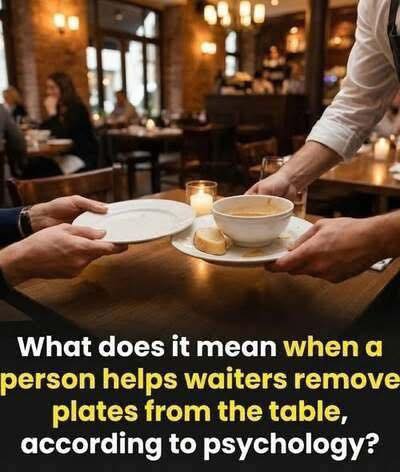
In the rhythm of everyday life, it is often the smallest gestures that speak the loudest. While grand acts of kindness tend to draw attention and admiration, they can sometimes be influenced by social expectations, a desire for recognition, or even subtle pressure to perform. In contrast, the quiet, almost unnoticed actions—like helping a waiter clear the table—tend to arise more naturally. These moments often occur without planning, without an audience, and without any expectation of acknowledgment. Precisely because of this, they can offer a more authentic glimpse into a person’s character.
Psychology has long emphasized that spontaneous behavior in low-stakes situations can be more revealing than carefully orchestrated actions. When someone instinctively reaches to stack plates, move glasses aside, or make space for a server, they are engaging in a form of unspoken communication. This communication is not verbal, yet it conveys attitudes, values, and patterns of thinking that extend far beyond the moment itself. It reflects how a person relates to others, how they interpret social roles, and how they respond to the needs of those around them.
One of the most commonly associated traits with this behavior is empathy. At its core, empathy is the ability to understand and, to some degree, share the feelings of another person. In a restaurant setting, helping a waiter does not require a deep emotional connection. Instead, it reflects a subtle awareness—an ability to recognize effort, workload, and perhaps even stress. A person who notices that a server is balancing multiple responsibilities and chooses to assist in a small way is demonstrating this awareness in action.
Importantly, empathy in this context is often quiet and cognitive rather than overtly emotional. It is less about feeling overwhelmed by another person’s experience and more about recognizing it and responding appropriately. People who display this kind of empathy tend to be attentive to details that others may overlook. They notice body language, pace, and environmental cues, and they adjust their behavior accordingly. Helping clear a table becomes a natural extension of this attentiveness.
Closely related to empathy is the concept of prosocial behavior. In psychology, prosocial actions are those intended to benefit others, often without any expectation of reward. Helping a waiter is a classic example. There is no formal requirement to do so, and in most cases, the action goes unnoticed or unacknowledged. Yet, for some individuals, the impulse to help arises naturally.
This tendency is often rooted in internal values rather than external incentives. People who frequently engage in prosocial behaviors tend to have a strong sense of social responsibility. They believe that small actions matter, even if they do not lead to visible outcomes. Their mindset is less about how their behavior will be perceived and more about whether it might be helpful. This distinction is subtle but significant. It suggests that their actions are guided by internal principles rather than by a desire to perform for others.
Another important factor reflected in this behavior is social awareness. Social awareness involves understanding the dynamics of a situation—recognizing what is happening, who is involved, and what might be needed. In a restaurant, many people focus primarily on their own experience: the food, the conversation, the ambiance. Someone who helps a waiter, however, is paying attention to the broader environment.
They notice when the table is crowded, when the server’s hands are full, or when clearing space might make the process smoother. This awareness is a key component of emotional intelligence, which encompasses the ability to recognize and respond to both one’s own emotions and those of others. Individuals with higher emotional intelligence tend to navigate social situations more fluidly. They are better at interpreting unspoken cues and adjusting their behavior in ways that facilitate positive interactions.
Interestingly, helping a waiter can also reflect a person’s attitude toward social roles and hierarchy. In many cultures, dining out involves clearly defined roles: customers are served, and staff provide service. These roles create a structure that most people follow without question. However, individuals who choose to step slightly outside of this structure—by assisting in small ways—may hold a more flexible view of these roles.
This does not necessarily mean they reject social norms. Rather, it suggests they prioritize cooperation over strict adherence to formality when the situation allows. Psychologically, this can be associated with a more egalitarian mindset. People with this perspective tend to view others as equals, regardless of their role or position. They are less likely to see interactions in terms of status and more likely to approach them as shared human experiences.
Personal experience can also play a significant role in shaping this behavior. Individuals who have worked in service-oriented roles often develop a deeper understanding of the demands involved. They know how physically taxing the work can be, how quickly tasks can accumulate, and how small gestures from others can make a difference. This firsthand knowledge can lead to what is sometimes referred to as experiential empathy—an understanding rooted in past experience.
However, it is important to note that such behavior is not limited to those with direct experience. Many people develop similar tendencies through upbringing, cultural influences, or personal values that emphasize kindness and consideration. In some cases, these values are reinforced over time through observation and reflection. Seeing others act with awareness and generosity can shape one’s own approach to similar situations.
Another psychological dimension to consider is the concept of initiative. Some individuals are naturally more inclined to take action when they see an opportunity to contribute. This does not necessarily stem from a desire for control or recognition. Rather, it reflects a sense of agency—a belief that one’s actions can have an impact, even in small ways.
In the context of a restaurant, this might manifest as quietly organizing dishes or passing items to make the process more efficient. These actions are typically performed in a respectful and unobtrusive manner. The individual understands the boundaries of the situation and acts within them. This balance between initiative and restraint is an important aspect of social competence.
At the same time, it is essential to avoid overinterpreting this behavior. Psychology consistently emphasizes that human actions are influenced by a wide range of factors, including context, mood, cultural norms, and social dynamics. A single action, no matter how meaningful it may seem, cannot fully define a person’s character.
For example, cultural differences can shape how such behavior is perceived. In some settings, helping a waiter may be seen as polite and cooperative. In others, it might be interpreted as unnecessary or even intrusive. Similarly, a person who typically engages in helpful behavior may choose not to do so in a particular situation due to fatigue, distraction, or social cues from others at the table.
Group dynamics can also influence behavior. People often adjust their actions based on the expectations and norms of those around them. If no one else at the table is helping, an individual may hesitate to act, even if they would normally do so. Conversely, seeing someone else take initiative can encourage similar behavior. These dynamics highlight the complexity of human interaction and the importance of considering context.
Another layer to explore is motivation. The same action—helping to clear a table—can be driven by different underlying motives. For some, the motivation is purely altruistic. For others, it may be practical, such as wanting to create more space or speed up the process. In certain cases, it may even be influenced by social signaling—a subtle way of demonstrating awareness or politeness in front of others.
Psychology recognizes that behavior often has multiple motivations, and these motivations can coexist. The key distinction lies in whether the action is primarily internally motivated or externally driven. Internally motivated actions tend to be more consistent and less dependent on external validation. They are more likely to occur regardless of who is present or whether the behavior is noticed.
What makes this behavior particularly meaningful is its context. It occurs in a moment where no action is required. The default expectation is passivity—to sit, wait, and allow the server to handle everything. Choosing to act, even in a small way, represents a departure from this default. It reflects a willingness to engage with the environment and to contribute to the flow of the situation.
This willingness is closely tied to a broader mindset—one that values connection, awareness, and participation. People who exhibit this mindset tend to approach interactions with a sense of shared responsibility. They recognize that even in structured environments, there is room for small acts of cooperation that can enhance the experience for everyone involved.
Over time, these small actions can have a cumulative effect. They shape how individuals experience shared spaces and how they perceive one another. A simple gesture can create a moment of ease, reduce stress, or foster a sense of mutual respect. While each individual act may seem insignificant, together they contribute to a culture of consideration.
This culture extends beyond the immediate interaction. When people experience small acts of kindness or awareness, they are more likely to carry those experiences into future interactions. In this way, seemingly minor behaviors can influence broader social patterns. They reinforce the idea that attention to others, even in small ways, is both valuable and impactful.
Ultimately, psychology does not treat this behavior as a definitive test of character. Instead, it views it as a window—a small glimpse into how individuals think, feel, and relate to others. It reflects tendencies rather than fixed traits, patterns rather than absolutes.
Helping a waiter clear the table is not about the act itself. It is about what the act represents: an awareness of others, a willingness to contribute, and an ability to navigate social situations with subtlety and care. Whether driven by empathy, experience, values, or habit, it reveals something fundamentally human—the instinct to notice and respond.
In a world where attention is often directed toward the extraordinary, these quiet moments remind us of the importance of the ordinary. They show that character is not only expressed through major decisions or dramatic actions, but also through the small, everyday choices that shape our interactions.
And perhaps that is what makes them so powerful. They are not performed for recognition. They are not designed to impress. They simply happen, often without thought, reflecting who we are when no one is watching closely. In those moments, the simplest actions can speak volumes.