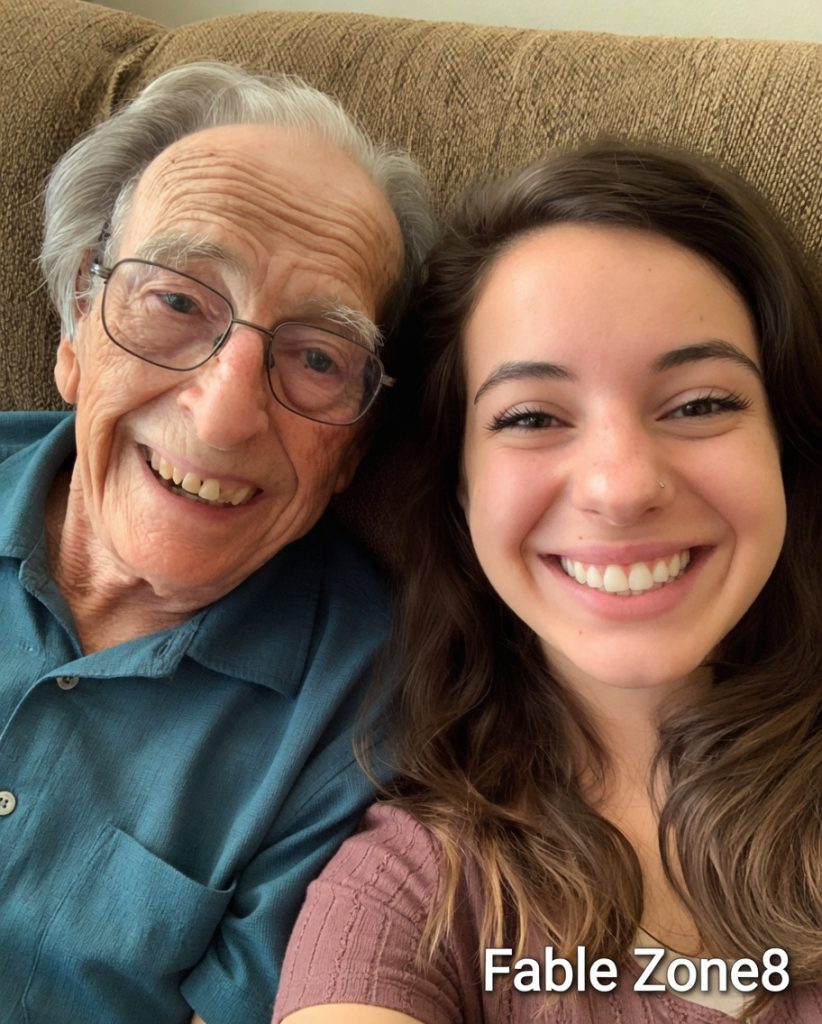
The voice on the phone wasn’t loud, but it carried a weight that felt impossible to ignore. It wasn’t threatening, and yet it unsettled me in a way I couldn’t explain. Calm—too calm. The kind of calm that makes your instincts react before your thoughts can catch up. My fingers tightened around my phone, my pulse racing as though it had already understood what my mind refused to process.
“Your grandfather wasn’t who you think he was. We need to talk.”
The words replayed in my head long after the call ended. At first, they felt offensive—almost cruel. It had only been two weeks since we buried him. Two weeks since I stood beside his grave, trying to comprehend how the man who had been my entire world could suddenly be gone. The idea that someone would call and say something like that felt wrong, like an intrusion into something sacred.
And yet… I didn’t hang up.
Curiosity has a way of slipping into grief, weaving itself through the cracks left behind by loss. It doesn’t ask permission. It doesn’t wait until you’re ready. It just settles in, quietly, persistently, until ignoring it becomes harder than confronting it.
For two days, I told myself I wouldn’t go.
I tried to dismiss the call as a mistake, a scam, or some kind of twisted joke. But the words lingered. They echoed in the quiet spaces of the house, in the moments when everything else fell silent. “He wasn’t who you think he was.”
My grandfather had been everything to me. After my parents died, he became my entire world—my protector, my teacher, my constant. He wasn’t perfect, but he was steady. Safe. The kind of person you build your life around without even realizing it.
So what could those words possibly mean?
I started noticing things I had never questioned before. Small things. The way he avoided talking about his past. The old desk in his room—the one with the locked drawer he never let me open. The absence of extended family, explained away with vague answers that had always seemed sufficient.
At the time, those details felt normal. Now, they felt like pieces of something I hadn’t known I was missing.
By the third day, the silence in the house became unbearable.
Grief has a way of amplifying emptiness. Every room felt too still, too quiet, too full of memories that no longer had anywhere to go. I could hear his voice in my head, could almost expect to see him sitting in his chair, calling me “kiddo” the way he always did.
But he wasn’t there.
And the only thing louder than that absence was the question I couldn’t answer.
So I went.
The address led me to a small office building on the edge of town. It wasn’t the kind of place you would notice unless you were looking for it. Plain. Unremarkable. Almost deliberately forgettable.
My hands trembled as I pushed the door open.
Part of me expected to be told I had the wrong place. That this had all been a misunderstanding. That I could walk away and return to the version of my life that, while painful, at least made sense.
Instead, a woman looked up from behind a desk and met my eyes with quiet recognition.
“You came,” she said.
That was the moment I knew this wasn’t random.
This was real.
She introduced herself as a lawyer. Not mine—his. My grandfather’s.
The words didn’t register at first. I didn’t know he had a lawyer. I didn’t know there was anything about his life that required one.
She gestured for me to sit, and for a moment, neither of us spoke. The silence felt heavy, like it was holding something I wasn’t ready to hear.
Then she slid a folder across the desk.
My name was on it. Typed. Official.
“Your grandfather asked me to contact you,” she said carefully. “But only after two weeks.”
Even now, he had been thinking ahead. Planning. Deciding when I should know, when I should be ready.
Or when he thought I would be.
My hands shook as I opened the folder.
The first thing I saw wasn’t a document.
It was a photograph.
Him—but younger. Standing in front of a large house I didn’t recognize. Dressed in a tailored suit I had never seen. He looked… different. Not just younger, but lighter. Confident. Like someone who belonged to a life I had never been part of.
I looked up, confusion tightening in my chest.
“What is this?”
The lawyer hesitated before answering.
“Your grandfather wasn’t poor.”
The words felt absurd.
They didn’t fit into anything I knew.
“We struggled,” I said, my voice unsteady. “We barely got by.”
“I know what it looked like,” she replied gently. “But that wasn’t the full truth.”
She paused, then said the words that unraveled everything.
“He was wealthy. Very wealthy.”
I laughed—but it came out wrong. Hollow. Sharp.
“That’s not possible.”
But her expression didn’t change.
And slowly, piece by piece, the truth began to unfold.
Years before my parents died, my grandfather had built a successful business. Not just stable—thriving. He had money, influence, security. A life that looked nothing like the one I grew up in.
Then something happened.
A betrayal. A legal battle. A decision.
He walked away.
Not because he had to—but because he chose to.
He sold what he could, secured the rest in ways that kept it hidden, and disappeared from that life entirely. By the time my parents died, he had already become someone else.
Someone simpler. Someone smaller.
Someone I recognized.
At first, the anger came quickly.
Hot. Immediate.
Why would he let us struggle like that?
Why would he say “we can’t afford it” when he clearly could?
Every memory shifted under the weight of that question. Every moment of disappointment, every quiet “no,” every time I thought we just didn’t have enough—it all felt like a lie.
“That wasn’t his choice to make,” I said, my voice breaking. “That was my life.”
The lawyer didn’t argue.
She just listened.
And then, gently, she handed me something else.
A letter.
My name was written on the front in his handwriting—the same slightly uneven script I had seen on birthday cards, notes, small reminders left on the kitchen table.
I didn’t want to open it.
Because opening it meant accepting everything I had just heard.
But I opened it anyway.
“Kiddo,” it began.
And just like that, the anger cracked.
He wrote about everything.
The life he left behind. The reasons he never told me. The fear that giving me everything would take something from me. The belief that struggle, while painful, would shape me into someone strong. Independent. Capable.
He admitted that he saw my disappointment.
That he knew I didn’t understand.
That it hurt him more than I could imagine.
But he also wrote that he believed in me.
That he believed I could become someone who didn’t rely on things that could disappear.
“I didn’t lie to hurt you,” he wrote. “I did it to protect the person I knew you could become.”
By the time I reached the end, my vision was blurred with tears.
The last line stayed with me.
“Everything I have left is yours now. But more importantly, everything you are… you built yourself.”
The lawyer explained the rest.
Accounts. Properties. Investments.
More money than I had ever imagined.
Enough to change everything.
But sitting there, holding that letter, none of it felt real.
Or important.
All I could think about was him.
The way he looked near the end—tired, but still trying to smile. The way he never let me see the full weight of what he carried. The quiet sacrifices I had never recognized.
And slowly, the anger began to shift.
Not disappear—but soften.
Because the truth was complicated.
He hadn’t been perfect.
He had made a choice that affected both of us. A choice I might never fully agree with.
But it hadn’t come from indifference.
It had come from love.
Messy. Imperfect. Human love.
The kind that doesn’t always make sense when you’re living through it.
The kind that sometimes only reveals itself when it’s too late to ask questions.
When I left the office, the world looked the same.
But it didn’t feel the same.
It felt like I was carrying two versions of him now.
The man I knew.
And the man I never got the chance to understand.
When I got home, I sat in his chair.
The old one that creaked when you leaned back too far.
The house felt different.
Still quiet—but not empty in the same way.
For the first time since he died, I didn’t feel completely lost.
I felt hurt.
Confused.
Overwhelmed.
But not lost.
Because now I understood something I hadn’t before.
Every “no.”
Every sacrifice.
Every moment that felt like lack.
It had all been intentional.
Not because he didn’t love me enough to give me more.
But because he loved me enough to give me less.
And maybe that’s the hardest kind of love to understand.
I don’t know what I’ll do with the money yet.
Maybe I’ll use it for something meaningful.
Maybe I’ll save it.
Maybe I’ll build something of my own.
But one thing is certain.
I’m not who I am because of what he left behind.
I’m who I am because of what he chose to give me while he was here.
And no secret—no matter how big—can take that away.