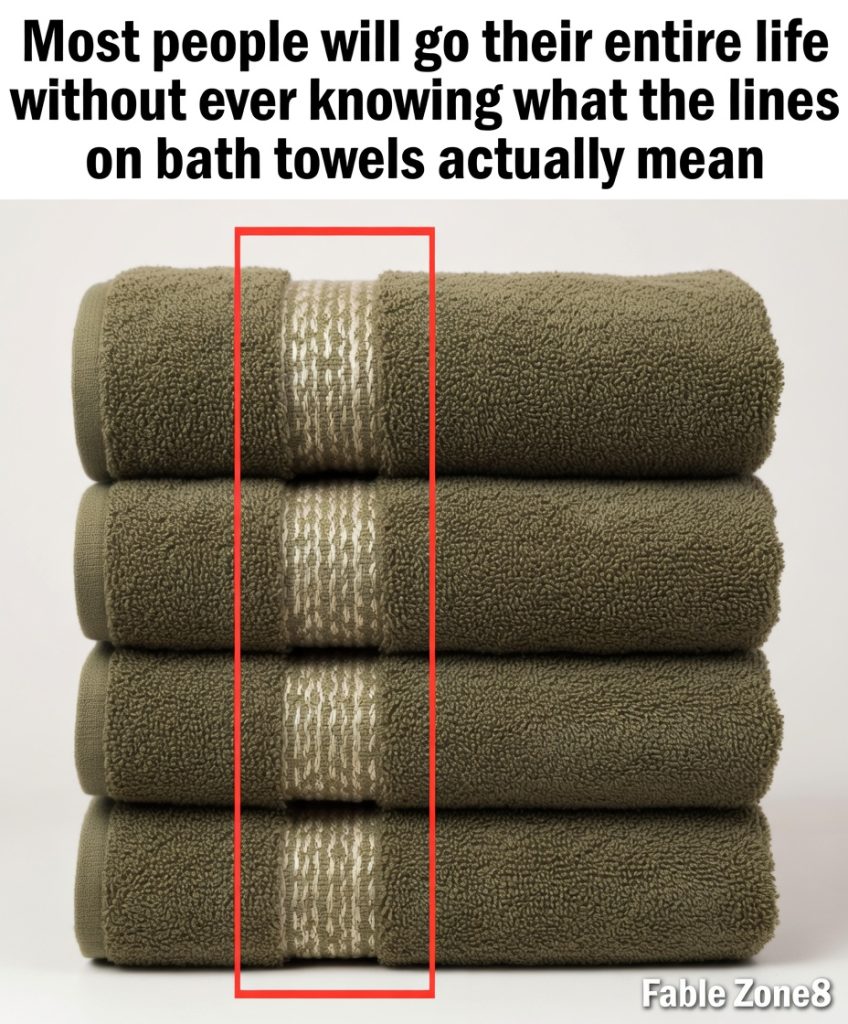
Towels are among the most familiar objects in daily life, yet their design is rarely questioned. We use them instinctively—after a shower, at the beach, in the kitchen—without considering how they manage to remain soft, absorbent, and intact through countless uses and washes. But hidden within their design is a small, often overlooked feature: the subtle line near the ends of many towels.
This feature is known as the dobby border, and far from being decorative, it plays a crucial role in how towels function.
At its core, the dobby border is a structural innovation.
Towels endure significant stress over time—twisting, pulling, washing, drying, and repeated handling. Without reinforcement, the edges of the fabric would begin to fray, stretch, and lose their shape. The dobby border addresses this by creating a tighter, flatter weave at the ends of the towel. This reinforced section distributes tension more evenly, preventing unraveling and preserving the integrity of the fabric.
In simple terms, it helps the towel last longer.
But its function doesn’t stop at durability.
The dobby border also contributes to maintaining the towel’s shape. Over time, fabrics without proper edge control can become warped or uneven, especially after repeated washing cycles. By stabilizing the edges, the dobby border ensures that the towel retains its original form—remaining balanced, symmetrical, and easy to handle.
Another important benefit lies in absorbency.
While the border itself is less absorbent due to its tighter weave, it actually supports the performance of the rest of the towel. By keeping the fabric structure stable, it allows the softer, looped sections—the parts that absorb water—to function more effectively. Without this structural support, the towel could lose efficiency over time.
There’s also a practical advantage that many people notice subconsciously: ease of folding.
The flatter, less bulky texture of the dobby border creates a natural guide for folding and hanging. Towels with this feature tend to stack more neatly, hang more evenly, and feel more organized in everyday use. It’s a small detail, but one that improves convenience in subtle ways.
From a comfort perspective, the border also reduces bulk at the edges. Without it, towel ends could feel thick, uneven, or even slightly uncomfortable. The dobby border smooths out these areas, contributing to a more refined and pleasant user experience.
Beyond function, the dobby border offers a space for design.
Because it is woven differently from the rest of the towel, it can incorporate patterns, textures, or branding elements without interfering with softness or absorbency. This allows manufacturers to add visual identity while maintaining performance. Historically, such woven borders were even used to signal craftsmanship and quality—subtle indicators of attention to detail.
Looking deeper, the dobby border reflects the broader science of textile engineering.
Towels must balance multiple properties at once: softness, strength, absorbency, and resilience. Materials like cotton are chosen for their natural ability to absorb moisture, while weaving techniques determine how the fabric behaves under stress. The dobby border works alongside these elements, reinforcing the structure and helping the towel withstand repeated washing, temperature changes, and mechanical wear.
It’s a reminder that even simple household items are the result of thoughtful design.
What appears to be just a line is actually a solution to multiple challenges—durability, usability, comfort, and aesthetics—all working together in a single feature.
On a larger scale, the dobby border represents something deeper about design itself.
It shows how small, intentional details can have a significant impact. It demonstrates that innovation doesn’t always come in dramatic forms; sometimes, it’s found in quiet improvements that make everyday life easier and more efficient.
We rarely think about towels.
But the next time you notice that subtle line near the edge, it’s worth remembering:
It’s not there by accident.
It’s there because someone designed it to make your everyday life just a little bit better.