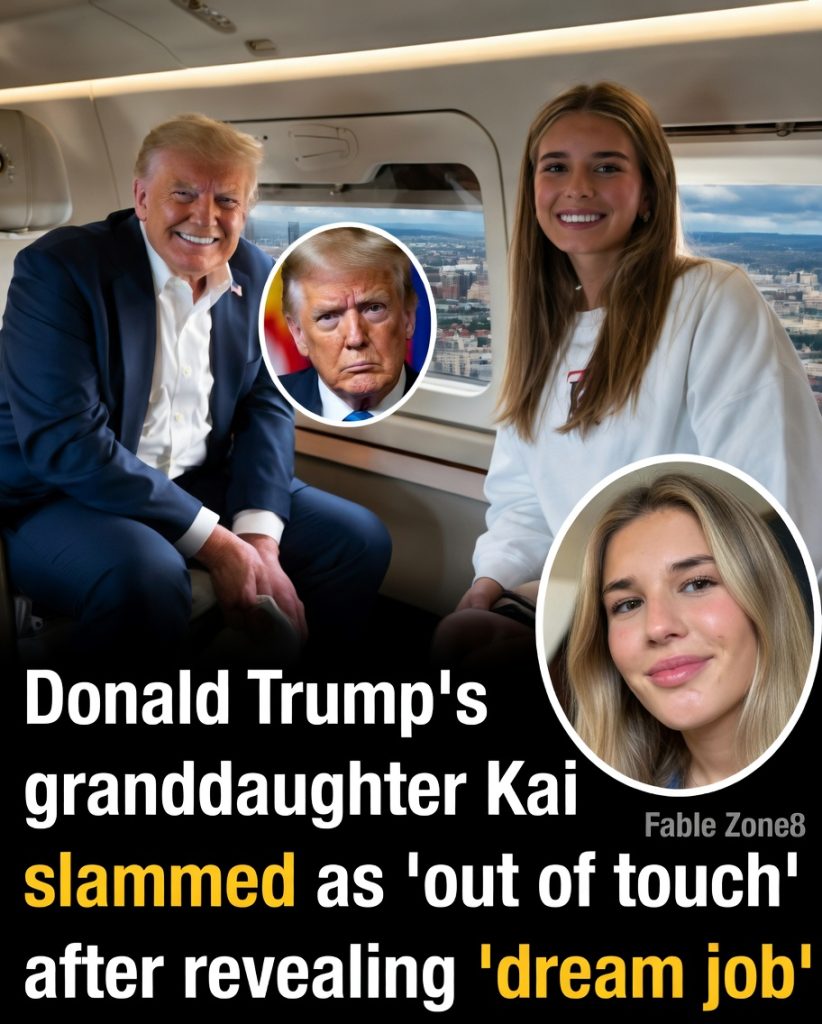
Kai Trump, the granddaughter of Donald Trump, recently found herself at the center of a heated public debate after openly sharing her “dream job” in an interview. What might have otherwise been a routine reflection on future ambitions quickly evolved into a broader conversation about privilege, opportunity, and the realities facing young people today.
In her remarks, Kai spoke with enthusiasm about pursuing a career that blends business, media, and influence—fields closely connected to her family’s public identity. She described her ideal role as one that would allow her to be creative, make meaningful decisions, and engage with people on a large scale. Her tone was aspirational and forward-looking, reflecting the mindset of someone exploring possibilities rather than claiming certainty.
However, the reaction online was immediate and divided.
A significant number of social media users criticized her comments, arguing that they revealed a disconnect from the everyday struggles faced by many young adults. For critics, the issue was not the ambition itself, but the context in which it was expressed. Growing up in a wealthy and well-connected family, they argued, provides access to opportunities that most people do not have—making discussions of “dream jobs” feel unrealistic or detached from economic realities.
Comments across platforms reflected this frustration, with many pointing to rising living costs, student debt, and competitive job markets as stark contrasts to the resources available to individuals in high-profile families. In this light, Kai’s aspirations were interpreted not just as personal goals, but as symbols of a broader inequality.
At the same time, a wave of support emerged in her defense.
Supporters emphasized her age and the importance of allowing young people to explore their ambitions without excessive judgment. They argued that having access to opportunity does not invalidate genuine interest or effort, and that public criticism can sometimes overlook the human side of individuals growing up under constant scrutiny.
This divide in reactions highlights a deeper cultural tension.
On one side is a growing sensitivity to issues of privilege and fairness, particularly among younger generations navigating economic uncertainty. On the other is a recognition that ambition, regardless of background, is a natural and important part of personal development.
Kai’s situation sits directly at the intersection of these perspectives.
Her family name carries significant weight in both business and politics, meaning that her words are rarely interpreted in isolation. Instead, they are filtered through public perceptions of the Trump family as a whole. This adds layers of meaning—and often criticism—to statements that might otherwise be seen as ordinary.
The discussion also reflects a broader question:
Can personal ambition be separated from inherited advantage?
For some observers, the answer is complicated. Access to networks, financial security, and visibility undeniably shapes opportunities. Yet others argue that these factors do not eliminate the need for personal direction, discipline, or purpose. In this sense, Kai’s comments become part of a larger conversation about how success is defined—and how much of it is earned versus enabled.
Another important dimension is the pressure of visibility.
Young members of high-profile families often grow up under intense public observation. Their choices, words, and even aspirations are subject to scrutiny in ways that most people never experience. This creates a unique challenge: trying to form an individual identity while being constantly associated with a powerful family legacy.
In Kai’s case, her response to the criticism has been relatively measured. Rather than engaging directly with the backlash, she has continued to frame her goals in terms of personal growth and meaningful work. This approach reflects a broader trend among younger public figures, who often balance self-expression with an awareness of how quickly narratives can form online.
Analysts note that situations like this are becoming increasingly common in the digital age.
Social media amplifies not only voices of support, but also criticism—often turning individual statements into symbols of larger societal debates. In this environment, even a simple comment about career aspirations can trigger discussions about inequality, privilege, and generational expectations.
Ultimately, the reaction to Kai Trump’s “dream job” reveals as much about public sentiment as it does about her.
It underscores the frustrations many people feel about economic disparity, while also highlighting the challenges faced by individuals growing up in highly visible families. The conversation is less about a single statement and more about what it represents in a broader cultural context.
As she continues to navigate her path, how Kai balances her ambitions with public perception will likely shape not only her career, but also how she is understood as an individual—separate from her family’s legacy.
In the end, her story reflects a modern reality:
Ambition is universal—but how it is perceived often depends on where you start.