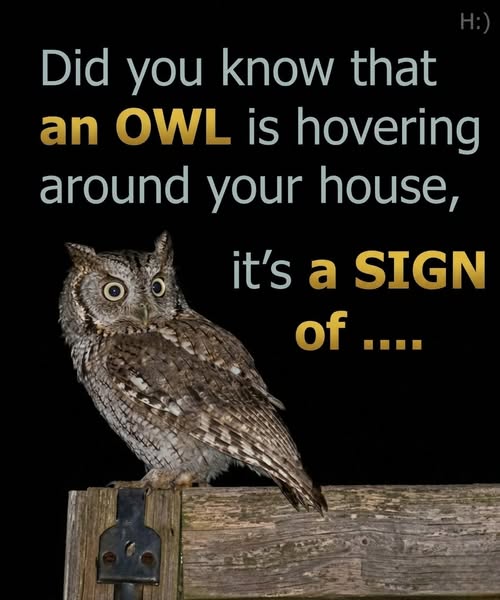
Introduction: A Presence You Rarely Notice
When night falls and most human activity slows down, a different world quietly awakens. Streets grow still, lights dim behind curtains, and the familiar daytime rhythm fades into silence. Yet above this apparent calm, life continues—unseen, unheard, and perfectly adapted to darkness.
Among the most fascinating nighttime visitors is the owl: a silent aerial predator that may pass through your neighborhood without ever revealing its presence.
To many people, the idea that an owl could be gliding above their home feels almost surreal. But in reality, owls are common across urban, suburban, and rural environments, quietly carrying out their nightly routines just beyond human awareness.
The Silent Flight: Nature’s Acoustic Engineering
One of the owl’s most remarkable adaptations is its ability to fly almost completely silently.
Unlike most birds, owls have specialized feather structures that:
- Reduce air turbulence
- Muffle wing noise
- Disrupt sound waves during flight
These features allow them to move through the air without the characteristic flapping sounds associated with other birds. As a result, an owl can approach its surroundings with almost no audible warning.
This silence is not accidental—it is essential for survival. It allows owls to:
- Hunt effectively
- Avoid detection by prey
- Navigate in darkness without alerting other animals
To human observers, this creates the illusion of a ghostlike presence moving through the night sky.
Why Owls Are Drawn to Human Environments
If an owl is seen near a house, it is rarely coincidence. Human settlements often provide ideal hunting conditions.
Common attractions include:
- Rodents such as mice and rats
- Insects drawn to artificial lighting
- Small birds nesting near buildings
- Open spaces like gardens and fields
Streetlights, compost areas, and trash bins can indirectly increase prey activity, making residential zones attractive hunting grounds.
From the owl’s perspective, a neighborhood is not “human territory,” but simply another section of a larger ecosystem filled with opportunities for feeding.
Extraordinary Senses: Seeing and Hearing in the Dark
Owls are equipped with sensory systems that make them exceptionally effective nocturnal hunters.
Vision in Low Light
Their eyes are adapted for darkness, containing a high number of rod cells that enhance night vision. While they do not see in complete darkness, they can detect movement and contrast at light levels far lower than humans can perceive.
Precision Hearing
Even more impressive is their hearing system:
- Asymmetrical ear placement allows spatial triangulation
- Sound can be pinpointed in three dimensions
- Prey can be located under leaves, snow, or soil
This combination of sight and hearing gives owls near-perfect awareness of their surroundings, even when nothing is visible to the human eye.
Hunting Behavior: Precision Over Power
Owls are not fast, chaotic hunters. Instead, they rely on:
- Patience
- Silence
- Precision timing
They often perch quietly for long periods, scanning and listening before making a calculated movement. When they strike, it is swift and efficient, minimizing energy use and maximizing success.
Their talons are their primary tools, designed to grasp and immobilize prey instantly.
Despite their reputation as powerful predators, owls are deeply strategic rather than aggressive in behavior.
The Illusion of “Watching You”
Many people feel a sense of unease when thinking about owls near their homes, partly because of their silent presence and glowing eyes in the dark.
However, owls are not interested in humans. They do not observe people in the way we imagine. Instead, they are focused entirely on:
- Movement of prey
- Sound cues
- Environmental patterns
What feels like “being watched” is usually just coincidence—an owl scanning its environment while hunting.
The perception of mystery often comes from human imagination filling in gaps left by darkness and silence.
Cultural Symbolism: Wisdom and Mystery
Across different cultures, owls have carried powerful symbolic meanings for centuries.
Some traditions associate them with:
- Wisdom and knowledge
- Intuition and insight
- Guardianship of hidden truths
Others interpret them as:
- Omens or symbols of transition
- Creatures of mystery or the unknown
- Messengers between worlds
These interpretations often stem from the owl’s nocturnal nature and its ability to appear suddenly and disappear without sound.
In reality, these symbolic meanings reflect human attempts to understand a creature that operates in a world we rarely experience directly.
Ecological Importance: Natural Pest Control
Beyond symbolism and mystery, owls play a critical ecological role.
They help maintain balance by:
- Controlling rodent populations
- Reducing agricultural pests
- Supporting healthy food chain dynamics
In many ecosystems, owls are essential regulators that prevent overpopulation of small mammals. In suburban areas, they provide natural pest control services without chemicals or human intervention.
Their presence often indicates a healthy, functioning environment.
Living Alongside Owls: A Quiet Coexistence
Owls do not require human interaction to thrive, but they often share space with people unknowingly. Most individuals will never realize when an owl passes overhead or perches nearby.
To coexist peacefully with owls:
- Avoid using rodenticides that can poison their food sources
- Maintain natural green spaces when possible
- Reduce excessive night lighting in outdoor areas
These simple practices help preserve the natural balance that allows owls to continue thriving near human settlements.
Conclusion: The Night Belongs to More Than Humans
The night sky above a quiet neighborhood is not empty—it is active with life that moves beyond human perception. Owls glide through this space effortlessly, guided by senses honed over millions of years of evolution.
Their presence is neither supernatural nor threatening, but natural and essential. They are part of a larger rhythm that continues whether or not we notice it.
So when you step outside at night and feel the silence settle around you, remember that somewhere above, an owl may be moving through the darkness—not watching you, not waiting for you, but simply living its ancient, silent routine.
And in that quiet movement, the night becomes something larger than fear or mystery—it becomes a shared world, full of life just beyond the edge of human awareness.