Introduction: A Historic Mission Meets an Unexpected Challenge
The Artemis II mission represents one of the most significant milestones in modern space exploration—the first crewed journey around the Moon in more than half a century. Designed as a critical step toward long-term lunar presence and future Mars exploration, the mission carries immense scientific, engineering, and symbolic importance.
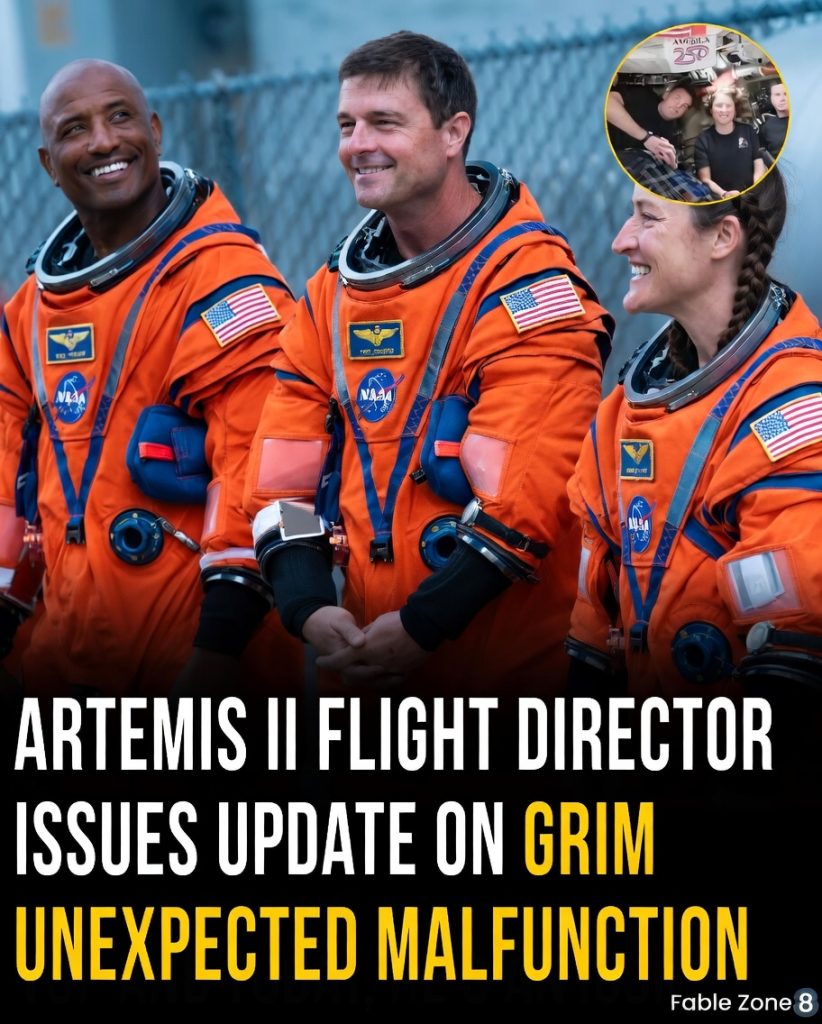
Aboard the Orion spacecraft, astronauts Reid Wiseman, Victor Glover, Christina Koch, and Jeremy Hansen embarked on a carefully planned trajectory that would test every aspect of human spaceflight beyond low Earth orbit. While the mission has largely proceeded successfully, an unexpected technical issue within the spacecraft’s life support system introduced an unplanned complication that drew attention from mission control and the global public alike.
At the center of the incident was a malfunction in the spacecraft’s waste management system—an essential yet often overlooked component of long-duration spaceflight.
The Role of Life Support Systems in Deep Space
In the vacuum of space, astronauts depend entirely on onboard systems to sustain life. Unlike missions in low Earth orbit, where resupply or rapid return is possible, deep space missions require fully self-contained environmental control systems.
These systems include:
- Oxygen generation and air circulation
- Carbon dioxide removal
- Temperature and humidity regulation
- Water recycling
- Waste management and sanitation
While often discussed less publicly, sanitation systems are critical for both health and psychological well-being. Even minor failures can affect crew comfort, operational efficiency, and overall mission stability.
The First Indications of a Problem
Early in the Artemis II mission, astronauts reported irregularities in the waste management system aboard Orion. Initial communications suggested a partial malfunction rather than a complete system failure.
A warning indicator illuminated on the onboard interface, signaling that the system was not operating within expected parameters. Although the toilet remained functional, certain components—particularly those responsible for airflow and waste evacuation—appeared to be compromised.
In spacecraft engineering, even a partial degradation in ventilation systems is treated seriously, as airflow is essential for both odor control and system safety.
Technical Diagnosis: A Jammed Ventilation Component
Following telemetry analysis and crew reports, NASA engineers identified a likely cause: a malfunction in a ventilation fan responsible for maintaining proper airflow within the waste processing unit.
This type of system performs several critical functions:
- Removing waste products efficiently
- Preventing buildup of gases and odors
- Maintaining pressure balance within sealed compartments
A jam or restriction in this system can quickly lead to reduced efficiency and secondary complications. In a tightly sealed spacecraft like Orion, airflow disruptions must be addressed promptly to avoid cascading system stress.
The crew, working in coordination with mission control, implemented immediate procedural adjustments to maintain functionality while engineers assessed long-term mitigation strategies.
Sensory Alert: The Burning Odor Concern
One of the most concerning aspects reported during the incident was the detection of an unusual burning smell within the hygiene compartment.
In spacecraft environments, any odor resembling burning material is treated with extreme caution due to the association with electrical faults or overheating components. Although no evidence of fire or thermal anomaly was confirmed, the presence of the smell prompted a rapid diagnostic review of surrounding systems.
Astronaut Jeremy Hansen noted the odor during a routine check, prompting immediate communication with the rest of the crew and mission control. In spaceflight operations, sensory observations—such as smell or sound—are as important as digital telemetry in identifying potential anomalies.
Crew Response: Training Meets Real-Time Problem Solving
The astronauts aboard Orion responded according to extensive training protocols designed for exactly such scenarios.
Their response included:
- Isolating the affected system
- Monitoring environmental readings
- Applying contingency procedures
- Coordinating continuously with ground engineers
Despite the discomfort and unusual nature of the issue, the crew maintained operational discipline. NASA later confirmed that sanitation systems remained functional, albeit with reduced efficiency.
Workarounds were implemented to ensure continued usability while minimizing risk of further complications.
Mission Control Perspective: Stability Maintained
NASA flight director Rick Henfling later addressed the situation, confirming that while the system was not performing optimally, it remained operational.
He emphasized that:
- No immediate threat to crew safety was present
- Life support systems remained stable overall
- Engineering teams were actively monitoring the situation
In space missions, redundancy is built into critical systems precisely for this reason. Even when one subsystem experiences degradation, backup procedures and alternative methods help maintain overall mission integrity.
The Lunar Flyby Continues
Despite the technical challenge, Artemis II successfully continued its mission objectives. The spacecraft completed its planned lunar flyby, passing behind the Moon and temporarily losing communication with Earth for approximately 40 minutes—a normal and expected phase of the trajectory.
During this time, the crew observed the lunar surface from unprecedented proximity, collecting valuable visual and operational data that will inform future Artemis missions.
The mission’s success in navigating this phase underscored the resilience of both the spacecraft and its human occupants.
The Broader Reality of Deep Space Engineering
Incidents like this highlight an essential truth about space exploration: even the most advanced systems are vulnerable to mechanical stress, environmental constraints, and unexpected failures.
Spacecraft design must account for:
- Microgravity effects on fluid systems
- Long-duration wear on mechanical components
- Limited repair capabilities
- Psychological and physical needs of crew members
Unlike Earth-based engineering environments, repairs cannot rely on external support or replacement parts. Astronauts and mission controllers must solve problems in real time, often under significant constraints.
Lessons for Future Missions
While the Artemis II toilet malfunction may appear minor in comparison to other spaceflight challenges, it provides valuable insights for future deep space missions.
Key lessons include:
- Importance of robust airflow redundancy in sanitation systems
- Need for easier in-flight maintenance access
- Enhanced monitoring of early warning indicators
- Continued refinement of life support reliability
As NASA prepares for longer missions, including potential journeys to Mars, every subsystem—no matter how mundane it may seem—becomes mission-critical.
Human Adaptability in Extreme Environments
Perhaps the most important aspect of this incident is not the malfunction itself, but the response to it. The Artemis II crew demonstrated the core principle of human space exploration: adaptability under pressure.
In environments millions of miles from Earth, success depends not only on technology, but on:
- Training
- Communication
- Decision-making under uncertainty
- Team coordination
The ability of astronauts and engineers to maintain composure and solve unexpected problems in real time remains one of humanity’s greatest strengths in space exploration.
Conclusion: A Small Failure, A Big Lesson
The Artemis II mission continues to represent a monumental step forward in human spaceflight. While the Orion spacecraft experienced an unexpected issue in its sanitation system, the situation was managed effectively without compromising crew safety or mission objectives.
In the broader context, this incident serves as a reminder that space exploration is not a seamless journey, but a continuous process of problem-solving and adaptation.
Even small malfunctions become opportunities for learning. And in that sense, Artemis II is not defined by a toilet system failure, but by how humanity responds when even the most basic systems are tested in the unforgiving environment of deep space.
The mission moves forward—stronger, more informed, and one step closer to the future of sustained human presence beyond Earth.