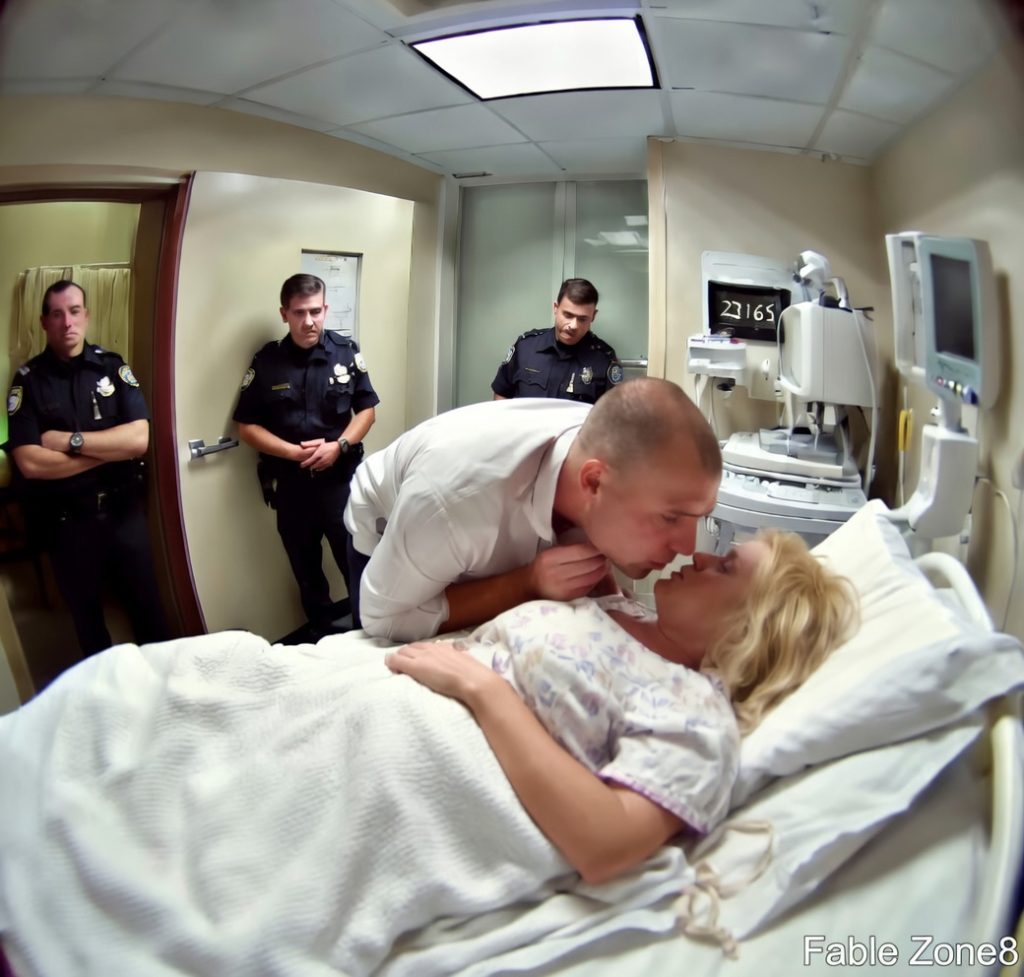
The room was so quiet it felt suffocating.
Even the steady rhythm of the heart monitor seemed distant, as if the sound itself was holding its breath. Greg stood frozen, the confidence he had carried just moments earlier dissolving into something brittle and uncertain. His eyes flickered between me and the detective, searching—desperately—for an explanation that no longer existed.
“You’re twisting my words,” he said finally, forcing a weak laugh that didn’t reach his eyes. “We joke like that sometimes. Dark humor.”
The lie collapsed the moment it left his lips.
I didn’t respond. I didn’t need to. For the first time since the fall, I wasn’t pretending to be unsure, fragile, or confused. I wasn’t playing the role he had written for me anymore.
The detective let the silence stretch. He didn’t rush, didn’t interrupt. He simply allowed Greg to sit in the weight of his own words.
Then he stepped forward.
“You can explain it downtown,” he said calmly. “But I wouldn’t recommend using that version again.”
Something inside Greg broke—not loudly, not dramatically, but in small, undeniable ways. His jaw tightened. His hands trembled. The mask slipped.
“Clara…” he said, turning back to me, his voice softening into something almost pleading. “You know I didn’t mean it. You know I’d never hurt you.”
For a second, the words felt unreal.
Then the memory came back—sharp, undeniable.
The push.
The sudden loss of balance.
The violent, breath-stealing impact of the stairs.
“I already know the truth,” I said quietly. “You already did.”
That was the moment everything ended.
The detective placed a firm hand on Greg’s shoulder. “You’re under arrest for attempted murder.”
Greg didn’t fight. He didn’t argue. He just stared at me—like he was trying to hold onto something that was already gone—before letting himself be led away.
When the door closed behind him, the air in the room changed.
For the first time since I woke up in that hospital bed, I could breathe.
It hadn’t started with certainty.
After the fall, I questioned everything. My memory felt fractured, unreliable. I told myself it was an accident—because the alternative was too terrifying to accept. Even when something inside me whispered that it hadn’t been right, I tried to silence it.
But doubt has a way of surviving.
And instinct doesn’t disappear—it waits.
The detective had come quietly, asking careful questions, watching my reactions more than my answers. He didn’t push. He didn’t need to. Something in his tone made me feel like I wasn’t imagining things.
So we made a plan.
A simple one.
He would be in the room. Hidden. Listening.
And Greg—believing I was still weak, still unsure—would come back to finish what he started.
He almost succeeded.
Not in harming me again—but in convincing me, one last time, that I was wrong.
Until he leaned in close.
Until his voice dropped to a whisper meant for no one else to hear.
“You should have died when you fell,” he said.
That was it.
No anger. No hesitation.
Just certainty.
And in that moment, every doubt I had been holding onto shattered completely.
In the days that followed, the truth unraveled faster than I could process it.
What began as a single moment turned into a pattern.
A plan.
Financial records revealed a life insurance policy—one I hadn’t known existed. The amount was staggering, far beyond anything we had ever discussed. Emails surfaced next—carefully worded, but unmistakable in their intent. Debts. Pressure. A second life I had never seen.
Even the staircase told a story.
Subtle changes. Almost invisible. But deliberate.
It hadn’t been an accident.
It had never been an accident.
Strangely, the pain of that realization didn’t break me.
It freed me.
Because the truth—no matter how ugly—is easier to carry than uncertainty.
I stopped asking myself if I had imagined it. I stopped replaying the moment, searching for alternative explanations. There weren’t any.
He had made a choice.
And now, so had I.
Recovery came in layers.
The physical healing was slow—bruises fading, fractures mending, strength returning one careful step at a time. But emotionally, something shifted much faster.
I wasn’t the same person who had fallen down those stairs.
That version of me had trusted without question. Had ignored small signs. Had believed love was enough to hold everything together.
The woman who survived was different.
Clearer.
Stronger.
Not because she wanted to be—but because she had no other choice.
When the trial began, I expected it to be overwhelming.
It wasn’t.
Compared to that moment in the hospital—the whisper, the truth, the realization—everything else felt distant.
Controlled.
The recording played in court.
His voice filled the room again, just as cold, just as certain.
There was no explaining it away. No rewriting what had been captured so clearly.
When I took the stand, I didn’t feel like a victim.
I felt like someone who had finally been heard.
The verdict came, and with it, something unexpected.
Not relief.
Not satisfaction.
Closure.
A quiet, steady sense that something heavy had finally been set down.
When I stepped outside the courthouse, the air felt different.
Lighter.
Cleaner.
For the first time in a long time, the future didn’t feel like something to fear.
It felt like something open.
Unwritten.
Mine.
What happened to me will always be part of my story.
But it doesn’t get to decide the ending.
Because in the moment he thought he had taken everything—
I made a choice.
To speak.
To stand.
To live.
And that choice changed everything.