It all started with something so small, so ordinary, that most people never give it a second thought—a thin white tag stitched into the seam of a pillow. For Emily Thompson, however, that tiny piece of fabric became the beginning of a surprisingly complex journey into the world of consumer rights, legal language, and long-standing misconceptions that have quietly shaped everyday behavior for generations.
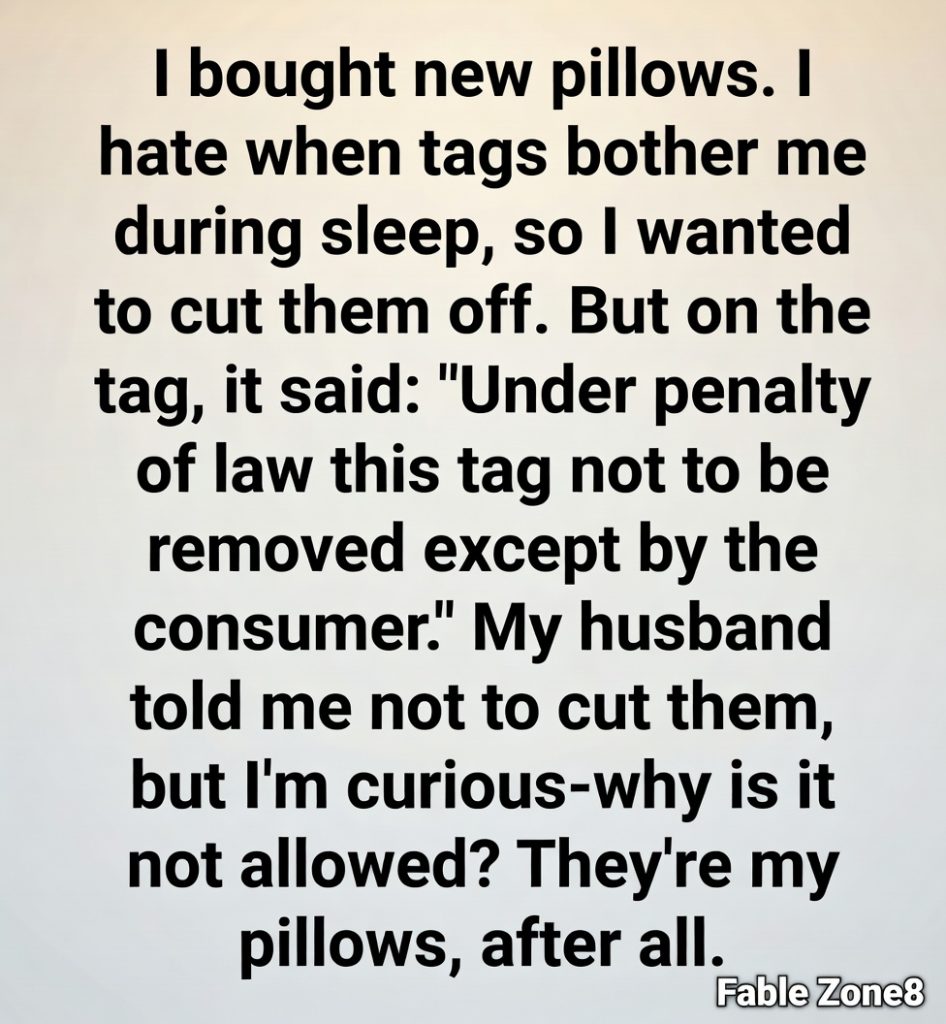
Emily had just purchased a set of high-quality memory foam pillows, eager to improve her sleep after weeks of restless nights. Like many people, she was excited about the promise of comfort and support, imagining peaceful evenings free from tossing and turning. But her excitement quickly turned into mild irritation the moment she laid her head down. The stiff tag attached to the pillow brushed against her neck, scratchy and impossible to ignore.
Annoyed but not surprised—after all, most pillows come with these tags—Emily reached for a pair of scissors. It felt like the most natural thing in the world. After all, she had paid for the pillows. They were hers. Why shouldn’t she be able to remove something that made them uncomfortable?
But just as she was about to cut, something caught her eye.
Printed in bold, capital letters were the words: “Under penalty of law this tag not to be removed except by the consumer.”
She paused.
The wording felt serious—almost threatening. For a brief moment, doubt crept in. What exactly did that mean? Was she allowed to cut it or not?
Her husband, noticing her hesitation, quickly stepped in. “You probably shouldn’t do that,” he said cautiously. “It says right there—penalty of law. What if it’s illegal?”
Suddenly, what had been a simple act became a question loaded with uncertainty. Could something as trivial as cutting a pillow tag actually have legal consequences?
Emily laughed it off at first, but the curiosity stuck with her. That night, instead of enjoying her new pillows, she found herself wondering about the meaning behind those words—and why they had been printed so prominently in the first place.
The next day, Emily decided to look into it. What she discovered was both fascinating and surprising.
The origin of those tags dates back more than a century, to a time when consumer protections were far less developed than they are today. In the early 1900s, the booming textile and bedding industries were not as regulated, and some manufacturers engaged in deceptive practices that would be unthinkable by modern standards.
Used mattresses and pillows were often resold as new. Materials like old rags, feathers, or even unsanitary stuffing were hidden beneath fresh outer layers, making products appear clean and unused when they were anything but. Consumers had no reliable way to verify what they were buying.
To address this issue, governments introduced strict labeling laws designed to protect buyers. Manufacturers were required to disclose exactly what was inside their products—what materials were used, whether they were new or recycled, and how they should be handled or cleaned.
These labels were not meant for consumers—they were meant for regulators, inspectors, and future buyers.
The now-famous warning—“do not remove under penalty of law”—was directed primarily at manufacturers, retailers, and resellers. It was meant to prevent them from removing the label and misrepresenting the product.
But there was one crucial detail that many people overlooked.
The phrase always included an important exception: “except by the consumer.”
This small clause completely changes the meaning of the warning.
It clearly states that once the product has been purchased, the consumer—the owner—has every right to remove the tag.
Yet somehow, over the decades, that message became lost.
Generations grew up believing that cutting off a pillow or mattress tag was illegal. Parents warned their children. Friends repeated it as fact. The idea became so widespread that it turned into a kind of modern myth—one that caused real confusion in everyday life.
Emily realized that her husband’s reaction wasn’t unusual at all. In fact, it was incredibly common.
People weren’t afraid of the tag because they had researched the law—they were afraid because they had always been told to be.
As Emily continued her research, she discovered that enforcement of these laws today is almost entirely focused on businesses, not individuals.
Regulatory agencies are concerned with preventing fraud in the marketplace—not policing what people do in their own homes. The idea of someone being fined or penalized for removing a tag from their own pillow is, for all practical purposes, nonexistent.
In reality, the tags remain for a variety of reasons that have little to do with consumer behavior.
They are used for manufacturing tracking, helping companies monitor production batches and identify defects if problems arise. They also provide important information about materials, which can be useful in cases of product recalls or safety concerns.
In some cases—particularly with mattresses—the tags include fire safety details and compliance information required by law. These details can be important for regulators or in legal situations, such as insurance claims.
But for everyday use, especially with simple items like pillows, the tag serves very little purpose once the product is in the hands of the buyer.
This realization was both reassuring and frustrating for Emily.
On one hand, she felt relieved knowing that she could remove the tags without any real risk. On the other hand, she couldn’t help but wonder why companies continued to use such intimidating language.
Why not update the wording to make it clearer? Why not communicate in a way that reflects modern understanding?
The answer, she discovered, lies partly in tradition and partly in practicality.
Changing labeling standards across an entire industry is not simple. It requires updates to manufacturing processes, legal approvals, and coordination across multiple regulatory bodies. For many companies, it’s easier—and safer—to continue using established language that has already been approved.
There is also a legal advantage. The strong wording helps protect companies from liability by ensuring that important information remains attached to the product until it reaches the consumer.
Even if the message is misunderstood, it still fulfills its original purpose.
Intrigued by what she had learned, Emily decided to share her experience online.
She wrote about the moment she hesitated with the scissors, her husband’s warning, and the surprising truth she uncovered. What she expected to be a simple post quickly gained attention.
People from all over began sharing their own experiences.
Some admitted they had always been too afraid to remove tags. Others confessed they had cut them off for years but felt a strange sense of guilt every time. Many were shocked to learn that the warning didn’t apply to them at all.
The conversation grew rapidly, evolving into a broader discussion about consumer rights, misinformation, and the ways in which outdated language can influence behavior.
Experts weighed in, explaining the history and legal context. Others pointed out how similar misunderstandings exist in other areas of daily life—rules and warnings that are followed not because they are enforced, but because they are believed.
Emily’s simple question had struck a nerve.
Eventually, she decided to take things one step further.
With a mix of curiosity and quiet confidence, she picked up her scissors again and carefully removed the tags from her pillows.
Nothing happened.
No warnings. No consequences. No legal trouble.
Just comfort.
That night, she slept better than she had in weeks.
It was a small change, but it felt symbolic—a reminder that not all rules are as restrictive as they seem, and that understanding the truth can be incredibly freeing.
In the weeks that followed, Emily reflected on what the experience had taught her.
It wasn’t just about pillow tags.
It was about the importance of questioning assumptions. About the value of seeking accurate information instead of relying on hearsay. About recognizing the difference between genuine legal requirements and outdated perceptions.
She realized how easily fear can shape behavior—even in the absence of real consequences.
And more importantly, she understood how empowering it can be to replace that fear with knowledge.
Today, Emily and her husband often laugh about the moment that started it all. What nearly became an argument turned into an unexpected lesson—one they now share with friends, family, and even their children.
They use it as an example of critical thinking. Of not accepting things at face value simply because they sound official or authoritative.
The tags are still there, of course. Manufacturers continue to print them, and they likely will for years to come.
But for many people, the meaning behind them has changed.
They are no longer symbols of restriction or fear.
Instead, they serve as reminders—of how far consumer rights have come, and how important it is to understand them.
In the end, what began as a minor annoyance became something much more meaningful.
A small act of curiosity led to a deeper understanding of ownership, responsibility, and personal freedom.
And for Emily, the conclusion was simple.
The pillows were hers.
The choice was hers.
And sometimes, the smallest decisions—like cutting off a tag—can reveal the biggest truths.