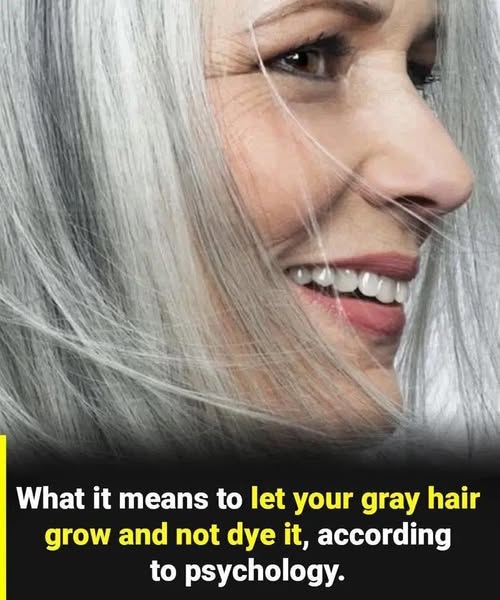
Leaving gray hair natural, without covering it with dye, has increasingly become more than a simple aesthetic preference; it has evolved into a deeply symbolic and psychologically layered decision that reflects inner change, emotional maturity, and a transformed relationship with time, self-worth, and identity. For decades, gray hair was framed almost exclusively as a visible marker of decline—something to correct, conceal, or delay as long as possible. Popular culture, advertising, and workplace norms reinforced the belief that youth equaled relevance, beauty, and vitality, while aging suggested loss, invisibility, and diminished value. Within this framework, dyeing gray hair became less about personal expression and more about compliance with unspoken social rules. Psychologically, the decision to stop dyeing often arises during periods of personal reassessment, when individuals begin to question whether maintaining a youthful appearance still aligns with their evolving values. Rather than signaling resignation, neglect, or surrender, letting gray hair show frequently represents an active refusal to participate in constant self-correction. It reflects a desire to live more honestly in one’s body, to stop negotiating with time, and to release the quiet exhaustion of trying to appear unchanged while life continues to move forward.
From an identity perspective, hair functions as one of the most visible and emotionally charged elements of self-presentation. It communicates age, health, confidence, creativity, and social belonging, often before a person speaks a single word. For many, dyeing gray hair is not a neutral grooming habit but a way of managing how they are perceived, particularly in environments that equate youth with competence or desirability. Choosing to let gray hair grow naturally often coincides with a broader process of identity redefinition, where individuals reassess who they are beyond professional roles, relationship status, or external approval. Psychologists note that such shifts are common during midlife transitions, but they can also occur after loss, burnout, illness, or moments of profound self-reflection. In these phases, people often feel compelled to align their outer appearance with their inner reality. Allowing gray hair to be visible can signal that identity is no longer anchored in striving or performance, but in self-acceptance and continuity. It does not indicate that someone has stopped caring about appearance; rather, it suggests that appearance is no longer the primary measure of worth or legitimacy.
Emotionally, the decision to stop dyeing gray hair is frequently associated with relief, calm, and a reduction in background anxiety. Maintaining dyed hair often creates a subtle but persistent pressure, as roots reappear and the body’s natural processes are framed as problems to be managed. This ongoing cycle can reinforce the belief that aging is something to hide, fight, or feel ashamed of, even when those beliefs are not consciously endorsed. Letting gray hair grow removes a recurring reminder that time is something to fear or control. Many people describe the transition as unexpectedly emotional, marked by vulnerability but also a growing sense of peace. There is often an initial discomfort as one adjusts to seeing themselves differently and anticipates others’ reactions. Over time, however, this discomfort frequently gives way to a sense of authenticity and ease. Psychologically, this shift reflects acceptance of impermanence and a willingness to coexist with change rather than resist it. Gray hair becomes less a symbol of loss and more a visible record of experience, endurance, and survival, carrying emotional meaning rather than stigma.
Socially, going gray challenges deeply rooted beauty standards, especially those imposed on women. While men’s gray hair has often been framed as distinguished, authoritative, or wise, women have historically faced stronger pressure to conceal it in order to remain socially visible and valued. This imbalance has psychological consequences, shaping how women perceive aging, desirability, and power. Choosing to embrace gray hair can therefore be an act of quiet resistance, one that confronts the fear of judgment, marginalization, or invisibility. It requires tolerating uncertainty about how one will be perceived and choosing self-alignment over social reassurance. For many, this decision strengthens self-trust, as it involves standing by personal values even when they diverge from mainstream expectations. Over time, this confidence often extends beyond appearance, influencing how individuals set boundaries, speak honestly, and navigate relationships. The act of letting gray hair be seen becomes intertwined with broader autonomy, reinforcing the belief that self-respect does not require constant approval.
At a deeper psychological level, allowing gray hair to remain visible reflects a changing relationship with time itself. Modern society promotes the illusion that aging can be paused, reversed, or controlled through discipline, consumption, and effort. While these narratives promise empowerment, they often produce chronic dissatisfaction, as the body inevitably resists total control. Accepting gray hair represents a shift toward a more compassionate and realistic understanding of the human lifespan. Instead of treating time as an enemy, individuals begin to see it as a companion—something that shapes character, perspective, and meaning. This reframing is associated with greater emotional resilience, as people become less reactive to signs of change and more focused on presence, depth, and continuity. Gray hair, in this sense, becomes a visual reminder not of what has been lost, but of what has been lived, endured, and integrated into identity.
Ultimately, the psychological meaning of letting gray hair go natural lies in authenticity and self-alignment rather than moral superiority or universal truth. For some, dyeing hair remains a joyful, creative form of self-expression, and there is no inherent virtue in choosing one path over another. However, for those who decide to stop, the choice often reflects a desire to live with fewer masks, less internal conflict, and greater coherence between inner values and outer presentation. It signals readiness to be seen as one truly is, without apology or disguise. In a culture that often equates worth with youth, perfection, and constant reinvention, embracing gray hair can be a powerful declaration that value does not diminish with time. Instead, it deepens, shaped by experience, self-knowledge, and the courage to inhabit one’s evolving identity with clarity, dignity, and self-respect.