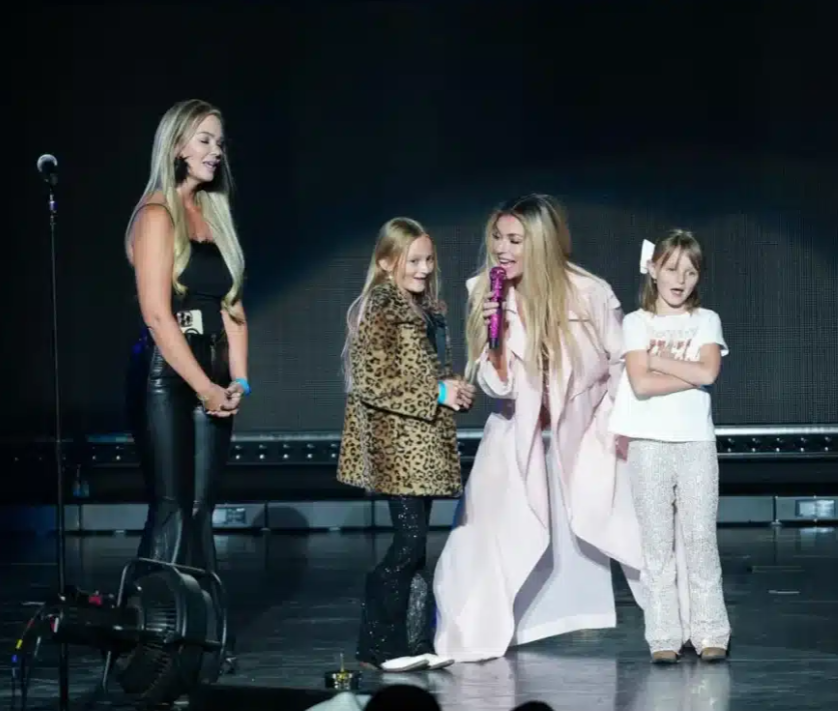
Shania Twain has never been a performer who quietly blends into the background, and her recent Las Vegas residency performance reaffirmed that truth with unmistakable force. As the opening notes filled the venue, audiences were reminded of her enduring vocal strength, polished stage presence, and the unmistakable charisma that has defined her career for decades. Yet it was not only her music that captured attention this time. Clips from the performance quickly circulated online, drawing widespread focus to the bold outfit she wore onstage. Within hours, the visuals ignited passionate discussion across social media platforms, where admiration, confusion, praise, and criticism collided. The reaction revealed far more than opinions about clothing; it exposed lingering discomfort around aging, gender expectations, and the idea that women in entertainment should eventually soften their visibility. Twain’s presence on that stage, confident and unapologetic, challenged those assumptions simply by existing as herself.
At 59, Twain appeared in a metallic bodysuit designed to reflect light dramatically, layered with shimmering textures and styled to amplify movement under concert lighting. On a stage built for spectacle, the outfit functioned as part of the performance rather than a standalone fashion statement. Still, online commentary quickly dissected the look frame by frame. Some viewers expressed surprise, questioning whether the outfit was flattering or appropriate, often couching their criticism in language tied to age rather than artistry. Others made comparisons to past fashion eras or suggested that such styles belonged to younger performers. Yet these reactions stood in stark contrast to the environment of a live concert, where exaggerated silhouettes, reflective materials, and bold design choices are not only common but essential. Stage costumes are meant to be seen from a distance, to move dynamically, and to translate emotion visually, a reality often lost when frozen into screenshots shared online.
Supporters of Twain were equally vocal, pointing out that bold fashion has always been central to her artistic identity. From the earliest days of her career, she has used clothing to challenge norms and expand the visual language of country and pop music. Her iconic leopard-print looks, cropped tops, and genre-blending aesthetics in the 1990s were once controversial themselves, yet they are now remembered as defining moments in pop culture. Fans argued that the Las Vegas outfit was not a departure from her history but a continuation of it, a modern expression of the same fearless energy that made her a global phenomenon. They emphasized that expecting a performer to tone down her self-expression with age ignores the very qualities that made her successful. Twain did not build her legacy by playing it safe, and expecting her to start now misunderstands both her career and her character.
Beyond the fashion itself, much of the conversation centered on Twain’s physical confidence and commanding stage presence. Viewers noted her stamina, her connection with the audience, and her ease moving through a demanding set list. For many fans, the outfit symbolized empowerment rather than provocation, a visible rejection of the notion that women should retreat from boldness as they grow older. In an industry that often rewards men for aging into authority while scrutinizing women for the same passage of time, Twain’s performance became a subtle act of resistance. Her confidence communicated a powerful message: experience does not diminish visibility, and self-assurance does not expire. The enthusiasm from her audience, both in the venue and online, suggested that many people are eager to see artists embrace longevity rather than apologize for it.
As the debate unfolded, it naturally expanded into a broader reflection on societal expectations and cultural double standards. Commentators questioned why male performers wearing unconventional or revealing stage outfits are frequently labeled daring or iconic, while women face criticism framed as concern or judgment. Others observed how nostalgia plays a role in shaping audience reactions, with fans sometimes unconsciously wanting artists to remain frozen in the image they first encountered decades earlier. Twain’s evolution, both visually and musically, disrupts that desire for permanence. She refuses to exist solely as a memory, choosing instead to assert herself as a living, evolving artist. In doing so, she challenges the idea that relevance must look a certain way or conform to an unspoken timeline dictated by age.
Amid the online noise, Twain herself has remained focused on the purpose of her Las Vegas residency, which celebrates the enduring impact of her groundbreaking album Come On Over while affirming her place in the present. The residency is both a retrospective and a declaration of continued creative freedom, blending nostalgia with modern performance elements. With record-breaking album sales, multiple Grammy Awards, and a fanbase spanning generations, her influence is undeniable. The intense reactions to her outfit ultimately underscore her relevance rather than diminish it. Artists who no longer matter rarely provoke debate or inspire strong emotion. Whether viewed as daring, unconventional, or empowering, Twain’s stage look fulfilled its role by amplifying conversation about identity, autonomy, and visibility. In an industry that often pressures women to fade gracefully, Shania Twain continues to stand firmly in the spotlight, reminding the world that confidence, authenticity, and artistic courage do not fade with time—they evolve, deepen, and demand to be seen.