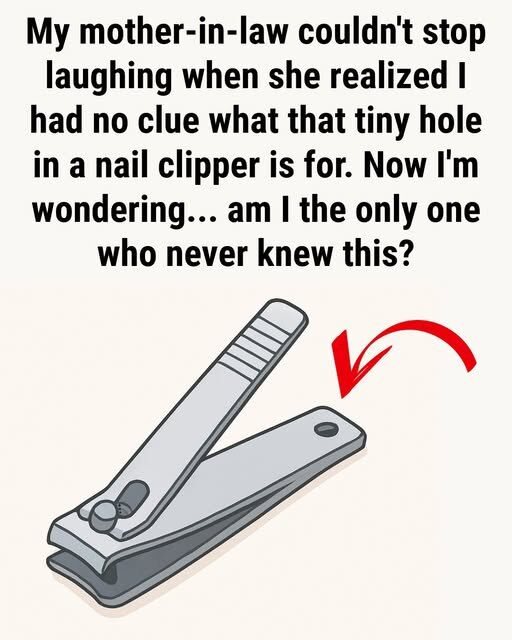
Most people use nail clippers automatically, without ever stopping to examine them closely. They sit quietly in bathroom drawers, toiletry bags, or pockets, performing a simple task so reliably that their design fades into the background of everyday life. Yet if you pause for a moment and really look at a standard nail clipper, one small detail often stands out: the tiny round hole at the end of one handle. It seems insignificant, almost decorative, and many assume it exists for no real reason at all. In reality, that little hole is the result of thoughtful, intentional design. It reflects a time when everyday tools were expected to be practical, portable, and adaptable to many situations. What appears to be a minor feature actually transforms a basic grooming item into a more versatile object, quietly solving problems most users never consciously notice.
The primary and most straightforward purpose of the small round hole is portability. It allows the nail clipper to be attached easily to a keychain, lanyard, hook, or small metal ring. By threading a key ring through the hole, the clipper can travel wherever you go, staying secure and easy to find. This feature is especially useful for people who are frequently on the move, whether commuting, traveling, or heading to the gym. Nail clippers are notorious for disappearing into the depths of bags and drawers, only to be urgently needed when they can’t be found. Attaching one to a keychain or toiletry loop solves that problem instantly. Instead of searching through clutter, the tool is always exactly where you expect it to be, ready for use at a moment’s notice.
Beyond portability, the hole also offers practical advantages in everyday organization. In shared bathrooms or busy households, small items like nail clippers tend to migrate from place to place, often ending up lost or duplicated. Hanging a clipper on a hook, pegboard, or bathroom organizer keeps it visible and accessible while reducing clutter. Some people even use the hole to keep multiple grooming tools together, attaching fingernail and toenail clippers to the same ring so they don’t get separated. Others store a clipper in a first-aid kit or sewing box, knowing it won’t slip loose and vanish among larger items. These small organizational benefits may seem trivial, but over time they add up, reducing frustration and making daily routines smoother and more efficient.
Interestingly, the hole can also improve grip and control during use. While not its original primary function, many users instinctively slip a finger through the hole while trimming their nails, especially when working at an awkward angle. This added point of contact can stabilize the clipper, helping prevent slips and uneven cuts. For people with limited hand strength, reduced dexterity, or shaky hands, this subtle improvement in control can make a noticeable difference. It demonstrates how good design often creates secondary benefits that emerge naturally through use. A feature intended for carrying and storage ends up enhancing comfort and precision as well, without adding complexity or cost.
The presence of the hole also tells a story about the history of personal grooming tools. Early nail clippers, which became widely available in the late 19th and early 20th centuries, were designed during a time when people often carried personal items with them throughout the day. Before modern bathrooms became universal fixtures in homes, grooming tools needed to be portable and durable. The small hole made it easy to attach a clipper to a chain, pocket loop, or bag, ensuring it stayed close at hand. This design choice reflected a broader philosophy of the era: everyday objects should be practical, multifunctional, and built to last. The fact that the hole remains part of modern clipper design shows how effective that original idea was.
Today, the tiny round hole on a nail clipper serves as a quiet reminder that even the simplest tools are often more thoughtfully designed than we realize. It doesn’t demand attention or advertise its usefulness, yet it continues to solve small, everyday problems with ease. In a world increasingly filled with disposable products and unnecessary features, this humble detail stands out as an example of functional simplicity. The next time you pick up a nail clipper, that little hole may no longer seem mysterious or meaningless. Instead, it becomes a symbol of how good design endures—subtle, practical, and quietly improving daily life in ways we often overlook.