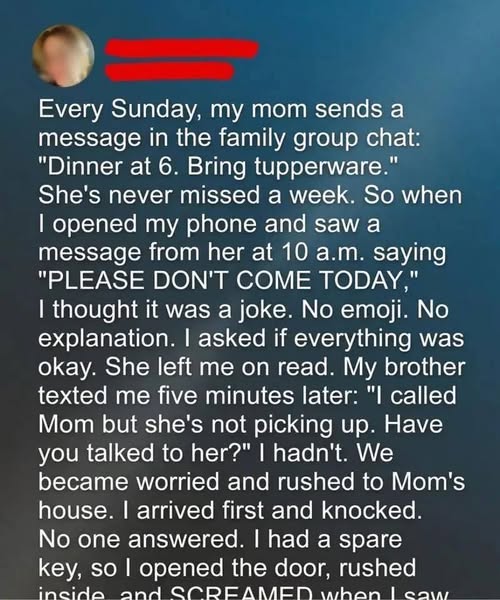
Every family builds its sense of belonging through repetition. Small routines, repeated often enough, harden into rituals that feel unbreakable. In our family, Sunday dinners were the thread that held everything together. They were never elaborate or performative, but they were sacred in their consistency. After my father died three years ago, those dinners became more than a habit; they became my mother’s anchor. Preparing his favorite meals, setting the table exactly as he liked it, and insisting that we gather every week was her way of keeping him present without saying his name too often. It wasn’t denial or resistance to grief—it was devotion. Those evenings carried warmth, old jokes, predictable disagreements, and stretches of silence that felt companionable rather than strained. They reminded us that something solid still existed beneath loss. That is why the text message felt so unsettling. “Please don’t come today.” No explanation, no apology, no follow-up. Just a sentence that cut cleanly through years of routine. My brother felt the shift immediately too. When something dependable breaks without warning, it’s rarely accidental. We didn’t argue about respecting her request. We both knew this wasn’t a preference; it was a signal. We drove over anyway, not out of defiance, but out of instinct, bracing ourselves for a truth that had clearly been waiting for the right moment to surface.
The house looked unchanged when we arrived, which somehow made the tension sharper. The porch light glowed warmly, the same signal she always used to say she was waiting for us. But when we knocked, the door stayed closed. I used my spare key, calling out as we stepped inside, our voices sounding too loud in the stillness. The air felt thick, as though the house itself was holding onto something unsaid. That’s when I saw him at the kitchen table. His back was turned, but the familiarity of his posture stopped me cold. The way he leaned forward slightly, the angle of his shoulders, even the tension in his neck stirred something painful and disorienting. For a fleeting moment, grief twisted into disbelief, as if my mind was trying to resurrect someone it knew was gone. My brother froze behind me. Our mother stood at the counter, slicing vegetables with careful precision, her movements controlled but brittle. She didn’t turn around. She didn’t ask why we were there. She only said, quietly, “Why didn’t you listen?” The man turned then, and while his face was not identical, the resemblance was undeniable. It felt like seeing a version of the past altered just enough to be disturbing, familiar enough to hurt but different enough to destabilize everything I thought I understood about our family.
What followed was not explosive or dramatic. There were no raised voices, no accusations hurled across the room. Instead, the truth emerged slowly, painfully, as though it had grown heavy over time and finally collapsed under its own weight. My mother sat down, her composure unraveling, and told us something she had carried for decades. The man was James—our father’s twin brother. The words felt unreal, like they belonged to another family’s story, not ours. She explained that she had known James before she ever met our father. Their relationship had been intense, consuming, and emotionally volatile. Then, without warning, James disappeared. No explanation. No goodbye. Just absence. She was left with unanswered questions and a quiet sense of abandonment that shaped her in ways she didn’t fully understand at the time. When she later met our father, she found something entirely different: steadiness, patience, and a love that didn’t demand proof or drama. Years into their marriage, she told him the truth. My father forgave her, but the wound his brother had caused ran deeper for him. James’s disappearance was not just personal betrayal—it was a fracture of trust that he could not mend. He asked for one thing in return for his forgiveness: that James never be part of our lives. My mother agreed, believing she was protecting the family she had built, even if it meant sealing away a painful chapter of her past.
James had returned now, decades too late, carrying regret rather than entitlement. He did not defend himself or offer excuses. He spoke quietly, acknowledging the damage he had caused and the years he could never recover. He said he only wanted to be seen, to be forgiven, to know the family that had grown without him. Listening to him stirred emotions I hadn’t expected. There was a flicker of compassion for a man who had lived with his mistakes for so long, but it collided with something stronger—loyalty. Loyalty to a father who had shown up every day, who loved us without conditions, and who asked only for honesty and distance from the brother who hurt him. My brother and I didn’t need words to understand each other. We chose boundaries over reconciliation, not out of anger, but out of respect for the life we were given. We told James he couldn’t stay. He nodded, accepting the decision without protest. He didn’t argue, didn’t plead. He simply stood, thanked us for listening, and left. The door closing behind him felt final, not dramatic, just weighted with everything that would never be resolved.
After he left, my mother broke down in a way I had never seen before. The kind of tears that come from carrying too much for too long, from managing love, guilt, and fear in isolation. She apologized repeatedly—not for loving our father, but for letting the past intrude on the present. We reminded her of the truth that mattered most: our childhood had been full, safe, and deeply loved. Whatever secrets existed before us had not diminished the life our father built with us. That night, the carefully prepared meal was forgotten. We ordered pizza, sat around the kitchen in mismatched chairs, and passed mugs of tea between us. The conversation drifted through memories, grief, and reassurance. There was sadness, but there was also relief. Spoken truth, even painful truth, has a way of loosening its grip. It stops echoing in isolation and becomes something shared, something survivable.
Before we left, my mother sent a message to the family group chat. Her tone was lighter than it had been all day. “Dinner next Sunday, 6 p.m. Bring containers. And maybe a hug.” In that moment, I understood something essential about families. They are not defined by the secrets they keep or the mistakes that precede them. They are defined by how they respond when truth finally surfaces—by the decision to hold each other closer instead of letting the past fracture what still stands. Silence can preserve peace for a while, but truth, when met with care, creates something stronger: understanding, resilience, and the courage to move forward without pretending the past never existed.