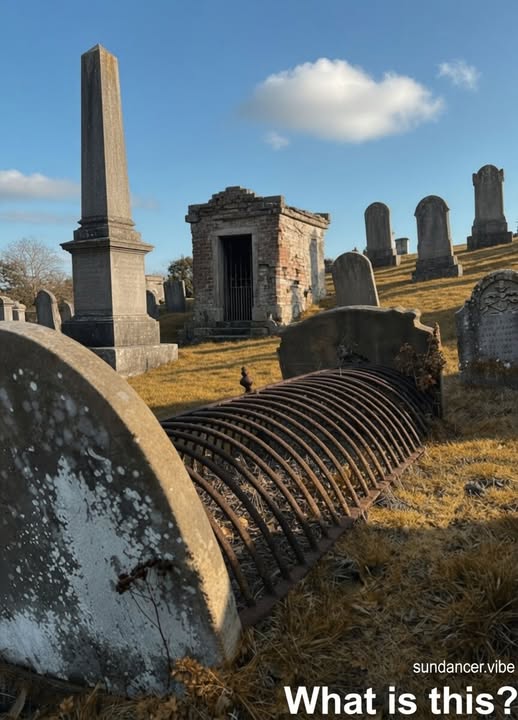
Across old churchyards in parts of Europe, especially throughout Scotland and northern England, visitors sometimes notice strange iron structures resting above centuries-old graves. At first glance, they appear unsettling — like cages abandoned by another era or fragments of forgotten machinery slowly surrendering to rust and time. Some resemble heavy iron grills laid across the earth, while others look almost like locked metal vaults built directly over burial plots. To modern eyes, these structures can seem mysterious, even frightening. Yet they were once considered necessary protections in a world gripped by fear, scientific transformation, and a disturbing underground trade involving the dead.
These objects were known as mortsafes.
Far from decorative monuments, mortsafes served a practical and deeply emotional purpose. They were designed to stop grave robbers from stealing newly buried bodies. During the late eighteenth and early nineteenth centuries, grave robbing became one of the most alarming social problems in many European communities. Families feared that loved ones buried with prayers and dignity might be dug up only days later and sold illegally to medical schools for anatomical study.
The existence of mortsafes reveals far more than an unusual burial custom. They tell the story of a society caught between scientific progress and moral outrage, between the growing needs of medicine and the ancient human belief that the dead deserved peace. These iron devices stand today as silent reminders of a period when communities fought to defend graves against an expanding black market fueled by the advancement of medical science.
To understand why mortsafes existed, it is important to understand the world that created them.
By the eighteenth century, medicine in Europe was changing rapidly. Universities and medical schools were beginning to place increasing emphasis on anatomy, surgery, and direct observation of the human body. Doctors and surgeons realized that true medical understanding could not rely entirely on ancient theories or textbooks. They needed practical experience. Students needed to examine real human bodies to understand muscles, bones, organs, disease, and injury.
This shift helped medicine progress dramatically. Surgical techniques improved. Knowledge of anatomy became more accurate. Physicians slowly moved away from superstition and toward evidence-based understanding. Yet this scientific progress created a major problem: there were not enough legal bodies available for study.
In many countries, the law allowed only the bodies of executed criminals to be dissected for medical education. Authorities believed this added an additional punishment beyond death itself. However, executions were relatively limited, while medical schools continued growing rapidly. As more students entered universities, demand for cadavers increased far beyond legal supply.
This shortage created an opportunity for criminals.
An illegal trade soon emerged in which grave robbers, often called “resurrectionists,” secretly exhumed newly buried bodies and sold them to anatomists and medical institutions. The term “resurrectionist” sounded less brutal than “grave robber,” but the reality remained horrifying for grieving families. Under cover of darkness, gangs would enter cemeteries shortly after funerals, dig into fresh graves, remove bodies, and transport them to buyers willing to pay substantial amounts.
The trade became surprisingly organized in some regions. Resurrectionists learned how to work quickly and quietly. Rather than fully emptying graves, they often dug only near the head of the coffin, broke open the lid, and removed the body using ropes. Clothing and jewelry were usually left behind because stealing personal property carried harsher legal penalties than stealing a corpse. In many legal systems at the time, the dead themselves were not considered property, creating strange loopholes that made prosecution difficult.
For ordinary families, this legal technicality offered little comfort.
The emotional horror of grave robbing spread rapidly through communities. Newspapers published stories about stolen bodies and disturbed graves. Rumors traveled from village to village. Families who had recently buried loved ones began fearing that the grave might not remain untouched even for a single night.
This fear became especially intense near major medical schools in cities such as Edinburgh, Glasgow, London, and Dublin, where demand for cadavers was extremely high. Cemeteries located close to teaching hospitals became prime targets. Poorer graves were particularly vulnerable because they often lacked strong coffins, guards, or protective measures.
As anxiety grew, communities began searching for ways to defend the dead.
One solution was the mortsafe.
A mortsafe was essentially a protective iron covering placed over a grave immediately after burial. Designs varied widely depending on region, wealth, and local craftsmanship. Some consisted of heavy iron plates secured with locks. Others resembled cage-like frameworks anchored into stone or earth. Many included thick bars that prevented digging from above while making access to the coffin nearly impossible without considerable time and noise.
The key purpose of the mortsafe was temporary protection.
Resurrectionists wanted fresh bodies because decomposition quickly reduced their usefulness for anatomical study. After several weeks underground, the value of a corpse declined dramatically. Families therefore needed protection only during the vulnerable early period after burial. Once decomposition advanced sufficiently, the mortsafe could be removed and reused for another grave.
Because iron was expensive, mortsafes were rarely owned permanently by individual families. Instead, many communities shared them collectively. Churches, burial societies, or local associations managed the devices and rotated them among newly buried graves as needed. In some villages, elaborate systems developed to ensure fair access to protection.
This cooperative approach reflected how widespread the fear had become. Protecting graves was not merely a private concern but a communal responsibility. Entire neighborhoods sometimes participated in efforts to guard cemeteries against intruders.
Mortsafes were only one part of these defensive measures.
In many places, watch houses were built overlooking graveyards so guards could patrol during the night. Volunteers or hired watchmen sat for hours in cold darkness listening for suspicious movement. Some cemeteries installed bells or alarm systems attached to graves. Iron fencing became more common around burial grounds. Dogs were occasionally used as deterrents. Armed patrols even appeared in regions where grave robbing was particularly severe.
The lengths people went to protect graves demonstrate how deeply burial mattered within society.
For many communities, disturbing a corpse was not merely criminal; it was morally and spiritually horrifying. Burial rituals represented love, closure, and respect. Families believed that the dead deserved peace. Interfering with a grave violated not only physical remains but emotional bonds between the living and the deceased.
Religious beliefs intensified these fears. Across Christian Europe, many people believed bodily integrity carried spiritual importance connected to resurrection and the afterlife. Although theologians debated the exact nature of resurrection, ordinary people often felt deeply uncomfortable with the idea of dismemberment or anatomical dissection. The thought that a loved one’s body might be cut apart on a medical table after burial felt profoundly disturbing.
Class divisions also shaped public reaction.
Ironically, the wealthy usually enjoyed greater protection from grave robbers because they could afford stronger coffins, private mausoleums, guarded cemeteries, or expensive mortsafes. Poorer communities often suffered most from body theft. Some medical institutions preferred bodies from impoverished neighborhoods because families lacked the resources to maintain prolonged grave protection.
This created additional resentment toward anatomists and surgeons, who were sometimes viewed with suspicion or hostility. Medical schools depended on bodies for education, yet many citizens believed the institutions benefited from exploitation of the vulnerable. Public trust in medicine became strained by rumors, secrecy, and occasional scandals.
No scandal demonstrated this tension more dramatically than the infamous Burke and Hare murders in Edinburgh during the late 1820s.
Unlike ordinary resurrectionists who stole already buried bodies, William Burke and William Hare murdered vulnerable individuals and sold the corpses directly to an anatomist. Their crimes shocked Britain and horrified the public because they revealed how valuable cadavers had become within medical education. The case intensified fears that scientific demand for bodies had created dangerous moral corruption.
Public outrage following such scandals increased pressure on governments to reform the system.
Authorities gradually recognized that harsh restrictions on legal cadavers had unintentionally encouraged criminal activity. As long as medical schools desperately needed bodies while lawful supply remained limited, grave robbing would continue.
This realization led to significant legal reforms during the nineteenth century.
One of the most important developments was the passage of laws allowing unclaimed bodies from hospitals, workhouses, and charitable institutions to be used for anatomical study under regulated conditions. In Britain, the Anatomy Act of 1832 transformed how medical schools obtained cadavers. Although controversial, the law aimed to reduce reliance on grave robbing by creating legal supply channels.
Over time, body donation systems also emerged, gradually introducing concepts of consent and ethical medical practice. While early reforms still disproportionately affected the poor, they eventually helped establish more transparent relationships between medicine and society.
As legal access to cadavers improved, the economic incentive for grave robbing declined.
By the mid-to-late nineteenth century, resurrectionists became far less common. Medical schools increasingly relied on regulated anatomical programs rather than illegal body traders. Cemeteries no longer required constant guarding. Mortsafes slowly disappeared from regular use.
Many were dismantled, melted down, or forgotten.
Yet some survived.
Today, surviving mortsafes remain scattered across historic churchyards, especially in Scotland. Visitors encountering them often feel immediate curiosity because the structures look unlike ordinary grave markers. Their heavy iron forms evoke both protection and imprisonment, reflecting the anxieties of the age that created them.
Historians now view mortsafes as valuable cultural artifacts that reveal the intersection of science, law, religion, and social fear during a period of rapid change.
They symbolize a unique moment in history when technological and medical advancement moved faster than ethical systems could adapt. Society desperately wanted better medicine, safer surgery, and improved understanding of disease. Yet many people were unwilling to accept the human cost of anatomical education as it existed at the time.
This tension between progress and morality appears repeatedly throughout history.
Scientific breakthroughs often create ethical dilemmas before laws and cultural norms fully catch up. In the era of grave robbing, the problem centered on cadavers and consent. Communities responded not through abstract philosophical debate alone but through practical action — building iron barriers over graves and organizing night watches to defend the dead.
Mortsafes therefore represent more than anti-theft devices. They reveal how ordinary people confronted a crisis using the tools available to them.
They also remind us that history is filled with unexpected solutions born from fear and necessity. What seems strange today once provided genuine comfort. For grieving families, the heavy iron cage over a grave symbolized love, vigilance, and protection. It reassured them that the deceased would remain undisturbed during a vulnerable time.
At the same moment, however, the existence of mortsafes reflected broader failures within society. They existed because legal systems had not adequately balanced scientific need with public trust. Communities resorted to iron defenses because institutions had not yet found humane, ethical ways to support medical education.
Eventually, reforms changed that balance.
Modern medicine still relies heavily on anatomical study, but contemporary systems emphasize consent, regulation, and ethical oversight. Body donation programs now allow individuals to choose whether their remains contribute to science. Medical schools operate within legal frameworks designed to respect dignity while advancing education.
The world that created mortsafes has largely vanished, yet the questions raised by that era remain surprisingly relevant.
How should society balance scientific advancement with moral responsibility? What happens when innovation moves faster than public trust? How do communities respond when institutions fail to protect deeply held values?
These questions continue appearing in debates over medical ethics, biotechnology, artificial intelligence, genetic engineering, and countless other fields. The details change, but the underlying tension between progress and human dignity persists across generations.
Standing before an old mortsafe today, one can sense that history physically embedded in iron and stone.
The rusted bars are reminders of grieving families who feared losing loved ones even after burial. They reflect communities that organized together against a hidden nighttime threat. They represent doctors struggling to expand medical knowledge within flawed legal systems. They embody the complicated relationship between scientific necessity and ethical limits.
Most importantly, mortsafes reveal something timeless about human nature.
Even in periods of rapid social transformation, people continue seeking ways to preserve dignity for the dead and peace for the living. The iron covers resting quietly in old graveyards were never simply objects. They were emotional responses to uncertainty, grief, and the fear that the boundaries of respect were disappearing in a changing world.
Although the resurrectionists are gone and the medical practices of that era have evolved, the mortsafe remains a powerful historical symbol. It reminds us that behind every strange artifact lies a deeply human story — one shaped by anxiety, compassion, conflict, and the enduring desire to protect those who can no longer protect themselves.