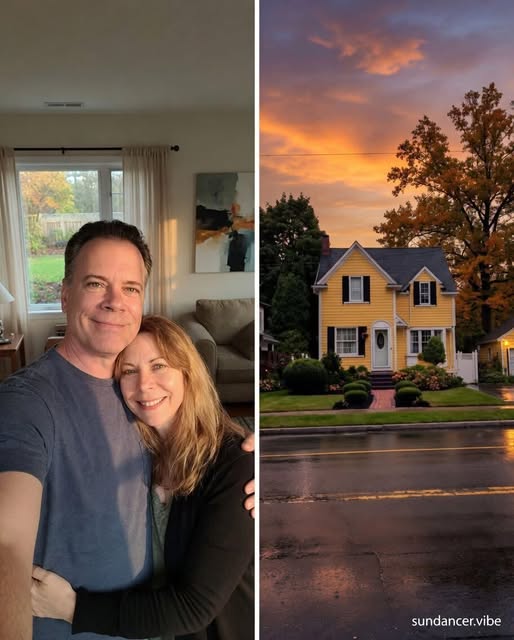
The porch light glowed softly against the late afternoon sky, casting warm yellow light across the cracked brick steps beneath my feet.
For several long seconds, I couldn’t speak.
The woman standing in front of me looked calm—too calm for someone who had just opened the door to her brother’s stunned wife after decades of secrecy.
“I’m sorry,” I finally whispered. “Did you say sister?”
She nodded slowly.
“My name is Evelyn.”
The name meant nothing to me.
And somehow, that hurt more than if it had.
Because after twenty-eight years of marriage, there should not have been entire people connected to my husband that I knew absolutely nothing about.
I stared at her, trying to find traces of Daniel in her face.
And suddenly I did.
The eyes. The shape of the jaw. The slight crease near the mouth when she looked uncertain.
It was there.
Hidden in plain sight.
“Oh my God,” I said quietly.
Evelyn stepped aside slightly.
“You should sit down.”
I followed her deeper into the house almost automatically, like my body had stopped waiting for permission from my thoughts.
The living room felt frozen in another decade.
Not outdated exactly. Just preserved.
Bookshelves lined the walls. Framed photographs filled nearly every surface. A piano stood near the window with sheet music still resting on top. The entire house carried the kind of silence that belongs to places holding old grief.
Evelyn motioned toward the couch.
I sat carefully, still gripping my purse in both hands.
“I don’t understand any of this,” I admitted.
“I know.”
She disappeared briefly into the kitchen and returned with two cups of tea.
The normalcy of the gesture almost overwhelmed me.
As if this were an ordinary conversation. As if people discovered secret houses and hidden siblings every day.
“When were you planning to tell me?” I asked suddenly.
Her expression shifted.
“I wasn’t.”
The honesty of the answer hit harder than an excuse would have.
“Why not?”
Evelyn lowered herself slowly into the chair across from me.
“Because Daniel asked me not to.”
My chest tightened again.
The room suddenly felt smaller.
“How long has this been going on?”
“This house?” she asked carefully. “Since our parents died.”
“No,” I said sharply. “The lying.”
She looked down at her tea.
“Almost thirty years.”
The number landed between us heavily.
Thirty years.
Nearly our entire marriage.
I leaned back against the couch, staring toward the framed photographs on the wall.
One showed Daniel as a teenager beside Evelyn and two older adults I assumed were their parents. Another showed him standing on the same front porch years younger, smiling in a way I hadn’t seen in a long time.
And suddenly, something inside me shifted.
Not anger exactly.
Something stranger.
Disorientation.
Because the man in those photographs wasn’t a stranger. He was my husband.
But there were entire chapters of him I had apparently never been allowed to read.
“Why?” I asked quietly.
Evelyn hesitated.
Then she stood.
“Come with me.”
I followed her down a narrow hallway toward the back of the house.
At the end was a small room with faded wallpaper and a single bed beneath the window.
The moment I stepped inside, I understood.
Medical equipment.
Not much. But enough.
A folded wheelchair near the closet. Medication bottles lined neatly on a shelf. Handrails attached beside the bed.
I looked at Evelyn.
“He takes care of you?”
She smiled faintly.
“Not in the way you think.”
Then she sat carefully on the edge of the bed.
“I have multiple sclerosis,” she explained softly. “I was diagnosed years ago. It got worse after our parents died.”
I stayed silent.
“Daniel helped me keep the house after their deaths. He paid for repairs when I couldn’t. Medical bills too, sometimes.”
I felt dizzy again.
“But why hide you?”
Evelyn looked toward the window.
“Because of his father.”
I frowned.
“What does that mean?”
She exhaled slowly.
“Our father was difficult. Proud. Extremely controlling. When Daniel married you, there was a huge fight in the family.”
I blinked.
“A fight about me?”
“He didn’t approve of Daniel leaving town. He believed family responsibility came before everything else. Especially me.”
A strange chill moved through me.
“What responsibility?”
Evelyn’s eyes lowered.
“I was already sick.”
The silence after those words felt enormous.
Suddenly pieces started forming faster than I could process them.
The unexplained absences. The vague business trips. The nights Daniel seemed emotionally distant afterward. The moments he disappeared into himself without explanation.
I had always assumed stress. Work. Aging. Life.
But now another possibility stood in front of me.
He had been carrying two worlds.
Not another marriage. Not another family.
But another burden. Another identity. Another version of himself.
“You really didn’t know,” Evelyn said quietly.
It wasn’t a question.
I shook my head slowly.
“No.”
She looked genuinely saddened by that.
“I told him many times that secrets become heavier with time.”
I laughed once under my breath.
“He should’ve listened to you.”
Evelyn gave a small smile.
“He rarely listens to anyone.”
That almost sounded familiar enough to break the tension.
Almost.
I walked slowly back toward the living room.
On the mantle above the fireplace sat another photograph.
This one stopped me cold.
Daniel. Me. Our children.
A copy of a family photo taken nearly fifteen years earlier.
I turned immediately.
“You have pictures of us here?”
“Of course,” Evelyn said.
I stared at her.
“He talks about you constantly.”
My throat tightened unexpectedly.
“He does?”
“All the time.”
I looked back at the photo.
There was something deeply unsettling about discovering you existed inside a hidden life you never knew about.
Not erased. Not replaced.
Included.
And somehow that made everything more emotionally complicated.
Because betrayal is easier to process when it comes wrapped in cruelty.
This wasn’t cruelty.
It was secrecy tangled together with shame, obligation, grief, and fear.
And that complexity made it harder to know where to place my anger.
The front door suddenly opened.
Both of us turned.
Daniel froze immediately when he saw me standing there.
The color drained from his face so quickly it frightened me.
For one long second, nobody moved.
Then he whispered my name.
“Madison.”
I had imagined this moment during the drive.
In every version, I yelled. Demanded answers. Cried.
But standing there now, I felt strangely calm.
Not because I wasn’t hurt. But because the truth was no longer what I thought it was.
And that changed the shape of everything.
“You own another house,” I said.
Daniel shut the door slowly behind him.
“Yes.”
“You have a sister I’ve never met.”
His eyes closed briefly.
“Yes.”
“Why?”
The word cracked more than I intended.
Daniel looked toward Evelyn for a moment before turning back to me.
“I didn’t know how to explain it anymore.”
I stared at him in disbelief.
“That’s your answer?”
“No,” he said quickly. “It’s just the truth.”
The exhaustion in his voice caught me off guard.
Not defensive exhaustion. The kind people carry when they’ve been holding something too long.
“I was going to tell you eventually.”
I laughed sharply.
“When? Our fiftieth anniversary?”
He flinched.
Evelyn quietly stood.
“I’ll give you both space.”
“No,” I said immediately.
She paused.
“I think you should stay.”
Because suddenly I realized something important.
For decades, Daniel had controlled the flow of truth between us.
I didn’t want another private version of events.
I wanted reality.
Complete reality.
Daniel loosened his tie slowly and sat down heavily in the chair across from me.
For the first time since I’d known him, he looked old.
Not physically. Emotionally.
“I met you during the worst period of my life,” he began quietly.
I folded my arms tightly.
“My mother had just died. Evelyn had already started getting sick. My father became impossible after the diagnosis.”
Evelyn looked down silently.
“He blamed me for wanting a future outside this house,” Daniel continued. “Every time I visited, he’d remind me that family responsibility came first.”
“And apparently he was right,” I said.
Daniel’s face tightened.
“No. That’s not what I mean.”
“Then explain it to me.”
He rubbed both hands over his face slowly.
“At first, I hid the house because I thought it would create tension. Then years passed, and it became harder to explain why I’d hidden it in the first place.”
“That’s not enough.”
“I know.”
“Twenty-eight years, Daniel.”
“I know.”
The repetition irritated me.
“You keep saying that like it fixes something.”
“It doesn’t,” he replied softly.
Silence filled the room.
Outside, evening had begun settling across the neighborhood. Shadows stretched longer across the walls.
Finally, Evelyn spoke.
“He was ashamed.”
Daniel looked at her immediately.
“Evelyn—”
“No,” she said gently. “You’ve hidden long enough.”
I watched both of them carefully.
“Ashamed of what?”
Daniel stared at the floor.
“My father believed illness was weakness. He treated Evelyn like a burden for years. After our mother died, things became worse.”
Evelyn’s expression remained calm, but I could see old pain moving quietly beneath it.
“I promised myself I would take care of her,” Daniel continued. “But I also wanted a life with you. I didn’t know how to balance both worlds.”
“You could’ve told me the truth.”
“I know that now.”
“No,” I said firmly. “You knew it then too.”
That landed.
Daniel looked at me with something close to heartbreak.
And for the first time since arriving, tears finally stung my eyes.
Because this was the part nobody talks about when trust breaks.
It’s not always betrayal in the dramatic sense.
Sometimes it’s the realization that someone decided, repeatedly, you could not handle the full truth.
That they built entire walls inside the marriage without your knowledge.
And even if the reasons sound understandable later, the loneliness of that exclusion still hurts.
“I would have helped,” I whispered.
Daniel’s face crumpled slightly.
“I know.”
“No,” I said again, tears slipping free now. “You don’t understand. I would have loved her too.”
The room became completely silent.
Evelyn looked away quickly.
Daniel covered his mouth with one hand.
For a moment nobody spoke.
Then, quietly, Evelyn stood and walked toward a cabinet near the dining room.
She opened a drawer and returned with a stack of envelopes tied together with ribbon.
She placed them carefully on the table in front of me.
“What are these?” I asked.
“Letters.”
I looked at Daniel.
His expression changed immediately.
“You kept those?”
“All of them,” Evelyn replied.
Confused, I untied the ribbon slowly.
The top envelope had my name written across it.
In Daniel’s handwriting.
My heart stopped.
“What is this?”
Daniel looked suddenly uncomfortable.
“They were letters I wrote over the years,” he admitted.
“To me?”
He nodded.
“But you never sent them.”
“No.”
I opened one carefully.
Inside was a dated letter from nearly nineteen years earlier.
Madison,
I almost told you tonight. You were asleep on the couch after helping the kids with homework, and I sat there thinking about how much easier my life would feel if I stopped carrying everything alone. But every year I wait makes the truth uglier. And now I’m terrified that honesty would look too much like betrayal.
My vision blurred.
I opened another.
This one described Evelyn’s worsening condition. Another described guilt after lying about weekend trips. Another talked about watching me plan family holidays while he secretly worried about hospital bills.
Letter after letter. Year after year.
A hidden emotional life documented but never shared.
By the time I looked up again, I felt emotionally exhausted.
“You wrote all these instead of talking to me?”
Daniel’s eyes filled.
“I didn’t know how to stop being afraid.”
The honesty of the answer broke something open inside me.
Not forgiveness. Not yet.
But understanding.
And understanding is dangerous sometimes.
Because once you understand someone’s fear, anger becomes more complicated to hold onto.
I leaned back slowly, clutching the letters in my lap.
“I don’t know what happens now,” I admitted.
Daniel nodded.
“I know.”
For once, the words sounded sincere instead of empty.
Night had fully settled outside by then. The porch light glowed warmly through the front window.
Evelyn moved quietly into the kitchen to give us privacy.
Daniel and I sat across from each other in silence.
Twenty-eight years together. Two children. Thousands of ordinary days.
And somehow, even after all that time, there were still hidden rooms inside each other we had never entered.
“I keep thinking about something,” I said finally.
Daniel looked up.
“What?”
“How lonely you must have been.”
His expression broke completely then.
Not dramatically. Not loudly.
Just quietly.
The kind of grief that comes from being fully seen after years of hiding.
“I made it lonely,” he whispered.
“Yes,” I said honestly. “You did.”
The truth sat painfully between us.
But unlike the secrets, at least it was finally shared.
Hours later, when I finally stood to leave, Daniel walked me to the door.
Neither of us knew exactly what the future looked like anymore.
Marriage after betrayal—especially complicated betrayal—doesn’t heal in a single conversation.
Sometimes trust doesn’t shatter all at once. Sometimes it erodes quietly beneath years of omission.
But standing there beneath the porch light, I realized something unexpected.
The truth had hurt. Deeply.
Yet strangely, it also felt like the first honest thing between us in years.
“I need time,” I said softly.
Daniel nodded immediately.
“I know.”
This time, the words carried no defense. Only acceptance.
Before I stepped off the porch, Evelyn touched my arm gently.
“I really am sorry,” she said.
I looked at her carefully.
None of this was entirely her fault.
She had lived inside the secrecy too.
“Me too,” I replied.
Then I walked toward my car.
The night air felt cold against my skin.
As I pulled away from the curb, I glanced once in the rearview mirror.
Daniel still stood beneath the porch light watching me leave.
And for the first time in twenty-eight years, I realized marriage is not just built on love.
It is built on access.
Access to each other’s fears. Truths. Families. Failures. Grief.
Without that access, even long marriages can slowly become carefully managed performances.
I didn’t know yet whether ours could survive what I had learned.
But I did know one thing.
The life I thought I understood had changed forever the moment I opened that attic box.
Not because my husband had another woman. Not because he had stopped loving me.
But because he had spent decades deciding which parts of himself I was allowed to know.
And once you discover that kind of silence inside a marriage, nothing ever feels quite the same again.
As I drove home through the dark streets, the letters rested on the passenger seat beside me.
Twenty years of words never spoken. Twenty years of fear disguised as protection.
And somewhere beneath all the hurt was a truth I still wasn’t ready to fully face.
Sometimes the people we trust most are not hiding because they want to deceive us.
Sometimes they are hiding because they are terrified that if we see every part of them clearly, we might finally decide to leave.
The tragedy is that secrecy often creates the very distance people are trying so desperately to avoid.
And by the time honesty finally arrives, entire lifetimes have already passed in silence.