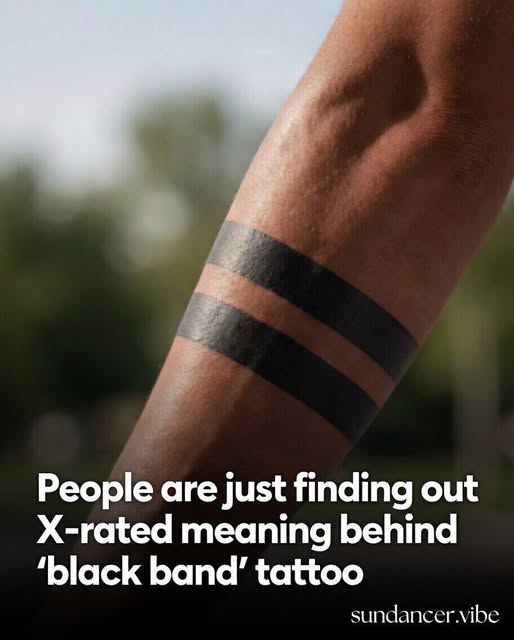
The black band tattoo is one of the simplest and most recognizable designs in body art, yet its meaning has recently become the subject of widespread debate. Traditionally, it consists of a solid stripe—or multiple stripes—wrapped around the arm, wrist, or leg, often chosen for its clean aesthetic and symbolic flexibility. For decades, people have used this design to represent deeply personal ideas such as strength, continuity, grief, or transformation. In many cases, it functions as a quiet form of expression rather than a bold statement, allowing the wearer to carry meaning without needing to explain it. However, the rise of viral discussions online has disrupted that understanding, introducing new interpretations that have surprised many. What was once considered a straightforward design has now become layered with speculation, raising questions about whether something so minimal can truly hold such varied and, at times, conflicting meanings. This shift has caused people to reconsider not just the tattoo itself, but the broader way symbols are interpreted in a connected world.
The recent surge in attention can be traced to social media posts suggesting that black band tattoos may serve as coded signals within certain communities. According to these claims, the number of bands, their thickness, or their placement on the body could indicate specific meanings that are not immediately visible to the general public. These interpretations quickly spread, fueled by curiosity and the appeal of uncovering something hidden. For many, the idea that a common tattoo might carry secret significance was both intriguing and unsettling. It introduced the possibility that a design chosen for personal or aesthetic reasons could be interpreted in ways the wearer never intended. At the same time, skepticism emerged just as quickly. Critics questioned the validity of these claims, pointing out the lack of consistent evidence and the tendency of online platforms to amplify ideas without verification. This tension between belief and doubt became a defining feature of the conversation, illustrating how quickly narratives can take shape when they resonate with a wide audience.
Understanding this debate requires looking beyond the present moment and considering the historical role of tattoos as symbols of identity. Throughout history, tattoos have been used to signify belonging, status, or shared experience, particularly within groups that relied on subtle forms of communication. In some cases, symbols did carry meanings that were understood only by those within a specific community. This context helps explain why the idea of coded tattoos feels plausible to many people. However, it also highlights the limitations of applying that framework universally. A design like the black band tattoo is not confined to a single culture or group; it appears across different societies, each with its own interpretations and traditions. As a result, assigning a singular or definitive meaning to it becomes problematic. The same visual element can represent entirely different ideas depending on who is wearing it and why. This complexity is often lost in viral discussions, where simplified explanations tend to spread more easily than nuanced ones.
Voices from within various communities, including LGBTQ+ individuals and tattoo professionals, have played an important role in clarifying this issue. Many acknowledge that coded symbolism has existed, particularly in periods when open expression was limited or unsafe. At the same time, they emphasize that it is inaccurate to assume that every instance of a particular design carries those meanings. For example, a black band tattoo worn as a memorial for a loved one has a completely different significance than one chosen for purely aesthetic reasons. Tattoo artists, who work closely with clients and understand the diversity of motivations behind body art, often stress that meaning is deeply personal. They caution against making assumptions based solely on appearance, noting that doing so can lead to misunderstandings and unnecessary judgment. Their perspective reinforces the idea that tattoos are not universal languages but individual expressions shaped by personal experience.
The role of the internet in shaping this conversation cannot be overlooked. Social media platforms are designed to prioritize content that captures attention, and the idea of a “hidden meaning” fits perfectly within that dynamic. When a post suggests that something familiar might hold a secret, it invites engagement, discussion, and speculation. As more people interact with the content, it gains visibility, creating the impression that the claim is more widely accepted than it actually is. This process can blur the line between fact and interpretation, especially when information is shared without context. In the case of black band tattoos, the viral narrative has taken on a life of its own, influencing how people perceive the design regardless of its original intent. This phenomenon reflects a broader trend in digital culture, where meaning is not only created but also reshaped in real time through collective interaction.
For many individuals, the debate has prompted a period of reflection. Some have begun to question how their own tattoos might be perceived by others, even if those perceptions are inaccurate. Others have rejected the viral claims entirely, choosing to focus on the personal significance of their designs rather than external interpretations. This range of responses highlights an important truth: meaning is not fixed. It evolves based on context, perspective, and communication. A tattoo that represents resilience for one person may be seen differently by someone else, and both interpretations can exist simultaneously without invalidating each other. This dynamic underscores the complexity of visual symbols in a world where information spreads rapidly and audiences are diverse.
Ultimately, the black band tattoo serves as a powerful example of how simple designs can become complex through interpretation. What began as a minimalist form of expression has transformed into a topic of global चर्चा, not because its meaning has changed universally, but because the way people talk about it has. The viral debate has revealed more about human behavior than about the tattoo itself. It shows how quickly assumptions can form, how easily narratives can spread, and how deeply people care about understanding the symbols they encounter. At the same time, it reinforces the importance of context and intention. Without them, even the most straightforward design can become a source of confusion. As the conversation continues, it is likely that the black band tattoo will return to its original role for many—a personal, flexible symbol defined not by public opinion, but by the individual who wears it.