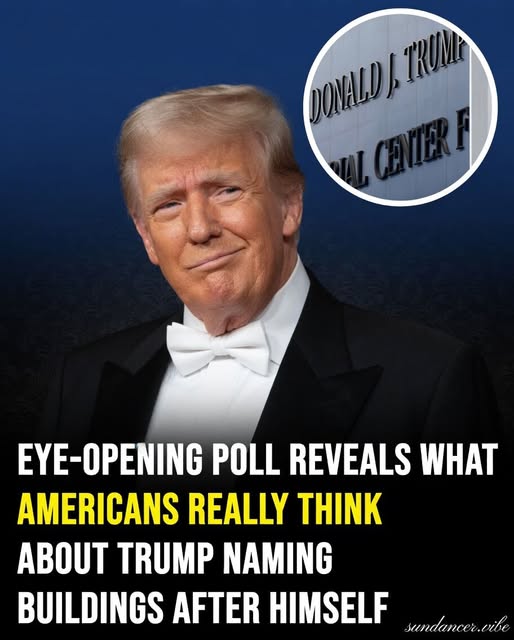
The question of how leaders are remembered has always been part of the American story, but recent discussions surrounding Donald Trump have brought that issue into sharper focus. Reports that some institutions and public landmarks could bear his name have sparked a wider debate that extends beyond politics into culture and national identity. A newly released poll suggests that Americans are not only divided on the issue, but also uncertain about the broader principles involved. At the center of the discussion is a fundamental question: when should a public figure be honored in a lasting and highly visible way? Trump’s long-standing association with branding—placing his name prominently on hotels, towers, and golf courses—makes the situation particularly distinctive. While that approach is widely accepted in private business, applying it to public institutions introduces a different kind of scrutiny. Public buildings are not personal assets; they are shared spaces meant to reflect collective values. For many, that distinction makes the idea of naming them after a sitting or recently serving political figure feel more complicated.
One of the most widely discussed examples in this debate involves the John F. Kennedy Center for the Performing Arts, an institution originally established as a living memorial to John F. Kennedy. The possibility of altering or adding to such a name has generated strong reactions. For critics, the center represents more than a building—it embodies a specific historical legacy and a set of ideals tied to a moment in American history. Changing that identity, even partially, raises concerns about preserving meaning and continuity. Supporters, however, argue that institutions are not static. They evolve over time, and recognizing contemporary figures can reflect ongoing contributions to public life. This disagreement highlights a deeper tension between preserving historical memory and adapting to the present.
The poll itself offers insight into how Americans view these questions. Conducted among thousands of respondents nationwide, it found that roughly half believe naming government buildings after Trump is not appropriate under any circumstances. Even more revealing is how opinions shift when timing is considered. Only a small percentage support naming buildings after a president while they are still in office. A slightly larger, though still minority, group is open to such recognition after a presidency ends. This suggests that many people are less concerned with the individual involved and more focused on the timing. There is a widespread sense that history requires distance—that legacies should be evaluated over time rather than defined in the moment. This preference reflects a broader cultural instinct toward caution when it comes to permanent public honors.
Political affiliation plays a role in shaping these views, but it does not fully determine them. Among Republicans, there is generally more openness to honoring Trump, particularly after his time in office. However, support within that group is not unanimous. Some express hesitation or uncertainty, indicating that the issue goes beyond simple party loyalty. Among Democrats, opposition is significantly stronger, with many rejecting the idea entirely. Yet even here, the reasoning often extends beyond partisan disagreement. Concerns about precedent are common, with many arguing that allowing current leaders to influence naming decisions could lead to a cycle of politically motivated changes. Over time, this could undermine the stability and meaning of public spaces, turning them into reflections of shifting political power rather than enduring symbols of shared history.
Another key aspect of the debate involves the difference between public and private naming practices. Trump’s business career was built in part on the strategic use of his name as a brand, a model that has been widely accepted in the private sector. Buildings bearing his name are familiar in cities around the world, representing a form of identity tied directly to ownership and investment. But public institutions operate under different expectations. They are funded and used by the broader population, meaning their names carry symbolic weight beyond individual recognition. For many Americans, this raises questions about representation. A name on a public building is not just a label—it is a statement about values, history, and collective identity. In a politically polarized environment, such decisions can feel less like neutral honors and more like expressions of influence.
Supporters of naming buildings after Trump argue that these concerns may be overstated. They point out that many public landmarks already bear the names of political figures, including presidents and lawmakers. From this perspective, Trump’s impact on American politics is significant enough to merit recognition, regardless of differing opinions about his leadership. Some also believe that honoring individuals during their lifetime allows them to witness and appreciate that recognition, rather than leaving it entirely to future generations. In this view, such decisions are not acts of self-promotion but acknowledgments of influence and achievement in real time.
Critics, however, remain cautious. They emphasize the difference between recognition that emerges organically over time and recognition that appears to be shaped by those currently in power. The concern is not only about Trump as an individual but about the precedent such actions might establish. If leaders can influence the naming of public buildings in their own honor, it could encourage similar efforts in the future, leading to frequent changes that reflect political cycles rather than enduring consensus. There is also the question of longevity. Names chosen during periods of strong political sentiment may not hold the same meaning decades later, potentially leading to further debate and even reversals.
Ultimately, the poll reveals a nation engaged in a deeper reflection about how it chooses to honor its leaders. While opinions vary widely, there is a noticeable preference for caution and deliberation. Many Americans appear to value the idea that recognition should be earned over time, shaped by historical perspective rather than immediate influence. In that sense, the debate is less about any one individual and more about how a country defines its shared memory. The outcome of this discussion remains uncertain, but one thing is clear: when it comes to naming the spaces that represent a nation, timing, intention, and collective agreement carry significant weight.