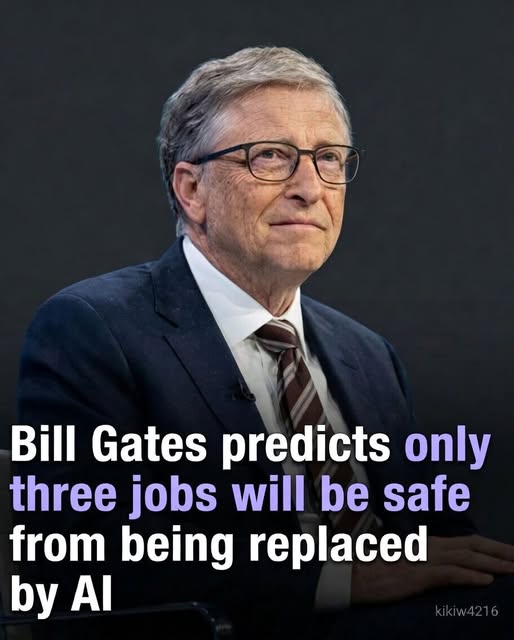
As artificial intelligence continues to reshape the global workforce, insights from Bill Gates offer a compelling look into what the future of careers may hold. Rather than framing AI as a force that will simply replace human workers, Gates consistently emphasizes its role as a transformative tool—one that will redefine how work is done rather than eliminate it entirely. The shift is already underway, with AI systems becoming capable of handling repetitive, data-heavy, and even moderately complex tasks across industries. This evolution is forcing both individuals and organizations to rethink what skills truly matter. According to Gates, the careers that will thrive are those that embrace collaboration between humans and machines, where technology enhances productivity but human insight, judgment, and emotional intelligence remain central. The concept he often refers to as “free intelligence” reflects a world in which advanced knowledge becomes widely accessible, fundamentally altering traditional barriers to expertise.
One of the most significant areas of transformation is healthcare, where AI is rapidly advancing in diagnostic accuracy, treatment planning, and patient monitoring. Systems can now analyze medical images, detect anomalies, and suggest possible diagnoses with remarkable precision. However, Gates highlights that the future of medicine will not be dominated by machines alone. Instead, the most successful professionals will be those who combine AI-driven insights with human empathy and ethical decision-making. A doctor may rely on AI to process vast amounts of data quickly, but the ability to communicate with patients, understand their fears, and provide reassurance remains uniquely human. This blend of technological efficiency and emotional intelligence will define excellence in the field. Similarly, roles such as nursing, caregiving, and mental health support are expected to grow in importance, as they rely heavily on human connection—something AI cannot authentically replicate.
Education is another domain poised for dramatic change. Gates envisions a future where AI-powered tutors provide highly personalized learning experiences, adapting in real time to each student’s needs, pace, and style. This could significantly reduce educational inequality by making high-quality instruction accessible to a broader population. However, this does not diminish the role of teachers—in fact, it elevates it. Educators will shift from being primary sources of information to facilitators of deeper learning, focusing on mentorship, creativity, and social development. The teachers who thrive will be those who inspire curiosity, encourage collaboration, and guide students in developing critical thinking skills. AI may deliver content efficiently, but it cannot replace the human ability to motivate, nurture, and build meaningful relationships within the classroom.
In the business world, the impact of AI is already visible, particularly in roles involving data analysis, customer service, and routine administrative tasks. Automation is streamlining operations, reducing the need for repetitive work, and increasing efficiency across sectors. Yet, Gates points out that this shift is simultaneously creating new opportunities. Careers centered around managing, interpreting, and applying AI systems are on the rise. Professionals who can bridge the gap between technology and real-world application—such as AI strategists, ethics specialists, and user experience designers—will be in high demand. Adaptability emerges as a critical trait; workers must be willing to continuously learn and evolve as technology advances. Those who resist change risk obsolescence, while those who embrace AI as a partner will find themselves at the forefront of innovation.
Creative industries also present an interesting paradox in the age of AI. Tools can now generate text, images, music, and even video content, raising questions about the role of human creators. Gates suggests that rather than diminishing creativity, AI has the potential to amplify it. By handling repetitive or technical aspects of production, AI frees artists, writers, and designers to focus on originality, storytelling, and emotional depth. The value of creative work will increasingly lie in its authenticity and cultural relevance—qualities that stem from human experience. Professionals who learn to use AI as a collaborative tool, directing and refining its output, will lead the next wave of creative innovation. This shift requires not only technical familiarity but also a strong sense of artistic identity and vision.
Looking ahead, Gates maintains a cautiously optimistic perspective on the future of work. He acknowledges the challenges, including job displacement and the need for large-scale retraining, but he also sees immense potential for growth and improvement in quality of life. He advocates for investment in education systems that prioritize critical thinking, emotional intelligence, and digital literacy, preparing individuals for a world where change is constant. Governments and organizations, he argues, must play a role in supporting workers through this transition, ensuring that opportunities created by AI are accessible to all. For individuals, the message is clear: focus on developing skills that machines cannot easily replicate—empathy, leadership, complex problem-solving, and the ability to navigate uncertainty.
Ultimately, the age of AI is not about competition between humans and machines but about collaboration. The careers that will thrive are those that leverage the strengths of both—combining computational power with human creativity and compassion. As Bill Gates often emphasizes, the goal is not merely to adapt to technological change but to shape it in ways that benefit society as a whole. Those who approach this new era with curiosity, resilience, and a willingness to learn will not only remain relevant but will help define the future of work itself.