The day had been designed with intention, shaped carefully around the idea that meaningful celebrations are built not from extravagance, but from attention. Every detail had been considered—small enough not to overwhelm, but deliberate enough to matter. The decorations reflected a balance between warmth and simplicity, the kind that invites people to relax rather than perform. The food was arranged thoughtfully, each dish chosen not just for taste but for familiarity, something that would connect guests to shared memories. Even the music had been curated with quiet care, a mix of songs tied to different chapters of his life. It wasn’t just about marking another year; it was about honoring the life we had built together, the routines, the laughter, the unspoken understanding that comes from time spent side by side. I wanted the evening to feel effortless, even though I knew how much effort had gone into creating that illusion.
When the doorbell rang earlier that afternoon, it didn’t feel significant. In the middle of preparation, interruptions become part of the rhythm. I assumed it was a guest arriving early or perhaps a delivery I had forgotten about. When I opened the door and saw the box in the courier’s hands, my reaction was mild confusion rather than suspicion. I hadn’t ordered a cake, but in the rush of organizing everything else, it seemed entirely possible that someone else had. A friend, a relative, someone who wanted to contribute to the celebration in their own way. I accepted it without much thought, signed for it, and placed it in the refrigerator. At the time, it felt like a small, pleasant addition—something that would simply become part of the evening without needing explanation.
As guests began to arrive, the house filled with energy exactly as I had hoped it would. Conversations layered over one another, laughter moved easily between rooms, and the atmosphere settled into something comfortable and familiar. My husband seemed genuinely happy, moving between groups, accepting congratulations, sharing stories. There was nothing outwardly unusual, nothing that suggested the evening would become anything other than what it was meant to be. For a while, I allowed myself to relax into that feeling, to believe in the version of reality unfolding around me. It’s easy, in moments like that, to trust what you see—to accept the surface of things as truth when everything appears aligned.
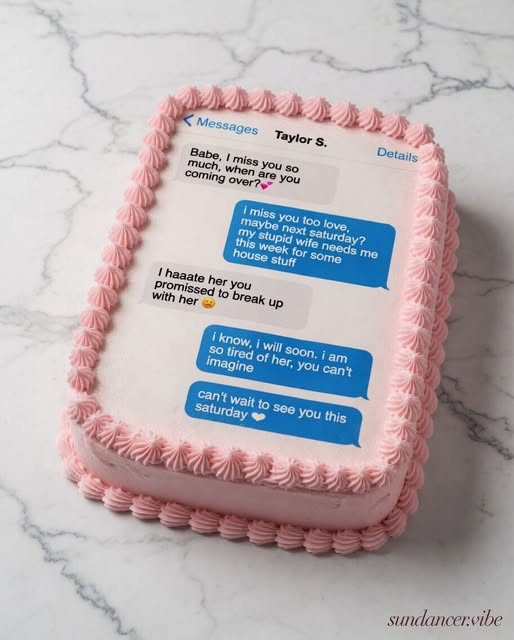
The shift came quietly, almost imperceptibly at first, when I went to retrieve the cake. The kitchen felt separate from the rest of the house, quieter, removed from the noise and movement of the gathering. I opened the box expecting something ordinary—a decorative message, perhaps a simple design. What I saw instead didn’t register immediately. It took a few seconds for my mind to catch up with my eyes, to understand that the image on the cake wasn’t decorative at all. It was specific. Intentional. A printed screenshot of text messages, laid out in frosting with a precision that made them impossible to ignore. As I read, the words began to take shape, forming a narrative I had never been meant to see. The tone, the familiarity, the intimacy—it all pointed to something undeniable. This wasn’t ambiguous. It wasn’t something that could be explained away with context or misunderstanding. It was clear in a way that left no room for interpretation.
Walking back into the room felt like crossing an invisible line. I was still holding the cake, but everything about the moment had changed. The atmosphere responded before I said anything. Conversations slowed, attention shifted, and the subtle cues people pick up on—expression, posture, silence—began to ripple outward. When I placed the cake on the table, the room seemed to pause entirely. At first, there was confusion as people tried to understand what they were seeing. Then recognition began to spread, followed by a silence so complete it felt almost physical. My husband’s reaction—or lack of one—spoke louder than anything else. There were no immediate denials, no attempts to dismiss what was in front of him. Just stillness. And in that stillness, something settled into place for me. Not just the realization of what had happened, but the understanding that there was no going back to what the evening had been meant to represent.
What followed wasn’t dramatic in the way people might expect. There was no shouting, no chaotic confrontation. Instead, there was a shift—a quiet but definitive movement from uncertainty to clarity. I spoke, not from a place of performance or anger, but from a point that had already crossed into acceptance of what I was seeing. The room, once filled with celebration, became something else entirely—a space where truth had surfaced without invitation and could no longer be contained. Guests began to leave, slowly at first, then all at once, each person carrying their own interpretation of what they had witnessed. The decorations remained, unchanged but now disconnected from their purpose. The music, once background, felt intrusive. The entire setting had been transformed, not physically, but emotionally.
Later, when the house was quiet again, the weight of the moment became clearer. Not heavier, just clearer. What had happened wasn’t just an exposure of betrayal—it was the end of a version of reality I had believed in. There was no immediate resolution, no simple way to repair or redefine what had been revealed. But there was something else, something that felt steady beneath the uncertainty. A sense of understanding that hadn’t been there before. The kind that doesn’t come from explanations or apologies, but from seeing something as it truly is, without distortion. The future remained uncertain, but the past had shifted into focus. And in that clarity, even without answers, there was a beginning of something new—not built on what had been assumed, but on what had finally been seen.