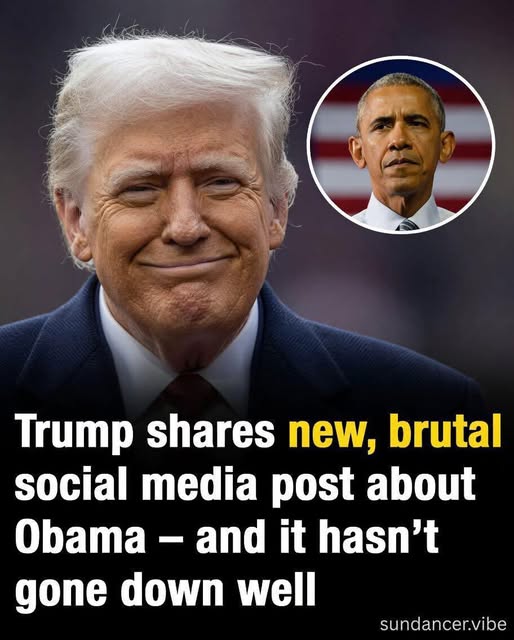
The modern political arena has evolved into a fast-moving digital ecosystem where narratives are no longer shaped solely by press briefings, legislative debates, or traditional media coverage, but increasingly by the immediacy and virality of social media content. In this environment, a single post can dominate public attention, reframing political conversations within hours and reaching millions without mediation. A recent example involves Donald Trump sharing a meme that references a past moment involving Barack Obama, reigniting a rivalry that has lingered in the public imagination for over a decade. The meme, simple in structure but loaded with implication, presents a visual contrast between the two figures alongside a caption suggesting that Trump has proven critics wrong. While such content may appear trivial at first glance, its rapid spread and the intensity of reactions it provoked reveal deeper truths about how political messaging now operates. The lines between communication, entertainment, and provocation have blurred, and leaders increasingly engage audiences in ways that are as performative as they are strategic.
The relationship between Trump and Obama has long served as a symbolic representation of contrasting political ideologies, leadership styles, and cultural narratives within the United States. Their differences extend beyond policy into tone, rhetoric, and the manner in which they connect with the public. One of the most frequently revisited moments in their shared history is the 2011 White House Correspondents’ Dinner, where Obama made remarks that many interpreted as pointed criticism of Trump. Over time, that moment has taken on a near-mythical status in political storytelling, often cited as a turning point or motivator, whether accurately or not. Trump’s repeated references to Obama’s past skepticism about his political prospects appear to be part of a broader effort to reshape that narrative, emphasizing themes of vindication and resilience. By revisiting these moments through modern platforms like social media, Trump effectively keeps the rivalry alive, allowing it to evolve with each new post and reaction. This ongoing dynamic illustrates how political figures can repurpose history to reinforce their current messaging, turning past interactions into tools for present influence.
At the same time, the broader context surrounding such posts often becomes entangled with speculation, exaggeration, and, in some cases, misinformation. Claims of new conflicts, dramatic confrontations, or symbolic gestures can quickly circulate alongside the original content, amplifying its reach but also complicating its interpretation. In the case of this particular meme, discussions extended beyond the image itself to include references to unrelated controversies, including alleged tensions with global figures and criticism over the use of AI-generated imagery. These additional elements, whether grounded in fact or not, contribute to a layered narrative that is difficult for audiences to fully verify in real time. The speed at which information travels online often outpaces the mechanisms designed to confirm its accuracy, creating a landscape where perception can overshadow reality. This phenomenon underscores a central challenge of the digital age: the need for critical engagement with content that is designed to provoke immediate emotional responses rather than thoughtful analysis.
The use of memes as a political communication tool reflects a broader shift in how messages are crafted and consumed. Memes are inherently flexible, capable of conveying humor, sarcasm, criticism, or endorsement within a compact and highly shareable format. When political figures adopt this medium, they tap into a cultural language that resonates with a wide audience, particularly younger users who are accustomed to rapid, visually driven communication. However, this approach also introduces ambiguity. A meme can be interpreted in multiple ways, allowing its creator to engage with controversy while maintaining a degree of plausible deniability. Supporters may view such posts as clever or relatable, appreciating the informal tone and perceived authenticity. Critics, on the other hand, may see them as dismissive of serious issues or indicative of a focus on personal rivalries rather than substantive governance. This divergence in interpretation highlights the complex role memes play in shaping political discourse, functioning simultaneously as tools of engagement and sources of division.
Another critical aspect of this situation is the role of social media algorithms in amplifying certain types of content. Platforms are designed to prioritize engagement, meaning that posts generating strong reactions—whether positive or negative—are more likely to be seen by a wider audience. This creates an incentive structure that rewards provocative or emotionally charged material, potentially at the expense of nuanced discussion. When high-profile figures like Trump share content that references longstanding rivalries or controversial topics, it is almost guaranteed to attract attention, fueling cycles of reaction and counter-reaction. These dynamics can deepen political polarization, as individuals are more likely to encounter content that reinforces their existing beliefs while dismissing opposing perspectives. Over time, this can lead to a fragmented public sphere in which consensus becomes increasingly difficult to achieve. The meme in question, while seemingly a small piece of content, fits into this larger pattern, illustrating how individual posts can contribute to broader trends in political communication and public engagement.
Ultimately, the resurgence of the Trump-Obama rivalry through a viral social media post serves as a microcosm of the evolving nature of politics in the digital era. It demonstrates how personal history, media strategy, and technological infrastructure intersect to shape the narratives that define public discourse. While such moments may appear fleeting, their impact can be lasting, influencing how leaders are perceived and how political conversations unfold. The blending of entertainment and politics raises important questions about the future of democratic engagement: whether these methods make leaders more accessible and relatable, or whether they risk reducing complex issues to spectacles driven by attention rather than substance. As audiences continue to navigate this environment, the responsibility to critically assess the content they encounter becomes increasingly important. In a world where a meme can carry as much weight as a policy statement, understanding the mechanisms behind its creation and spread is essential for maintaining an informed and balanced perspective on the ever-changing landscape of modern politics.