The morning of my seventy-third birthday arrived quietly, almost reverently, as though the world itself understood that something within me had already shifted long before the day began. I woke before the sun, not out of habit alone but because sleep had gradually loosened its hold on me over the years. Age does that—it replaces deep rest with reflection, and dreams with memory. The house was still, wrapped in that fragile silence that exists just before dawn. It was a silence I had come to cherish, because in it, there were no expectations, no performances, no roles to fulfill.
I moved through my routine with care. Coffee first—always coffee. The slow, deliberate process grounded me: the measured scoop, the gentle pour of hot water, the aroma that filled the kitchen like something familiar and reassuring. Rituals, I had learned, are not just habits; they are anchors. And after fifty years of marriage, I needed anchors more than ever.
Fifty years. Half a century of shared space, shared decisions, shared identity. Or at least, that’s what it looked like from the outside.
I stepped into the garden, watching as the early light touched the edges of petals and leaves. It was beautiful in a way that required nothing from me. No effort. No compromise. For a brief moment, I allowed myself to believe that this day might pass gently. That it might be just another quiet milestone—acknowledged, perhaps celebrated, but not disrupted.
But life, I had come to understand, does not often grant such simplicity—especially not when truth has been waiting patiently beneath the surface.
By midday, the house had transformed. The stillness was replaced with voices, laughter, movement. Guests arrived in waves—friends, acquaintances, people who had known us for years, decades even. They brought gifts, smiles, assumptions. They saw me as they always had: composed, gracious, dependable. The wife.
That role had become second nature over the years. I wore it effortlessly, like a well-tailored garment that concealed more than it revealed. I smiled, greeted, hosted. I listened to stories I had heard before, laughed at jokes that required no thought. It was all part of the performance.
Because that’s what it had become. A performance.
And somewhere beneath that polished exterior, something within me had already changed. Not recently. Not suddenly. It had been shifting quietly for months, perhaps longer. A slow unraveling of illusion. A steady awakening to something I could no longer ignore.
By late afternoon, the energy in the garden had shifted. There was an anticipation in the air, subtle but unmistakable. People gathered closer, drinks in hand, voices lowering just enough to suggest that something was about to happen.
He moved among them with confidence. My husband. A man who had spent a lifetime curating his image, shaping perceptions, controlling narratives. His gestures were practiced, his laughter just slightly exaggerated. I watched him the way one watches something from a distance—no longer emotionally tethered, but still aware.
When he finally called for attention, tapping his glass, the sound cut cleanly through the crowd. Conversations faded. Faces turned. Silence settled.
I did not move.
His speech began predictably. Praise, gratitude, carefully chosen words that painted a picture of a life well lived. He called me his “rock,” his “partner,” his “foundation.” The audience responded exactly as expected—smiles, nods, quiet approval.
Foundation.
That word echoed in my mind, not as a compliment, but as a realization. Foundations support. They bear weight. They are essential—but they are rarely seen, rarely celebrated. They exist so that something else can stand tall.
And then, his tone shifted.
It was subtle, but unmistakable. There was a new energy in his voice—something closer to pride than affection. Something self-congratulatory. He spoke of honesty. Of truth. Of making things right.
And in that moment, I understood exactly what he was about to do.
Not because I was surprised.
But because I already knew.
Months earlier, I had discovered the truth. Not through confrontation, not through confession, but through quiet observation and undeniable evidence. Another life. Another woman. Children. Years—decades—of deception woven seamlessly alongside the life I believed we shared.
At the time, I had imagined many possible reactions. Anger. Grief. Public confrontation. But what I felt instead was something far more unsettling.
Clarity.
And clarity, I learned, does not demand immediate action. It waits. It observes. It prepares.
So when he introduced her—when he brought his hidden life into the open as though unveiling something noble—I felt none of the shock he expected. No collapse. No tears.
Only stillness.
She stood beside him with quiet confidence, as though she had always belonged there. Their children lingered behind, uncertain but present, living proof of everything he had concealed.
The crowd shifted uneasily. Confusion rippled through the guests. Was this bravery? Honesty? Or something else entirely?
He spoke as though he were offering a gift—sharing his “full life,” inviting acceptance, expecting admiration for his supposed courage.
But what he failed to understand was this: truth, when revealed without accountability, is not honesty. It is performance.
And this was his final act.
As he spoke, I watched him—not with anger, but with detachment. The kind of detachment that only comes when something inside you has already let go.
This was his moment. The peak of his illusion.
And I had already prepared mine.
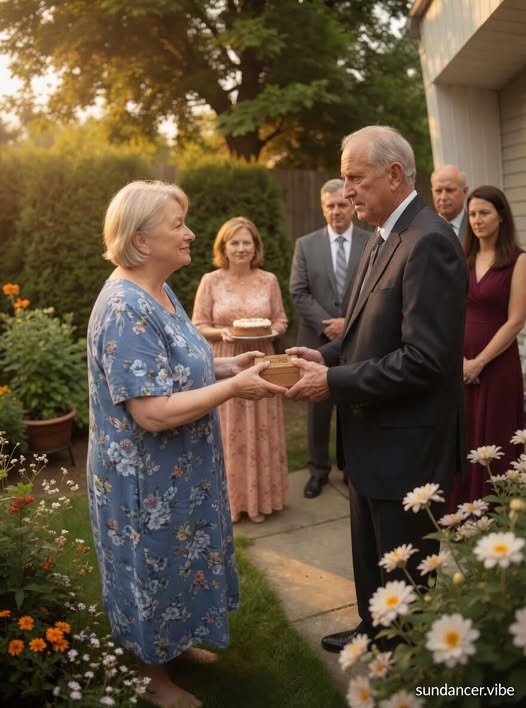
When I stepped forward, the room seemed to narrow around me. The noise faded. The movement stilled. In my hands, I carried a small, elegantly wrapped box.
It looked simple. Unremarkable.
But it contained everything.
I approached him calmly, meeting his gaze with a steadiness that caused the first flicker of uncertainty to appear in his expression.
“I knew,” I said.
Two words. No accusation. No explanation.
Just truth.
He hesitated before taking the box. That hesitation—small, almost imperceptible—was the first crack in the image he had so carefully constructed.
As he opened it, the air seemed to thicken. The room held its breath.
Inside was a key.
And beneath it, a document.
Not symbolic.
Legal.
Final.
Divorce papers. Financial records. Proof of ownership. Evidence that everything he believed he controlled—everything he assumed was his—had, in fact, never belonged to him in the way he imagined.
The house. The accounts. The assets.
All legally secured.
All beyond his reach.
His hands trembled.
And in that moment, the illusion collapsed.
There was no dramatic outburst. No shouting. No spectacle. Just silence.
A heavy, undeniable silence that forced everyone present to confront what had just happened.
I did not linger.
I turned away—not in defeat, but in completion.
Inside the house, I spoke calmly, thanking the guests, ending the gathering with a quiet finality that required no explanation.
It was over.
Not just the party.
The performance.
The marriage.
The version of myself that had existed within it.
In the days that followed, everything unfolded exactly as it needed to. Access revoked. Accounts secured. Legal boundaries enforced.
He reached out, of course.
First with anger.
Then disbelief.
Then something that resembled desperation.
But by then, his voice no longer carried weight. It no longer reached me in the way it once had.
Because something far more important had already taken place.
I had stepped out of the role I had occupied for fifty years.
And I did not step back into it.
The most profound change was not external. It was internal.
Freedom, I discovered, is not loud. It does not announce itself with celebration or triumph. It arrives quietly—in the absence of tension, in the stillness that follows release.
Weeks later, in a space that belonged entirely to me, I began to rediscover something I had long forgotten.
Myself.
There was no dramatic reinvention. No sudden transformation. Just a gradual return to authenticity. I arranged my surroundings based on comfort, not expectation. I allowed silence to exist without filling it. I made choices without consulting anyone else’s needs or opinions.
And in that simplicity, there was something extraordinary.
Peace.
Occasionally, I heard fragments of what became of him. Of the life he had tried to merge, sustain, justify.
But those stories felt distant. Detached. Like echoes from a chapter that no longer belonged to me.
Because the truth is, what mattered was never what he lost.
It was what I reclaimed.
At seventy-three, I finally understood something that had taken me a lifetime to learn:
Being a foundation is not the same as being whole.
And for the first time in my life, I was no longer holding up someone else’s world.
I was standing—fully, independently—within my own.