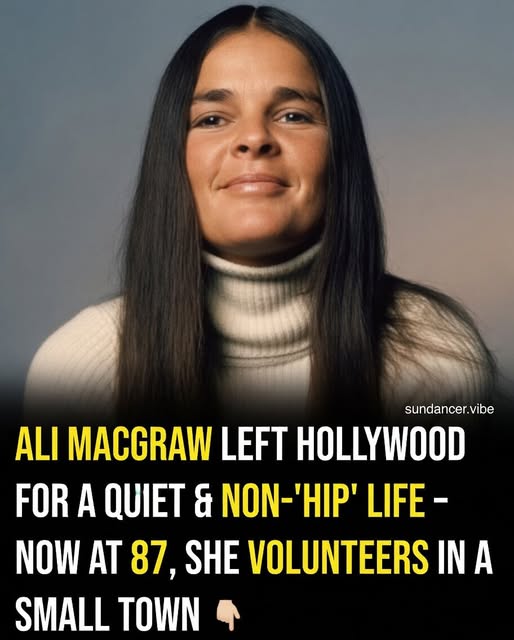
The life of Ali MacGraw unfolds like a film script filled with dramatic turns, emotional intensity, and a quiet, reflective resolution that few could have predicted during her meteoric rise to fame. Best known for her unforgettable role in Love Story, MacGraw became one of the most recognizable faces of the early 1970s almost overnight. Yet behind that sudden stardom lay a far more complex journey—one shaped by love, sacrifice, identity struggles, and ultimately, a deeply personal reinvention that led her away from Hollywood and toward a life of meaning on her own terms.
Born Elizabeth Alice MacGraw in 1939 in Pound Ridge, her early life bore little resemblance to the glamorous image she would later project on screen. She grew up in a household defined by creativity but shadowed by instability. Both of her parents were artists, immersed in their craft, yet financial security was often elusive. Her father, in particular, carried emotional scars from his own upbringing—traumas that manifested in unpredictable and sometimes troubling behavior. The environment was not one of ease or comfort. Privacy was scarce, emotional safety even more so.
These early experiences, however, shaped MacGraw in profound ways. They instilled in her a resilience that would later prove essential, as well as a deep sensitivity that became part of her screen presence. She learned early how to observe, adapt, and endure—qualities that would quietly support her through the many transitions of her life.
Education became her first avenue toward independence. Attending Wellesley College, she began to carve out her own identity, separate from the instability of her childhood. There, she developed both intellectual confidence and a clearer sense of direction. Yet even then, her path was not firmly set. Like many young people, she was searching—for purpose, for belonging, for a way to channel her creative instincts.
Her entry into the professional world began not in film, but in fashion. Working at Harper’s Bazaar in New York, she started behind the scenes in a demanding, often unforgiving environment. The job required discipline and attention to detail, and while it was far from glamorous, it provided valuable exposure to the creative industries. Over time, her striking appearance and natural elegance did not go unnoticed. Photographers began to see in her something more than an assistant—something that translated powerfully in front of the camera.
What followed was a gradual but significant transition. MacGraw moved into styling and modeling, stepping into the visual narrative rather than simply helping shape it. Her presence—at once understated and captivating—resonated in an era that was redefining beauty standards. She wasn’t conventional in the traditional Hollywood sense, but that very difference made her compelling.
The shift from modeling to acting came almost organically. Opportunities emerged, and she took them, initially without any grand ambition of becoming a major film star. Her early role in Goodbye, Columbus brought her critical attention and earned her a Golden Globe for Most Promising Newcomer. It was a strong beginning—but nothing could have prepared her for what came next.
In 1970, Love Story was released, and everything changed.
Her portrayal of Jenny Cavilleri—a young woman whose love story is both deeply romantic and tragically brief—struck a chord with audiences around the world. The film became a cultural phenomenon, remembered for its emotional impact and iconic line, “Love means never having to say you’re sorry.” MacGraw’s performance was central to its success. She brought a natural authenticity to the role, blending vulnerability with strength in a way that felt genuine rather than theatrical.
Almost overnight, she became a global star. The role earned her an Academy Award nomination and solidified her place in Hollywood’s elite. Fame, however, arrived with a force that few can truly anticipate. It reshaped her life—her relationships, her opportunities, and her sense of self.
At the height of this success, her personal life began to take center stage in ways that would profoundly influence her career. Her marriage to Robert Evans, a powerful Hollywood producer, seemed to align perfectly with her rising status. Together, they represented a kind of cinematic ideal—talent and influence united. They welcomed a son, Josh Evans, and for a time, it appeared that MacGraw had achieved both professional and personal fulfillment.
But life, like the films she starred in, rarely follows a predictable script.
During the filming of The Getaway, she met Steve McQueen—a figure whose charisma and intensity were legendary. Their connection was immediate and undeniable. What followed was a passionate relationship that quickly became one of Hollywood’s most talked-about romances.
Choosing to be with McQueen required a significant sacrifice. She left her marriage to Evans and stepped into a new life defined by love—but also by compromise. McQueen, known for his strong personality and independent spirit, brought a different dynamic into her world. While deeply magnetic, he was also controlling and often insecure within the relationship.
Over time, those dynamics began to shape MacGraw’s life in ways that limited her independence. McQueen discouraged her from continuing her acting career, expressing a desire for her to remain at home. For someone who had just reached the peak of her professional success, this was no small decision. Yet driven by love and perhaps a hope for stability, she stepped away from Hollywood.
At first, the choice may have felt like a meaningful commitment. But as time passed, the cost became clearer. The relationship grew strained under the weight of expectations, jealousy, and control. MacGraw found herself increasingly isolated—not just from her career, but from a sense of personal autonomy.
By 1978, the marriage had reached its breaking point, and the couple divorced. The end of the relationship marked not only an emotional loss but also a turning point in her life. Years away from the industry had altered her professional trajectory, and Hollywood itself had changed. The opportunities that once came easily were now far more elusive.
She attempted to return to acting, appearing in films such as Players and Just Tell Me What You Want, but the magic of her earlier success proved difficult to recapture. The industry’s shifting dynamics—particularly its limited roles for women over a certain age—added another layer of challenge.
Beyond professional setbacks, MacGraw faced deeply personal struggles. The loss of identity, combined with the emotional aftermath of her relationship, led her into a difficult period marked by alcohol dependence. It was a coping mechanism that, over time, created more problems than it solved. She later spoke candidly about this phase of her life, acknowledging the impact it had not only on herself but also on those closest to her, including her son.
In 1986, recognizing the need for change, she made a decisive move. She entered the Betty Ford Center, beginning a journey of recovery that would reshape her life. It was not an instant transformation, but it marked the beginning of a new chapter—one rooted in self-awareness, accountability, and healing.
Around the same time, another life-altering event occurred. A wildfire destroyed her home in Los Angeles, forcing her to confront yet another loss. But within that loss lay an unexpected opportunity—a chance to start over in a different environment.
She chose to leave Los Angeles behind.
Eventually, she settled in Tesuque, a quiet community far removed from the noise and pressure of Hollywood. There, life unfolded at a slower, more deliberate pace. The move was not just geographical—it was deeply symbolic. It represented a shift in priorities, a redefinition of success, and a commitment to living authentically.
In the years that followed, MacGraw built a life centered on balance and purpose. While she never completely abandoned acting—appearing occasionally in projects like The Winds of War and later returning to the stage—her focus expanded beyond the screen. She explored interests such as yoga, design, and community involvement, finding fulfillment in areas that were not tied to fame or public validation.
Her relationship with her son remained a central anchor. Over time, she rebuilt and strengthened those bonds, reflecting a deeper understanding of what truly mattered. She also became more open about her journey, sharing her experiences in a way that resonated with others facing similar struggles.
Looking back, her story defies the typical narrative of Hollywood rise and fall. It is not simply about success gained and lost, but about transformation. It is about the courage to make choices—even flawed ones—and the resilience to learn from them.
Ali MacGraw did not disappear when she left the spotlight. Instead, she redefined her place in the world. She moved from a life shaped by external expectations to one guided by internal clarity. In doing so, she found something that fame alone could never provide—a sense of peace rooted in authenticity, self-acceptance, and the quiet strength of having lived fully, with all its imperfections.
Her journey serves as a reminder that reinvention is always possible, and that sometimes, stepping away from the world’s expectations is the very thing that allows a person to finally come home to themselves.