The Crescent Hidden in Silk
“Marry the girl who doesn’t know what this is.”
It was the kind of sentence that drifted through the internet like a passing cloud—amusing, slightly confusing, and intentionally vague. People shared it with images of obscure objects, turning ignorance into a joke, curiosity into entertainment. It was never really about marriage. It was about recognition, about belonging to some invisible group that understood without explanation.
I never paid much attention to those posts. They felt like inside jokes I didn’t need to be part of.
Until the day I found the object.
It started with the bag.
I wasn’t looking for anything in particular that afternoon. The thrift store was quiet, almost empty, the air filled with that familiar blend of old fabric, faint perfume, and dust that seemed to belong exclusively to places where objects waited for second lives.
I wandered slowly, touching things without intention—coats, books, chipped porcelain cups—until I saw it.
The bag sat alone on a shelf, understated among louder, flashier items. It wasn’t trying to impress anyone. Soft leather, pale and smooth, with a muted elegance that felt almost deliberate in its restraint.
When I picked it up, I noticed the scent.
Lilac.
Faint, but unmistakable.
It caught me off guard—not because it was strong, but because it was precise. It reminded me of something I couldn’t fully place at first. Then, slowly, it surfaced.
My mother.
She had worn a similar scent when I was younger. Not often, not enough to define her, but enough that the association lingered somewhere beneath conscious thought.
The feeling was subtle, but it stayed.
I bought the bag without overthinking it.
At home, I set it on the table and studied it more carefully. It was well-made, clearly. Not brand-new, but not worn down either. It had been used with care. There were no obvious flaws, no damage, nothing that suggested it had been discarded for any practical reason.
It felt… misplaced.
As if it had ended up in that store by accident.
I opened it slowly, exploring each compartment. Most were empty, save for a faint trace of the same lilac scent that seemed embedded in the lining.
Then I found the pocket.
It was small, tucked into the side, easy to miss unless you were looking closely. Inside, there was something.
A small object.
I pulled it out and turned it over in my hand.
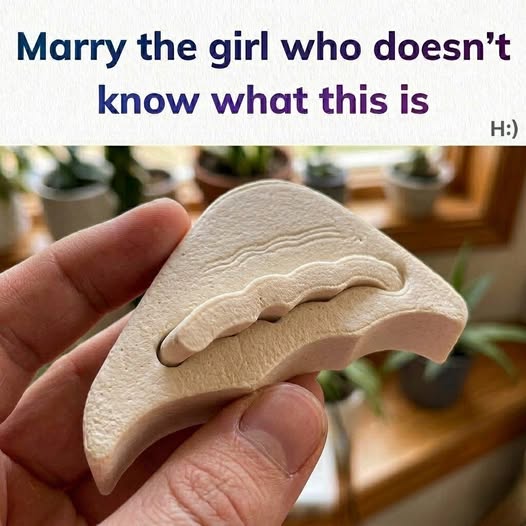
It was crescent-shaped, smooth, and pale—almost ivory in color. Light, but not fragile. One side had a thin adhesive strip, still covered, still unused. There were no markings, no branding, nothing to explain what it was or where it came from.
It looked intentional. Designed.
But for what?
At first, I assumed it was something ordinary I simply didn’t recognize. Some small accessory, something specific to a use I hadn’t encountered before.
But the longer I looked at it, the stranger it felt.
There was a precision to it. A subtle curvature that suggested it wasn’t generic. It had been made for something very particular.
I slipped it back into the bag and tried not to think about it.
But curiosity has a way of returning.
The next day, I brought it to work.
It didn’t take long before I showed it to someone.
“Any idea what this is?” I asked casually.
She took it, turned it in her hands, frowned slightly.
“Maybe a wrist rest?” she suggested.
Another coworker leaned in.
“No, it’s too small. Could be a bra insert?”
“Foot pad?” someone else added from across the desk.
Each guess seemed plausible for a moment, then fell apart under closer thought. The shape didn’t quite match. The material didn’t feel right for any of those uses.
“It’s weird,” one of them said finally, handing it back.
That was the word that stuck.
Weird.
Not useless. Not broken.
Just… unexplained.
That night, I examined it more carefully.
Under stronger light, I noticed faint pressure marks along the edges. Subtle, but there. As if it had been used before—but not heavily. Not worn down.
Cared for.
I started searching online.
I tried different combinations of words: “crescent adhesive insert,” “luxury accessory pad,” “custom shoe insert.”
Eventually, I found something that looked similar—high-end inserts designed for shoes, particularly heels. They were meant to provide comfort, to adjust fit, to support specific pressure points.
But none of the images matched exactly.
Those looked mass-produced. Standardized.
This didn’t.
This felt… personal.
The next day, I took it somewhere else.
A small boutique that specialized in repairing designer shoes.
The owner was older, observant in a way that made you feel like she noticed more than she said. I handed her the object without explanation.
She looked at it for less than five seconds before nodding.
“Custom insert,” she said.
“For what?” I asked.
“Heels. High-end. Probably handmade.”
“Handmade?”
She glanced at me, then back at the object.
“These aren’t sold in stores,” she explained. “They’re fitted. Made for a specific person, for a specific pair of shoes.”
I hesitated.
“A specific person?”
“Yes,” she said simply. “And always part of a pair.”
Something about that sentence stayed with me.
Part of a pair.
I thanked her and left, the object feeling heavier in my pocket than it had before.
At home, I went through the bag again.
This time, more carefully.
I checked every seam, every fold, every hidden corner. It felt excessive, almost intrusive, but I couldn’t shake the sense that I had missed something.
And I had.
It was tucked deeper than the pocket where I found the insert—almost hidden within the lining itself.
A small, folded piece of paper.
I unfolded it slowly.
“Meet me where we last stood. Bring the other one.”
I read it again.
And again.
The words didn’t change, but their meaning seemed to shift the longer I looked at them.
The other one.
But there was no other one.
Days passed.
I tried to ignore it, to treat it as nothing more than a coincidence—a forgotten note, an unrelated object.
But once a question forms, it doesn’t disappear easily.
It waits.
The poster appeared three days later.
It was on a street I walked often, but I might have missed it if something hadn’t drawn my attention to it. A slight movement of paper in the wind. A flicker of contrast against the wall.
A missing person.
A woman, late twenties.
Last seen leaving a fashion event.
The description mentioned a handbag.
Donated by mistake.
I stood there longer than I should have.
Back home, I took the insert out again.
This time, I looked closer than ever.
Under the right angle, in the right light, I saw something I hadn’t noticed before.
Tiny engraved initials.
Barely visible.
I compared them to the name on the poster.
They matched.
Exactly.
For a long time, I didn’t move.
The room felt different somehow. Smaller. Quieter.
The note.
The insert.
The bag.
None of it felt accidental anymore.
That night, sleep didn’t come easily.
Every sound seemed sharper. Every shadow lingered a little too long.
I kept thinking about the note.
“Bring the other one.”
What if someone was still waiting?
The thought settled in slowly, then all at once.
Just before dawn, I made a decision.
I didn’t call anyone.
I didn’t ask questions.
I simply put everything back.
The insert in its pocket. The note in its hidden fold. The bag exactly as I had found it.
Then I walked back to the thrift store.
It was still closed.
The donation bin sat outside, half-filled with discarded things.
I stood there for a moment, holding the bag.
Then I placed it inside.
For a second, I hesitated.
Then I let go.
The next morning, I walked past again.
The bag was gone.
No sign it had ever been there.
No answers.
No explanation.
Just absence.
I never saw the second insert.
And no one ever came looking for the first.
But sometimes, late at night, I still think about that note.
And I wonder—
what would have happened if I had brought the other one.