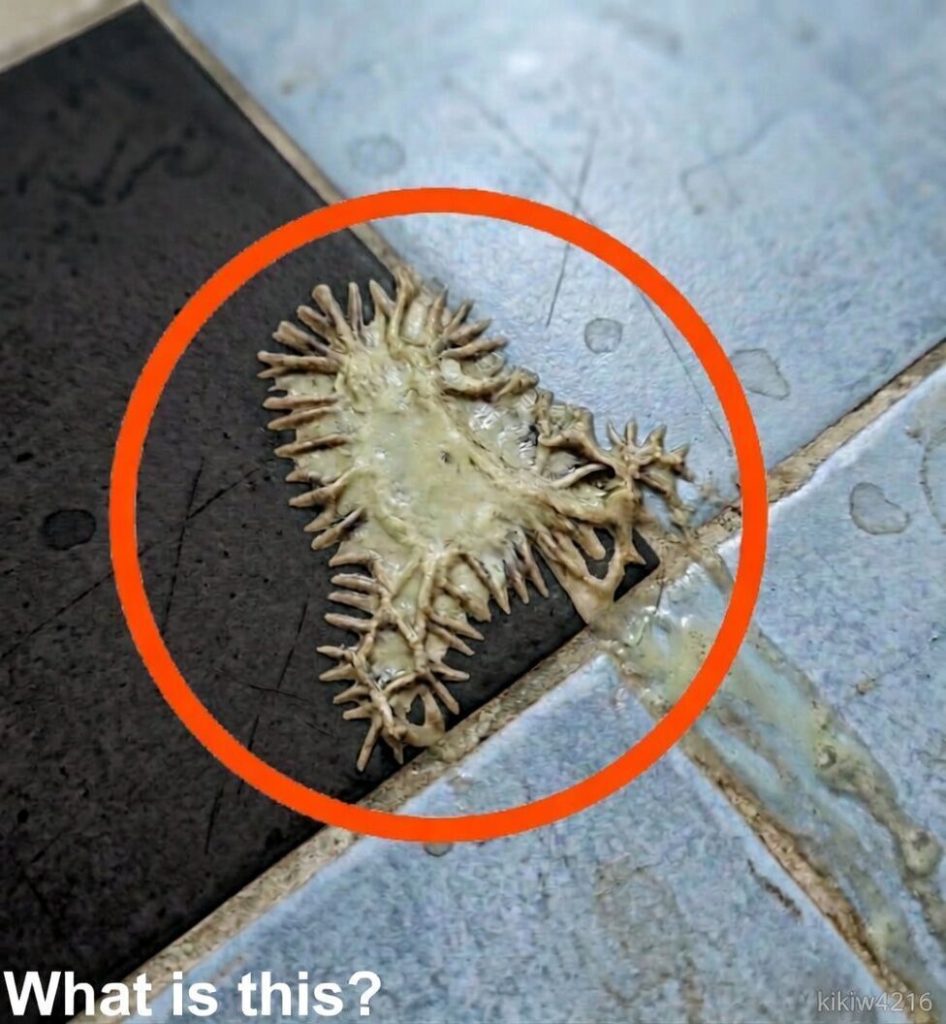
The Object in the Bathroom
At first, it didn’t seem like much.
Just something small. Out of place.
But the longer we stared at it, the harder it became to look away.
It was sitting near the edge of the sink, where nothing ever sat. Pale, slightly irregular, and completely unfamiliar. Not something either of us recognized. Not something that belonged.
That was the first problem.
“Did you put that there?” she asked.
“No,” I said.
That was the second.
Silence followed—not comfortable, not casual. The kind of silence that fills itself with possibilities.
And not the good kind.
We stood there longer than we should have, both of us trying to make sense of something that refused to explain itself. At first, we laughed it off—half-joking guesses thrown into the air like a way to keep things light.
“A piece of soap?” I suggested.
“It doesn’t look like soap.”
“Mold?”
“That’s worse.”
“Okay, not mold.”
But the laughter didn’t last.
Because uncertainty has a way of growing when it isn’t resolved.
Minutes passed. Then more.
And slowly, the bathroom stopped feeling like a bathroom.
It became something else.
A space of questions.
“What if it’s something… alive?” she asked quietly.
I didn’t answer right away.
Because I had thought the same thing.
“That’s not likely,” I said finally, trying to sound certain.
But even to me, it didn’t sound convincing.
We grabbed tools—not real ones, just whatever was nearby. Tweezers. A flashlight. My phone.
We crouched closer, careful but curious.
It didn’t move.
That should have been reassuring.
It wasn’t.
“Maybe it’s from the pipes,” I said. “Something that came up.”
She frowned.
“That’s not better.”
“No, it’s… different.”
But not better.
We started listing possibilities, each one slightly worse than the last.
Some kind of fungus.
A piece of something biological.
Residue from something we didn’t want to name.
Each theory built on the last, turning a small, silent object into something far larger in our minds.
That’s how it works.
The unknown expands to fill whatever space you give it.
And we gave it a lot.
After nearly an hour, the room felt smaller.
The air heavier.
Every surface slightly less trustworthy.
“How long do you think it’s been there?” she asked.
“I don’t know.”
That answer bothered her more than anything else.
Because it wasn’t just about the object anymore.
It was about what we didn’t know.
About the space we thought we understood.
About the idea that something unfamiliar could exist right in front of us—and go unnoticed.
That’s when the conversation shifted.
Subtly, but unmistakably.
“Maybe we should have cleaned more thoroughly,” she said.
“It’s not about cleaning.”
“Then what is it about?”
I hesitated.
Because I wasn’t sure.
And that uncertainty didn’t stay contained.
It spread.
To the apartment.
To the systems behind the walls.
To everything we assumed was safe.
“What if there’s more of it?” she asked.
“There’s not,” I said quickly.
But now I was guessing too.
That’s the thing about situations like this.
They don’t just challenge what you see.
They challenge what you believe.
About your environment.
About control.
About how much you actually know.
We considered calling someone.
A professional.
Pest control. Maintenance. Anyone who could give us an answer.
But then came the hesitation.
“What if it’s nothing?” she said.
“What if it’s not?”
That question sat between us.
Heavy.
Unavoidable.
Because both possibilities felt uncomfortable.
Overreacting felt embarrassing.
Underreacting felt dangerous.
And we were stuck somewhere in between.
So we kept looking.
Documenting.
Taking pictures.
Zooming in.
Analyzing texture, color, shape.
Trying to impose logic on something that resisted easy classification.
At some point, the fear shifted again.
Not gone—but changed.
Less sharp.
More… thoughtful.
“This is ridiculous,” I said eventually.
She looked at me.
“Is it?”
I exhaled.
“No. I mean… yes, but also no.”
She smiled slightly.
“That makes sense.”
And strangely, it did.
Because what we were experiencing wasn’t just fear.
It was uncertainty.
And uncertainty does something specific to people.
It forces you to confront how you think.
How you react.
How you handle not knowing.
I realized I had been trying to take control of the situation—not because I had answers, but because I felt like I was supposed to.
She had been asking questions—not because she expected answers, but because she needed reassurance.
Two different responses.
Same feeling underneath.
We were both unsettled.
We just showed it differently.
That realization changed something.
Not about the object.
But about us.
We stopped trying to solve it immediately.
Instead, we slowed down.
Talked.
Not just about what it could be—but about why it was affecting us so much.
“It’s weird how something so small can do this,” she said.
“It’s not the size,” I replied. “It’s the unknown.”
She nodded.
“Yeah.”
That was it.
The unknown.
Not dangerous.
Not harmless.
Just… undefined.
And that’s what made it powerful.
Eventually, we made a decision.
We would isolate it.
Clean around it.
And if it was still there the next day—or changed in any way—we’d call someone.
It wasn’t a perfect plan.
But it was enough.
Enough to restore a sense of control.
Enough to let us step away.
That night, the apartment felt different.
Not unsafe.
Just… observed.
Like we were more aware of everything.
Corners.
Surfaces.
Details we had ignored before.
But something else had changed too.
We were more aware of each other.
Of how we responded.
How we supported.
How quickly fear could either divide or connect.
And in our case—
it connected.
The next morning, we checked the bathroom again.
The object was still there.
But in daylight, it looked different.
Less ominous.
More… ordinary.
Still strange.
Still unexplained.
But no longer overwhelming.
We ended up calling someone.
And the answer, when it came, was almost anticlimactic.
Something minor.
Unusual, but not dangerous.
Easily explained once you knew what to look for.
We laughed about it afterward.
Not because it was funny—
but because of how far our minds had gone.
That’s the real story, though.
Not the object.
Not even the fear.
But what it revealed.
About perception.
About how quickly the familiar can feel unfamiliar.
And about how relationships respond when certainty disappears.
Because the truth is—
we don’t just live in our homes.
We trust them.
And when that trust is questioned, even briefly, it forces us to reevaluate more than just our surroundings.
It forces us to look at how we handle the unknown.
Together.
In the end, the object didn’t matter.
But the moment did.
Because it reminded us of something simple, but important:
It’s not the mystery itself that defines us.
It’s how we face it.
And whether we face it alone—
or side by side.