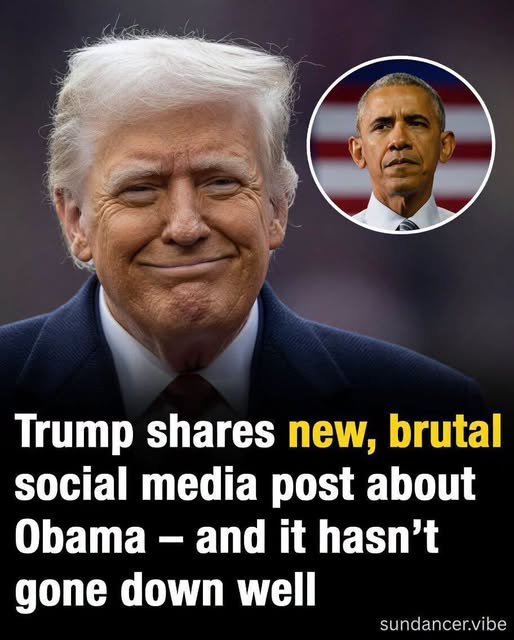
In today’s political landscape, communication no longer travels only through press conferences, official statements, or televised interviews. Instead, it increasingly moves through short-form digital content—memes, screenshots, reposts, and algorithm-driven social media interactions that spread faster than traditional journalism can fully contextualize them. Within this environment, political figures are not just policymakers but also content participants in an attention-driven ecosystem where symbolism often matters more than detail.
One of the most consistent examples of this transformation is the way high-profile American political figures engage with social media narratives that revive older rivalries and reinterpret past events. Among the most enduring of these is the public dynamic between Donald Trump and Barack Obama, two figures who represent contrasting political styles, communication approaches, and visions of leadership in the modern United States.
Their historical interaction has been widely documented and often referenced in political commentary. One of the most frequently cited moments is the 2011 White House Correspondents’ Dinner, where then-President Obama made remarks that many interpreted as light but pointed commentary about Trump’s earlier public persona. That moment later gained symbolic significance once Trump entered electoral politics, as it became part of a broader narrative about skepticism, media attention, and political emergence.
In the current digital era, however, such historical moments are no longer confined to archival footage or political analysis—they are repeatedly resurfaced in edited clips, meme formats, and commentary posts that circulate widely across platforms like X (formerly Twitter), Instagram, Facebook, and Truth Social. These reposts often strip away nuance, replacing context with emotional framing designed to provoke engagement.
When political figures share or amplify such content, it becomes more than commentary—it becomes part of a live political performance shaped by audience reaction. Supporters interpret these posts as affirmation of resilience, victory, or long-term vindication. Critics interpret them as unnecessary provocation or distraction from governance. In both cases, the content achieves its primary function in the digital economy: attention.
The rise of memes as political instruments
Memes have evolved far beyond humor. In modern politics, they function as compressed ideological statements. A single image with a caption can communicate a narrative about strength, rivalry, injustice, or validation. Unlike traditional political messaging, memes are flexible—they can be interpreted as satire, sincerity, or strategic ambiguity depending on the viewer’s perspective.
This ambiguity is part of what makes them powerful. A meme does not require full context to be effective. Instead, it relies on emotional recognition. Viewers bring their own interpretation to the image, filling in gaps based on prior beliefs. This makes memes particularly effective in polarized environments, where audiences are already primed to interpret political content through established viewpoints.
When political leaders engage with memes referencing opponents, predecessors, or historical narratives, they are not simply sharing content—they are reinforcing identity signals to their base while simultaneously provoking reaction from opposing groups.
Digital rivalry and the persistence of political memory
The Trump–Obama dynamic illustrates how political memory functions in the digital age. Rather than fading after electoral transitions, rivalries persist online, continually resurfaced through curated content. Old speeches, debates, jokes, and interviews are repackaged into new formats that circulate among supporters and critics alike.
This creates a layered political timeline where past and present coexist simultaneously. A statement made a decade ago can re-enter public debate instantly when reframed in a meme or viral clip. As a result, political figures remain symbolically active in each other’s narratives long after direct engagement has ended.
This phenomenon also highlights how political identity is increasingly constructed through contrast. Leaders are often defined not only by their policies but by their perceived opposition to others. In this environment, historical references become tools for reinforcing present-day messaging.
The role of misinformation and narrative distortion
A significant challenge in this ecosystem is the blending of verified information with speculation, exaggeration, or fictional additions. As political content circulates, context is frequently lost. Captions are edited, images are repurposed, and statements are paraphrased without verification.
This creates a fragmented information environment where audiences may encounter multiple conflicting interpretations of the same event. Some versions may emphasize humor, others conflict, and others entirely fabricated extensions of real situations.
The result is not necessarily intentional deception in every case, but rather structural distortion—an environment where speed and emotional impact are rewarded more than accuracy or depth. Algorithms prioritize engagement, and engagement often correlates with strong emotional reactions rather than careful analysis.
Artificial intelligence and political imagery
Another emerging factor is the use of AI-generated imagery in political discourse. AI tools can create realistic or stylized images of public figures in contexts that may not have occurred. These images can spread rapidly, sometimes without clear labeling, contributing to confusion about what is real and what is digitally constructed.
While AI-generated content can be used for satire or artistic expression, it also raises concerns about authenticity. When combined with political messaging, it can blur the line between commentary and fabrication, especially for audiences encountering the content without context.
This development adds another layer to the already complex media environment, where visual credibility is no longer guaranteed simply by appearance.
Polarization and audience segmentation
One of the most significant outcomes of this digital transformation is increased political polarization. Social media platforms tend to segment audiences into ideological clusters, reinforcing existing beliefs through algorithmic recommendation systems. Content that aligns with a user’s prior engagement is more likely to be shown, while opposing viewpoints may be minimized or framed antagonistically.
In this environment, political memes and viral posts serve as reinforcement tools. They strengthen in-group identity while simultaneously defining out-groups in simplified or symbolic terms. Over time, this reduces exposure to nuanced discussion and increases reliance on emotionally charged summaries of complex issues.
Political communication as performance
Modern political communication increasingly operates as performance. Leaders are not only expected to govern but also to maintain a continuous presence in the digital attention cycle. Posts, reactions, and reposts become part of a larger narrative strategy that blends messaging with visibility.
This does not necessarily replace traditional governance, but it exists alongside it in a parallel communication stream that can influence public perception just as strongly as policy decisions.
The challenge is that performance-based communication rewards immediacy and emotional resonance, while governance often requires complexity, compromise, and time. The tension between these two modes defines much of contemporary political discourse.
Conclusion
The circulation of political memes referencing historical rivalries like that between Trump and Obama reflects a broader transformation in how political narratives are created, shared, and consumed. Social media has compressed time, amplified symbolism, and blurred the boundaries between fact, commentary, and interpretation.
In this environment, political figures function not only as decision-makers but also as symbols within an ongoing digital conversation shaped by millions of users. Memes, AI-generated imagery, and viral posts are no longer peripheral—they are central to how political identity is expressed and understood.
Whether this shift ultimately enhances democratic engagement or weakens informed discourse remains an open question. What is clear, however, is that political communication has permanently changed. It is faster, more visual, more emotional, and more fragmented than ever before—and it is still evolving.