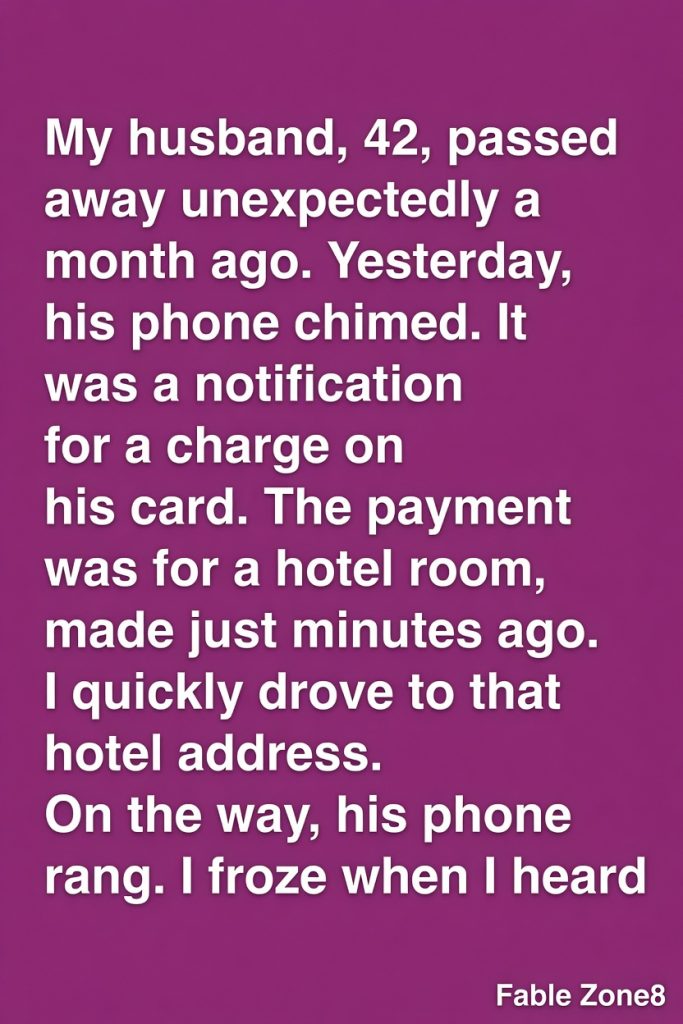
I froze the moment I heard her voice.
It wasn’t just words—it was familiarity. Warmth. Intimacy. A tone that didn’t belong to me.
“Hey love… are you almost here? The room is ready.”
The phone nearly slipped from my shaking hand.
My husband David had been dead for just one month.
A sudden heart attack. No warning. No goodbye that made sense in hindsight. Just collapse, chaos, and then silence—followed by grief so heavy it felt like breathing itself had become optional.
And now his phone—his dead phone—was ringing with a woman who spoke to him like he was still alive and on his way to meet her.
I ended the call without speaking.
But my world didn’t end it.
It cracked open.
Because nothing about this made sense.
The credit card charge came first.
A hotel room.
Booked minutes before the notification reached me.
Paid with his card. His name. His identity.
Then the message followed.
“Room 312. I miss you. Especially after last month’s scare when you thought your wife was getting suspicious.”
My stomach turned.
A scare?
I had been grieving. Planning a funeral. Holding our children together while my own life unraveled.
And somewhere in that same timeline… David had been meeting someone else.
I drove without thinking.
The hotel sat on the edge of town—ordinary, beige, forgettable. The kind of place people pass without noticing. But now it felt like a crime scene no one had cordoned off yet.
My hands wouldn’t stop shaking on the steering wheel.
Inside, everything moved too normally.
A receptionist smiled.
A couple checked in.
A suitcase rolled across tile.
Life continued while mine collapsed.
I didn’t speak. I just went to the elevator.
Room 312.
Each step down the hallway felt like walking toward a version of my life I wasn’t prepared to survive.
When I knocked, I expected denial.
Instead, a woman opened the door.
She looked at me once—and knew.
“You’re his wife,” she whispered.
The air left my lungs.
Inside the room, everything looked lived-in. Not messy. Not careless. Familiar. Two wine glasses. A suitcase. A jacket draped over a chair like someone had just stepped out moments ago.
Like David might return.
Except he never would.
“I didn’t know,” I said automatically, though I wasn’t sure what I meant anymore.
She sat down slowly.
And then she told me everything.
Three years.
Work trips that weren’t work trips.
Weekends that didn’t exist.
A version of my husband I had never met—but she had loved.
And the worst part?
“He told me you were drifting apart,” she said quietly. “That you were more like roommates.”
I laughed once, sharp and broken.
Roommates.
We had raised children together. Buried parents together. Built a life that looked solid from the outside.
And still—there had been another life running parallel beside it.
She showed me messages.
Photos.
Voicemails.
Evidence of a man who could be two people without either ever fully knowing the other.
In one photo, he was smiling on a beach I didn’t recognize.
In another, he was holding her hand like it was something fragile and precious.
I felt sick.
Not just because he had lied—but because he had lived.
Fully.
Elsewhere.
While I believed we were shared.
“I thought I knew him,” I whispered.
She didn’t answer.
Because neither of us really had.
When I left the hotel, the sky looked wrong. Too bright. Too indifferent.
Grief had already been unbearable.
Now it had multiplied.
Because I wasn’t just mourning David anymore.
I was mourning the version of him I had built my entire life around.
That night, I didn’t sleep.
I sat in the dark replaying everything.
Late nights at “work.”
Sudden business trips.
The phone always face down.
The distance I once blamed on stress, age, routine.
Now it all rearranged itself into something sharper.
Truth doesn’t always arrive loudly.
Sometimes it arrives disguised as a notification.
Over the next weeks, I searched for more.
Bank statements revealed hotel charges I had never seen.
Gifts I never received.
A second email account.
A quiet financial trail leading to a life I had never been invited into.
Our children thought I was grieving normally.
I wasn’t.
I was reconstructing a stranger.
The man they called Dad.
The man I called husband.
Were they the same person?
I no longer knew.
One night, I found his journal in his office drawer.
Inside were entries written in uneven handwriting.
Confession without audience.
He wrote about feeling split.
About loving me—but feeling invisible inside the life we built.
About loving her—but feeling guilty every time he returned home.
He didn’t excuse himself.
But he didn’t fully condemn himself either.
He was just… divided.
And somehow, that was worse than hatred.
Because it meant there had never been a clear villain.
Only choices.
And consequences.
The woman from the hotel contacted me again weeks later.
Not to defend herself.
Not to compete.
But to share closure.
She mailed me a small box of things he had left behind—watch, notes, a folded receipt.
“I didn’t want to erase him,” she wrote.
Neither did I.
That was the hardest truth.
Because even after everything, I still missed him.
Not the man he had been everywhere.
But the man I thought he was with me.
Grief became something more complicated after that.
It wasn’t linear.
It wasn’t clean.
It came in waves of anger, disbelief, nostalgia, and strange compassion.
I stopped asking how he could do it.
And started asking how he carried it.
Two lives.
Two truths.
One collapse.
Healing didn’t come quickly.
It came in fragments.
In therapy sessions where I learned that betrayal doesn’t erase love—it rewrites it.
In conversations with my children where silence mattered more than explanations.
In nights where I finally stopped searching through his past and started rebuilding my own future.
There was no dramatic resolution.
No perfect forgiveness.
No final understanding that made everything make sense.
Only acceptance that some stories end without clarity.
And still continue anyway.
Eventually, I stopped defining him by what he hid.
And started defining myself by what I survived.
Because the truth is—
I didn’t just lose my husband.
I lost the illusion of certainty.
And in that loss, I found something unexpected.
Myself.
Not as someone’s wife.
Not as someone’s widow.
But as someone still standing after the story collapsed.
And learning, slowly, how to live in the light of everything she now knows.
