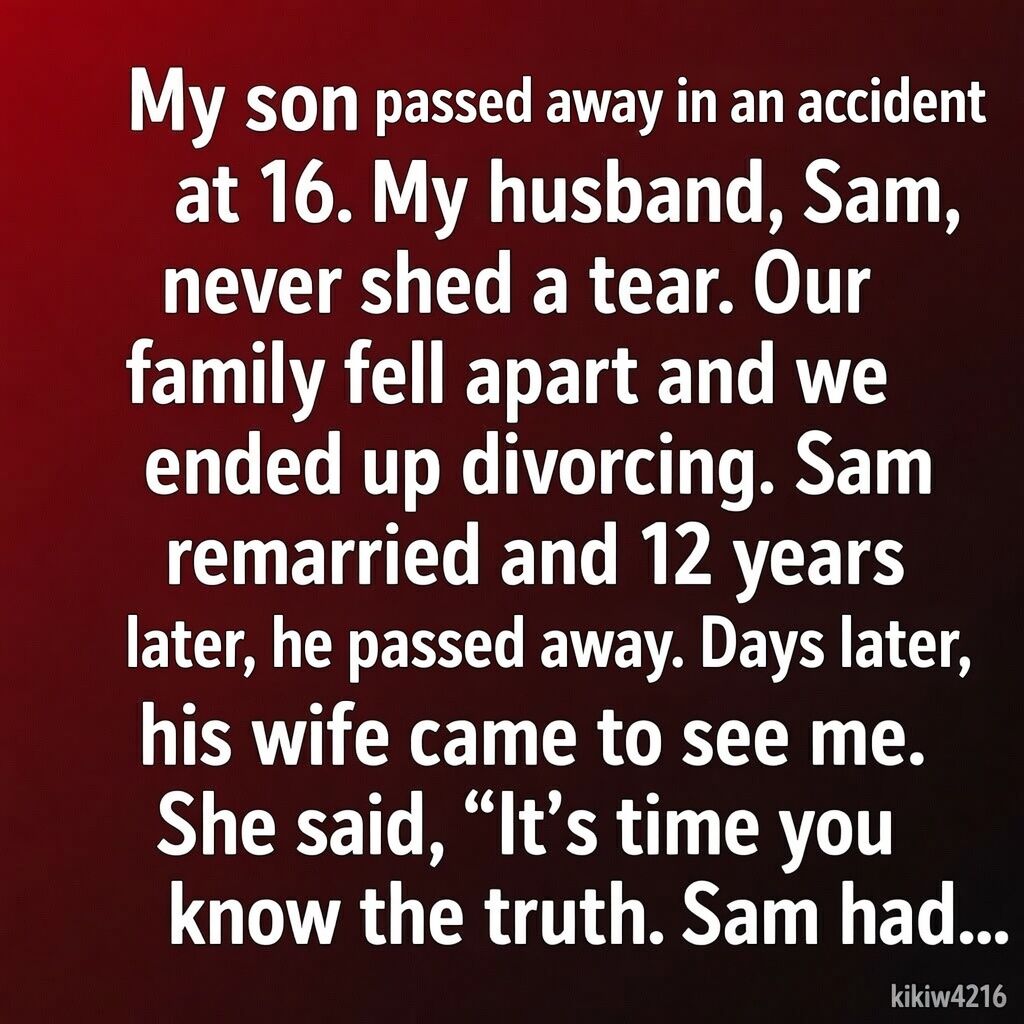
When my son died at sixteen, my world didn’t just break—it collapsed entirely, as if everything I had built my life around had been quietly erased in a single, brutal moment. There are no words that truly capture what it feels like to lose a child, but if I had to try, I would say it feels like breathing becomes optional, like your heart keeps beating only out of habit, not purpose. Every memory becomes both a comfort and a weapon, reminding you of what was and what will never be again.
The accident happened on an ordinary afternoon, the kind that never hints at the devastation waiting just hours ahead. One moment he was texting me to ask what we were having for dinner, and the next, I was standing in a hospital hallway, gripping a doctor’s words like they might somehow change if I squeezed hard enough. They didn’t.
My husband, Sam, stood beside me through it all—through the hospital, the funeral, the endless stream of condolences—but something about him felt… different. While I unraveled completely, crying until my body physically ached, Sam remained composed. Still. Silent.
At first, I thought he was just in shock.
But the shock never wore off.
At the funeral, I sobbed openly, clutching tissues that dissolved in my hands, while Sam stood beside me like a statue. He didn’t cry. Not once. Not when they lowered the casket, not when family members broke down around us, not even later that night when we were finally alone.
I remember lying in bed, my chest heaving with grief, waiting—hoping—that he would break too. That he would cry with me, hold me, show me that I wasn’t alone in this unbearable pain.
But he didn’t.
He just stared at the ceiling in silence.
That silence became the beginning of the end for us.
In the weeks that followed, I drowned in my grief while Sam seemed to function almost normally. He went back to work sooner than I expected. He handled paperwork, spoke to insurance companies, organized things that felt meaningless in the face of our loss. People praised him for being “strong.”
I hated that word.
Because to me, it didn’t feel like strength. It felt like absence.
It felt like he had already moved on while I was still trapped in the worst moment of my life.
Our home, once filled with laughter and teenage chaos, became unbearably quiet. Every corner held memories—his shoes by the door, his half-finished homework, the jacket he left on a chair. I couldn’t escape it.
And Sam? He never talked about any of it.
If I brought up our son, he would nod, maybe say something short, then change the subject. If I cried, he would sit beside me awkwardly, pat my shoulder, and eventually leave the room.
I started to resent him.
How could he not feel what I was feeling?
How could he not be destroyed the way I was?
That resentment grew quietly at first, like a crack in glass, barely visible but spreading with time. We stopped having real conversations. Everything became surface-level—groceries, bills, schedules. The deeper parts of our relationship simply disappeared.
Then came the arguments.
They were never really about what we said they were about. A misplaced bill, a forgotten errand, a minor disagreement about dinner—each one exploded into something much bigger. Underneath it all was the same unspoken accusation:
You don’t care.
Six months after we buried our son, we signed divorce papers.
Just like that, a marriage of over twenty years ended in a sterile office, reduced to signatures and legal language. There was no dramatic goodbye, no emotional closure. Just two broken people walking away from each other, each convinced the other had failed them.
For years, I believed Sam had failed me.
The years that followed were a blur of survival. I learned how to live alone, though “living” often felt like the wrong word. I went to therapy. I joined support groups. I created rituals to honor my son—visiting his grave, celebrating his birthday quietly, keeping his memory alive in the only ways I knew how.
Sam became a distant figure in my past.
I heard through mutual acquaintances that he had remarried. That news stung more than I expected. It felt like confirmation of everything I had believed—that he had moved on easily, that our loss hadn’t affected him the way it had affected me.
I told myself I didn’t care.
But I did.
Twelve years passed.
Twelve years of separate lives, separate grief, separate healing.
Then one day, I received a call that stopped me in my tracks.
Sam had died.
A heart attack in his sleep.
Fifty-eight years old.
I didn’t know how to feel.
There was sadness, of course. But also confusion. And something else I didn’t want to admit—regret.
I attended the funeral quietly, sitting in the back, watching a life I had once been part of being remembered without me. His new wife stood at the front, composed but visibly grieving. I felt like an outsider looking in.
After the service, I left without speaking to anyone.
I thought that would be the end of it.
I was wrong.
A week later, there was a knock on my door.
When I opened it, I found a woman standing there—Sam’s wife.
She looked nervous, almost fragile, but there was a determination in her eyes that made me step aside and let her in without question.
We sat at my kitchen table in silence for a moment before she spoke.
“He wanted you to know the truth,” she said softly.
Those words alone were enough to make my heart race.
She reached into her bag and pulled out a worn leather journal.
“This is his,” she continued. “There are more.”
I frowned, confused. “What is it?”
“He wrote to your son,” she said.
My breath caught.
She placed the journal in front of me and opened it to a random page.
The handwriting was unmistakably Sam’s.
“I saw a boy today who looked just like you would at twenty. I wanted to talk to him. I didn’t. I just stood there like an idiot, wondering who you would have become…”
My hands started to shake.
“There are hundreds of entries,” she said gently. “He wrote almost every day.”
I looked up at her, my mind struggling to process what I was hearing.
“He never stopped grieving,” she added.
The words hit me harder than anything I had felt in years.
“He just didn’t show it,” she continued. “Not to you. Not to anyone.”
Tears blurred my vision as she explained.
Sam had believed—truly believed—that if he broke down, he wouldn’t be able to support me. That if he let himself feel everything, he would collapse completely. So he did the only thing he thought he could do.
He locked it all inside.
Every tear he didn’t shed in front of me, he shed alone.
Every word he didn’t say to me, he wrote in those journals.
Every week, for twelve years, he visited our son’s grave before dawn. He talked to him. Brought flowers. Left letters.
He never missed a single week.
I felt like the ground beneath me had shifted.
All those years, I thought he didn’t care.
All those years, I thought I was grieving alone.
I was wrong.
She handed me another item—a sealed envelope.
“He wrote this before he died,” she said. “For you.”
My hands trembled as I opened it.
Inside was a letter.
“I know you think I didn’t feel it. That I didn’t love him the way you did. But the truth is, I felt it so deeply I didn’t know how to survive it. I thought if I stayed strong, I could hold us together. I didn’t realize my silence was pushing you away. I’m sorry I couldn’t show you how much it hurt. I’m sorry I lost you too.”
By the time I finished reading, I was crying harder than I had in years.
Not just for my son.
But for Sam.
For us.
For everything we lost—not just in the accident, but in the years that followed because we couldn’t understand each other’s grief.
In the weeks after her visit, I read every journal.
Every page revealed a man I thought I knew, but clearly didn’t. A man who loved deeply, grieved silently, and carried a weight so heavy it eventually broke him.
He hadn’t moved on.
He had endured.
Quietly.
Alone.
That realization changed everything for me.
I started to see our past differently. Not as a story of abandonment, but as a tragedy of miscommunication. Two people grieving the same loss in completely different ways, unable to meet in the middle.
I had needed tears.
He had needed silence.
Neither of us knew how to give the other what they needed.
And it cost us everything.
Today, I carry both grief and understanding.
I speak openly about what I learned, especially to couples facing loss. Because if there’s one thing I know now, it’s this:
Grief doesn’t look the same for everyone.
Some people cry.
Some people go quiet.
Some people fall apart.
Some people hold everything together until they can’t anymore.
None of it means they love less.
If anything, it often means they love so much they don’t know how to express it.
I keep Sam’s letter framed beside a photo of our son now.
Not as a reminder of regret, but as a lesson.
A lesson in compassion.
In patience.
In never assuming that silence means absence of love.
Because sometimes, the deepest pain is the one you never see.
And sometimes, the strongest love is the one that was there all along—you just didn’t know how to recognize it.