Some moments in life seem small on the surface but carry the weight to change everything. For me, it happened over dinner—under soft lighting, surrounded by family, with the clinking of glasses and the comforting aroma of Italian food filling the air. It should have been just another evening. Instead, it became the moment I finally stopped playing a role I never agreed to.
We had gathered at a well-known restaurant, the kind of place where the menu is slightly overpriced but the atmosphere makes it feel worth it. My brother John sat across from me, his voice filling the table as he talked about work, his kids, and the endless responsibilities that came with his life. His wife Sarah nodded along, occasionally chiming in, while Aunt Mary observed everything with her usual air of authority.
I listened, smiled, and contributed where I could. It was familiar—this rhythm we had fallen into over the years. I was the easy one. The flexible one. The one without a spouse, without children, without “real” obligations in their eyes.
Dinner went smoothly. We ordered appetizers, entrees, desserts. I kept my order modest—a steak, a salad, two glasses of wine, and a shared starter. Nothing extravagant. I had learned over time to be mindful, knowing how these nights often ended.
And then the bill came.
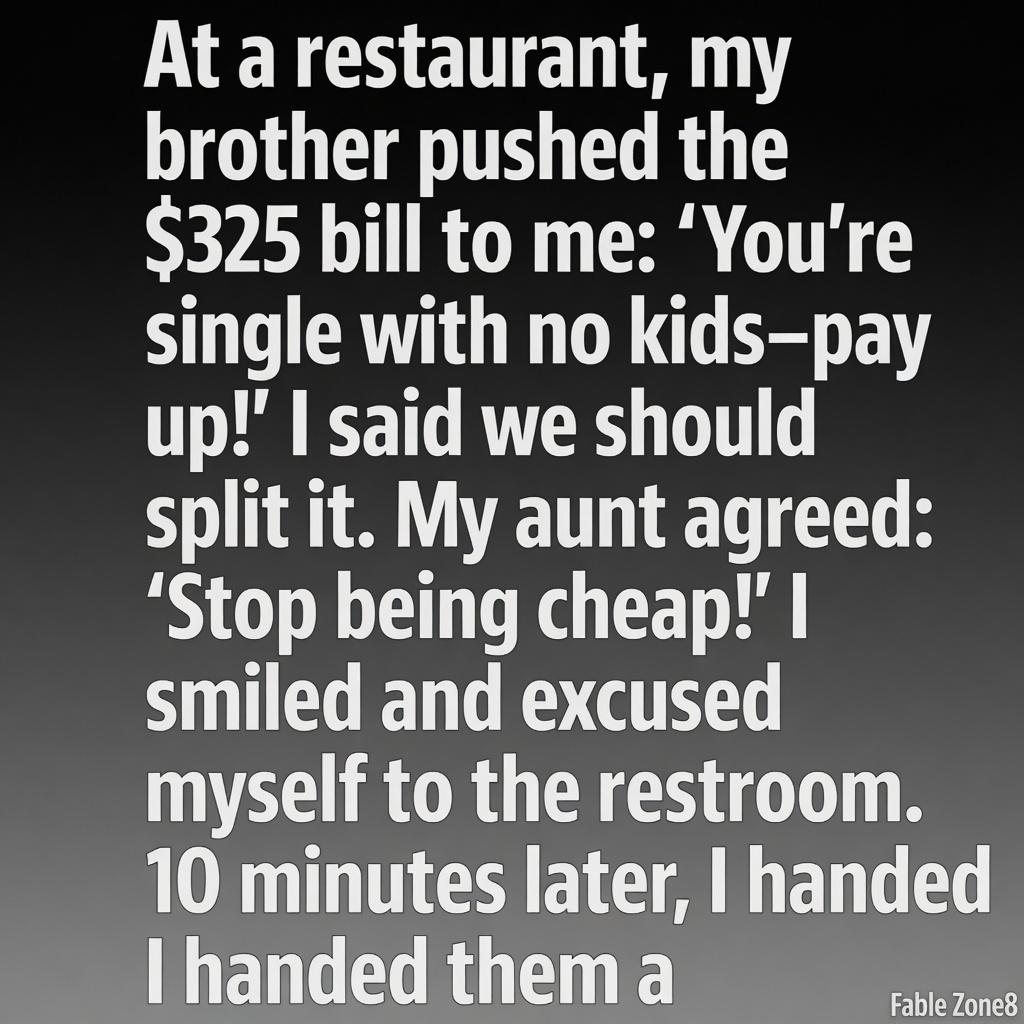
It landed in the center of the table like it always did—casually, almost ceremonially. For a brief second, no one moved. Then John picked it up, glanced at it, and without hesitation, slid it directly toward me.
“You’ve got this,” he said with a smirk. “You’re single. No kids. Must be nice.”
There was laughter. Not loud, not cruel—but enough.
I felt something shift inside me.
I had heard variations of that line before. At birthdays. Holidays. Family outings. It was always said lightly, as if it were a joke. But it never felt like one.
I looked at the total: $325.
I took a breath and said calmly, “Why don’t we just split it?”
The reaction was immediate.
Aunt Mary leaned forward, her expression tightening. “Oh, come on,” she said. “Don’t be cheap.”
Cheap.
The word landed harder than it should have.
For a moment, I considered letting it go—just like I always had. Paying the bill, smiling, driving home, and adding it to the quiet list of things I never spoke about.
But something in me refused this time.
Instead of arguing, I smiled.
“Give me a second,” I said, standing up. “I’ll be right back.”
I walked to the restroom, but I wasn’t there to wash my hands or check my phone. I needed space—ten minutes to think, to breathe, and to decide what kind of person I was going to be in that moment.
Standing in front of the mirror, I replayed everything.
The dinners I had paid for without question.
The trips I had helped fund.
The times I was expected to contribute more simply because I could.
It wasn’t about money. It had never really been about money.
It was about expectation.
In their eyes, my life was easier, lighter, less demanding. And because of that, I had quietly become the family safety net—the one who absorbed the extra cost, the one who made things “easier” for everyone else.
But no one had ever asked if that was fair.
I pulled out my phone and calculated my portion. Every item. Every dollar. Tax included. Then I added a full 20% tip—for my share.
When I was done, I walked to the front, spoke to the manager, and asked if they could separate the bill. He nodded, clearly familiar with situations like this.
Within minutes, it was done.
I paid my portion, took the remaining bill, and wrote a short note.
Then I went back.
The table looked exactly the same—but everything felt different.
I placed the bill down gently.
“I covered my share,” I said. “Plus tip. The rest is yours.”
Silence.
Not the comfortable kind. The heavy kind.
John stared at the paper, confused at first. Then his expression shifted.
“What is this?” he asked.
“My part,” I replied calmly.
Aunt Mary picked up the note, reading it slowly. Her face changed as the words sank in.
“No one is being cheap,” I added. “I just paid exactly what I ordered.”
The air at the table grew tense.
Sarah looked between us, unsure what to say. The kids sensed something was wrong and went quiet.
John leaned back, shaking his head. “You’re seriously doing this right now?”
“Yes,” I said.
The conversation that followed wasn’t loud, but it was sharp.
He accused me of making a scene.
I told him the scene started when the bill was pushed to me.
Aunt Mary tried to bring up “everything they’ve done for me.”
I asked her to name one time I hadn’t given more than I received.
There were no clear answers.
Just discomfort.
For the first time, the dynamic had shifted—and no one knew how to handle it.
I didn’t raise my voice. I didn’t insult anyone. I just stood firm.
“I love you all,” I said. “But I’m not paying for everyone anymore just because I’m single. That doesn’t make me responsible for the bill.”
No one argued after that.
Not really.
They just sat there, processing.
I picked up my jacket.
“Goodnight,” I said, and walked out.
The cool night air hit differently.
For the first time in a long time, I felt… light.
Not because I had saved money—but because I had finally drawn a line.
The days that followed were interesting.
John texted me the next morning.
At first, he was annoyed. Said I embarrassed him.
But later in the conversation, something shifted.
“Maybe we got used to it,” he admitted. “Didn’t realize how it looked.”
Aunt Mary’s message came later. Longer. More defensive.
But even she eventually wrote, “I shouldn’t have called you cheap.”
Sarah reached out separately.
“I think it was fair,” she said. “Honestly.”
That surprised me.
But what surprised me more was what happened after.
The next time we went out, someone said, “Let’s just split it evenly.”
No jokes.
No assumptions.
Just… fairness.
It wasn’t a dramatic transformation. No big apologies. No emotional speeches.
Just a quiet correction.
And that was enough.
Looking back, that dinner wasn’t really about a bill.
It was about identity.
For years, I had been placed into a role—the “easy one,” the “available one,” the “financially flexible one.” And I had accepted it, partly out of love, partly out of habit.
But roles only exist as long as we play them.
The moment we stop, everything changes.
That night taught me something simple but powerful:
Boundaries don’t have to be loud to be effective. They just have to be clear.
I didn’t need to argue, fight, or prove anything.
I just needed to act differently.
And that was enough to rewrite the script.
Now, when I sit at a table—family or otherwise—I don’t feel that quiet pressure anymore.
Because I know something I didn’t fully understand before:
Fairness isn’t selfish.
And respect isn’t something you wait for—it’s something you show people how to give you.
Sometimes, all it takes…
is one bill, one decision, and the courage to finally say: “No more.”