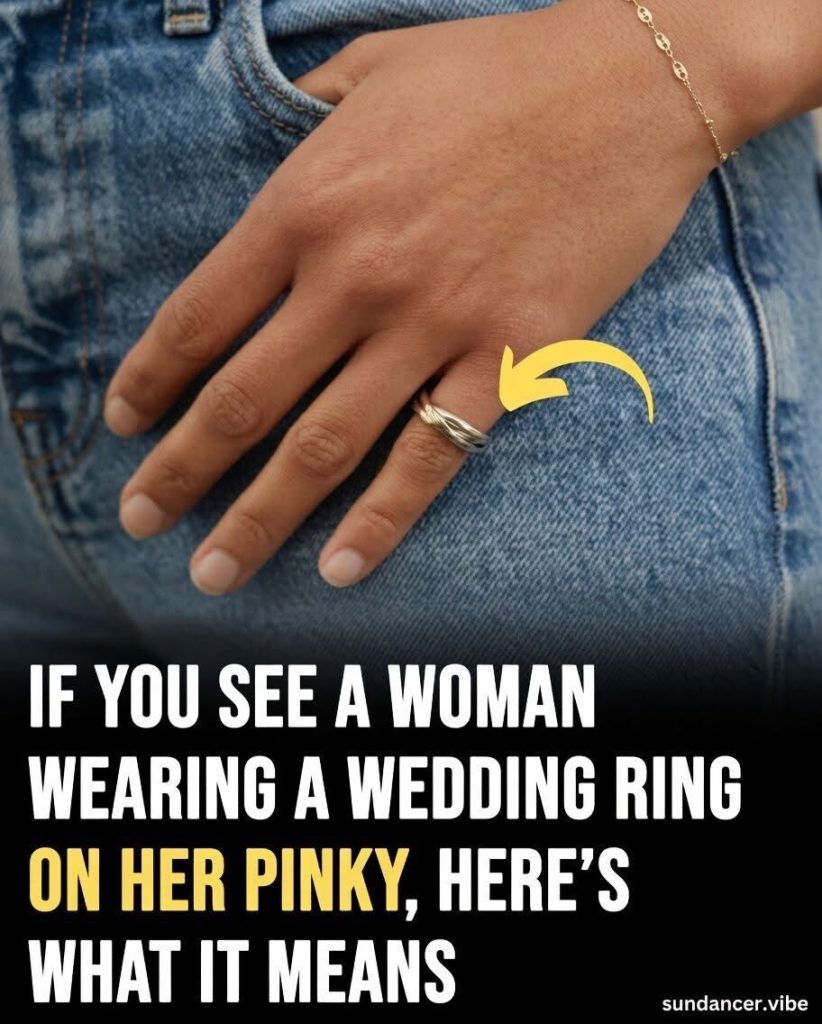
In recent years, a subtle yet meaningful shift has begun to take shape in the world of personal expression and symbolism. It’s not loud or attention-seeking, nor does it demand explanation at first glance. Yet for those who understand it, the message is deeply powerful. More and more women are choosing to wear rings not on the traditional ring finger, but on their pinky finger—and behind that choice lies a story far richer than fashion alone.
For generations, rings have carried clear, almost universally understood meanings. A ring on the left ring finger signified engagement or marriage, a visible declaration of commitment to another person. It told the world, without words, that love had been promised and partnership established. Jewelry, in this sense, functioned as a social signal—one that tied identity closely to relationship status.
But the pinky ring disrupts that narrative.
Rather than pointing outward toward someone else, it turns inward.
A Symbol Reclaimed
The modern pinky ring movement is often linked to the jewelry brand Fred + Far, founded by Melody Godfred. What began as a personal idea evolved into a broader cultural conversation. Godfred introduced the concept of a “self-love pinky ring,” encouraging women to make a commitment—not to a partner, but to themselves.
Her reasoning was simple but striking: if society places so much importance on pledging love to others, why shouldn’t that same level of intention be directed inward?
The pinky finger, often overlooked and rarely associated with major life commitments, became the perfect symbol. By placing a ring there, women reclaim the idea of commitment and redefine it. It becomes a daily reminder: I choose myself. I honor my needs. I am worthy of my own love.
This isn’t about rejecting relationships. In fact, many women wear both an engagement ring and a pinky ring simultaneously. The message isn’t either/or—it’s balance. Loving yourself doesn’t diminish your ability to love others; it strengthens it.
Roots in History
While the modern meaning feels new, the pinky ring has a long and layered history.
During the Victorian era, women sometimes wore rings on their pinky finger as a quiet declaration of independence. At a time when marriage was often seen as a necessity rather than a choice, this small gesture signaled something radical: autonomy. It suggested that a woman could define her own path, even within a society that limited her options.
Though the original context has faded, the underlying idea has endured. Today’s pinky ring wearers are, in many ways, continuing that legacy—only now with greater freedom, clarity, and intention.
Why This Trend Is Growing Now
The rise of the pinky ring isn’t happening in isolation. It reflects broader cultural changes in how women view themselves and their roles in society.
For decades, women were often taught—explicitly or subtly—that their worth was tied to external validation. Success was measured through relationships, appearance, or approval from others. While progress has been made, remnants of those expectations still exist.
At the same time, modern life has introduced new pressures: constant comparison through social media, unrealistic beauty standards, and the expectation to excel in every role simultaneously—career, family, relationships, personal growth.
In response, many women are redefining what fulfillment looks like.
Self-love is no longer dismissed as selfish. It’s recognized as essential.
The pinky ring fits naturally into this shift. It’s not just an accessory; it’s a physical manifestation of a mindset. It serves as a quiet rebellion against the idea that self-worth must be earned externally.
The Psychology Behind the Symbol
There’s something powerful about turning an abstract idea into a tangible object.
Wearing a ring on the pinky finger creates a constant visual cue. Every glance at your hand becomes a reminder of your commitment to yourself. In moments of doubt, stress, or insecurity, that reminder can be grounding.
Psychologists often emphasize the importance of rituals in reinforcing behavior and mindset. Small, repeated actions—like putting on a ring each morning—can strengthen internal beliefs over time.
For many women, the pinky ring becomes part of that ritual.
It might represent:
- A promise to set healthier boundaries
- A commitment to personal growth
- A reminder to prioritize mental health
- A symbol of healing after a difficult chapter
The meaning is deeply personal, and that’s part of its strength.
More Than Just a Trend
It would be easy to dismiss the pinky ring as just another passing trend, amplified by social media. But its staying power suggests something deeper.
Across platforms like Instagram and TikTok, women share stories tied to their rings—stories of recovery, independence, transformation, and rediscovery. The hashtag culture surrounding the movement has created a sense of community, where individuals feel seen and understood.
This shared experience turns a simple piece of jewelry into a collective symbol.
It’s not about following fashion. It’s about expressing identity.
A Shift in How We Define Love
One of the most significant aspects of the pinky ring movement is how it reshapes the concept of love itself.
Traditionally, love has been framed as something directed outward—toward a partner, family, or others. Self-love, while acknowledged, was often treated as secondary or even indulgent.
The pinky ring challenges that hierarchy.
It suggests that self-love is not a luxury. It’s the foundation.
When you value yourself, you make different choices. You set boundaries more confidently. You pursue opportunities that align with your goals. You recognize when something—or someone—is not right for you.
In this sense, the pinky ring is not just symbolic. It’s practical.
It influences behavior.
Criticism and Conversation
Like any cultural movement, the pinky ring trend has its critics.
Some argue that it commercializes self-love, turning a meaningful concept into something that can be bought and sold. Others question whether a physical object is necessary to validate an internal belief.
These critiques aren’t without merit.
However, many supporters counter that the value doesn’t lie in the price or brand of the ring, but in the intention behind it. A pinky ring doesn’t have to come from a specific company. It can be a simple band, a vintage piece, or even something handmade.
The meaning is created by the wearer.
And in that sense, it remains accessible to anyone.
Cultural and Personal Interpretations
It’s also important to recognize that not every pinky ring carries the same meaning.
In some cultures, pinky rings have long been associated with status, profession, or family heritage. In others, they may simply be a stylistic choice.
The modern self-love interpretation is just one layer in a much broader history.
This diversity of meaning doesn’t weaken the trend—it enriches it. It allows individuals to assign their own significance, making the symbol adaptable across different backgrounds and experiences.
The Quiet Power of Small Choices
What makes the pinky ring particularly compelling is its subtlety.
It doesn’t demand attention. It doesn’t require explanation. It exists quietly, known fully only to the person wearing it.
And yet, that quietness is part of its power.
In a world that often rewards loud declarations and visible achievements, choosing something small and personal can feel grounding. It’s a reminder that not all meaningful decisions need to be announced or validated by others.
Sometimes, the most important commitments are the ones made in silence.
A Broader Cultural Shift
Ultimately, the rise of pinky rings reflects a larger transformation in how women define success, identity, and fulfillment.
It signals a move away from external definitions of worth and toward internal alignment. It suggests that happiness is not something to be found in a specific milestone or relationship, but something cultivated from within.
This doesn’t mean rejecting love, family, or partnership.
It means approaching those things from a place of wholeness rather than need.
Conclusion: What It Really Means
So, what does it mean when a woman wears a ring on her pinky finger?
It might mean she’s choosing herself after years of putting others first.
It might mean she’s healing from something difficult.
It might mean she’s celebrating her independence.
Or it might simply mean she likes how it looks.
But in many cases, it represents something deeper.
A quiet promise.
A personal declaration.
A shift in perspective.
It says: I am enough. I matter. I choose myself.
And in a world that often encourages women to look outward for validation, that message carries more weight than any diamond ever could.