Some moments arrive quietly, without any sign that they will matter. They seem ordinary at first—small gestures, passing encounters, brief conversations that could easily fade into the background of daily life. And yet, every so often, one of those moments expands into something much larger, revealing connections, memories, and truths that were waiting just beneath the surface.
It began, as many meaningful stories do, with something simple.
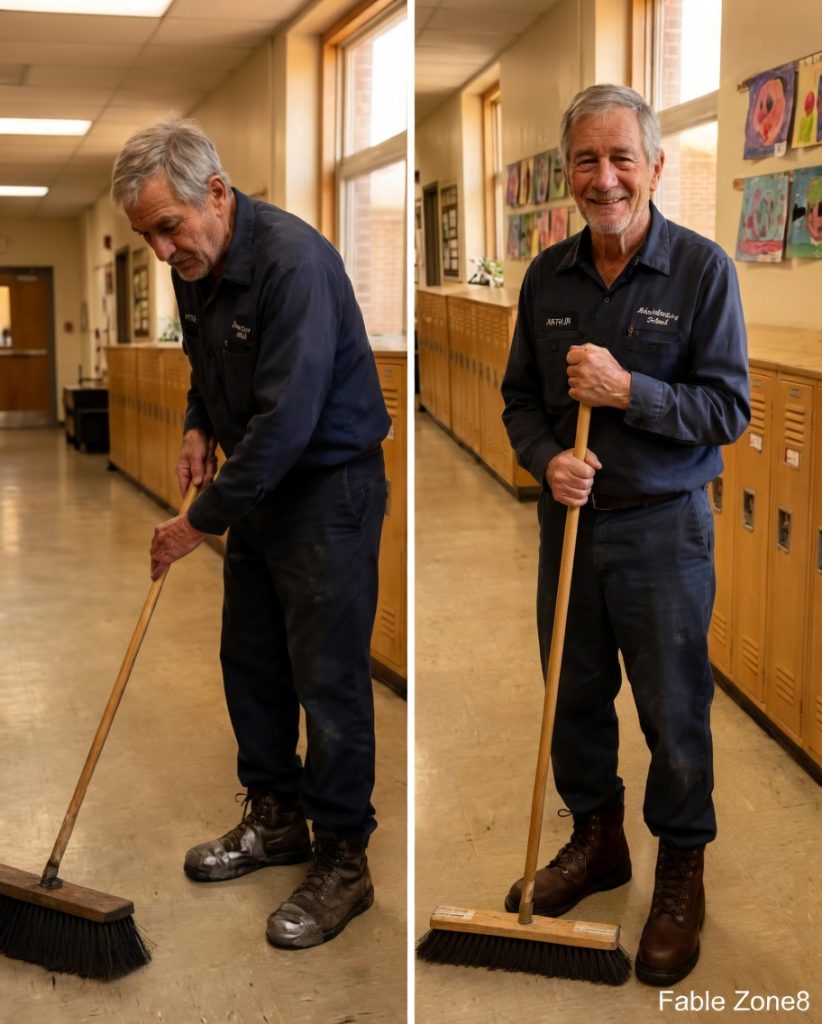
A rainy evening. A pair of worn boots. A man who refused a gift.
At the time, I didn’t fully understand why his reaction stayed with me. I had offered what I thought was a kind gesture—something practical, thoughtful, and easy to accept. The boots he wore were clearly old, their soles thinned by years of use, their leather marked by time and weather. Replacing them felt like the obvious solution.
But he declined.
Not abruptly. Not with irritation. But with a quiet firmness that carried more weight than words alone. There was something in his expression—something guarded, almost protective—that made it clear this wasn’t just about footwear.
I left that evening with a lingering sense that I had misunderstood something important.
Days later, that feeling returned when I found myself inside his home.
It was modest, almost bare, yet filled with objects that seemed to hold meaning far beyond their appearance. Nothing was extravagant, nothing particularly new, but everything felt intentional—as though each item had been chosen, kept, or preserved for a reason.
Then I saw the photograph.
It hung on the wall in a simple frame, slightly faded with time. At first glance, it appeared ordinary—a group of people standing together, smiling in front of what looked like a neighborhood park. But something about it caught my attention.
I stepped closer.
Recognition came slowly, like a memory surfacing after years of silence. The park in the background was unmistakable. I had been there countless times as a child. I knew the shape of the trees, the curve of the path, the way the light fell in the late afternoon.
But it wasn’t just the place.
It was one of the people.
A woman stood near the center of the photograph, her expression warm, her posture relaxed. There was something familiar about her—something that tugged at a part of my memory I hadn’t visited in years. And then, suddenly, it became clear.
I had known her.
Not deeply, not in a way that would have stayed at the forefront of my mind. But she had been part of my childhood—one of those quiet, kind presences that shape your early years without you fully realizing it at the time.
She had lived nearby. She would sometimes leave baked goods at our door, small gestures of kindness that felt comforting in ways I couldn’t articulate as a child. She asked simple questions—how school was going, whether I liked what I was learning—and listened to the answers with genuine interest.
She had been, in many ways, a gentle constant.
And now, she was here again—unexpectedly, through a photograph on the wall of a man I barely knew.
When I asked him about her, his expression changed.
It softened.
There was pride there, unmistakable and quiet. But there was also something else—something heavier. A kind of sorrow that had settled over time rather than appearing suddenly.
He told me she was his wife.
The realization landed slowly, layering itself over the memory I had just uncovered. Two separate parts of my life—one from the past, one from the present—had suddenly aligned in a way that felt almost impossible.
When I told him what I remembered, he looked at me with a kind of disbelief that mirrored my own. It took time, and conversation, for the connection to fully take shape.
But once it did, it was undeniable.
We began to talk—not just about the photograph, but about the neighborhood, the small details that only someone who had lived there would recognize. The old swing set that creaked with every movement. The stray dog that followed children home but never stayed. The streetlights that flickered before turning fully on at dusk.
Each detail added another thread, weaving our separate memories into something shared.
What struck me most was the way he spoke about her.
She wasn’t described as someone who had simply existed in the past. She felt present in his words, as though her influence hadn’t faded but had instead settled into the rhythm of his daily life.
And then I understood something I hadn’t before.
The boots.
They were never just boots.
They were part of that story.
Part of what remained.
In the days that followed, I found myself returning—not out of obligation, but out of curiosity, and something deeper I couldn’t quite name. Each visit revealed more, not just about his life, but about the way people carry their past with them.
We talked about many things.
Sometimes about her—her habits, her laughter, the way she approached small moments with care. Sometimes about the present—his routines, his work, the quiet structure of his days. And sometimes, we spoke about nothing in particular, letting the silence exist without needing to fill it.
My daughter joined me once.
At first, she was shy, uncertain how to navigate this unfamiliar space. But curiosity has a way of overcoming hesitation, especially in children. She began asking questions—simple ones, direct and unfiltered.
He answered them patiently.
And something shifted.
The man who had once seemed guarded began to open in small, noticeable ways. His responses carried warmth, and occasionally, a quiet humor that hadn’t been there before.
It was during one of those visits that he said something that stayed with me.
He admitted that it wasn’t just memory that made him refuse the boots.
It was fear.
Accepting something new, he explained, felt like letting go of what he still had. The boots, worn as they were, were a connection—a tangible link to a life that had changed. Replacing them felt like erasing part of that connection.
His words reframed everything.
Grief, I realized, doesn’t follow logic.
It doesn’t operate on practicality or efficiency. It attaches itself to objects, routines, and rituals—not because they are inherently important, but because of what they represent.
To someone on the outside, it might seem simple: replace the boots, move forward. But for him, it wasn’t about moving forward.
It was about holding on.
Understanding that changed how I approached everything.
Instead of trying to convince him to accept something new, I asked a different question.
What if we didn’t replace them?
What if we preserved them?
At first, he didn’t respond. The idea seemed unfamiliar, as though it hadn’t occurred to him that there might be another option. But as I explained—repairing them, strengthening them without erasing their history—something shifted in his expression.
It wasn’t immediate.
But it was there.
A few days later, we took the boots to a small repair shop.
The craftsman who examined them did so with care, as though he understood their significance without needing it to be explained. He ran his hands over the worn leather, studied the soles, and nodded thoughtfully.
“They’ve been through a lot,” he said.
It sounded less like an observation and more like a recognition.
“But they’re not done yet.”
Watching the repair process felt unexpectedly meaningful.
It wasn’t just about materials or technique. It was about preservation. About honoring something that had endured rather than replacing it with something easier.
When the boots were ready, the difference was subtle.
They still looked worn. Still carried the marks of time. But they were stronger now, capable of continuing rather than being set aside.
He held them carefully.
And this time, there was no resistance.
Only acceptance.
He thanked me, but not in the way I had expected. It wasn’t about the repair itself. It was about understanding. About recognizing what the boots meant and choosing to work with that meaning instead of against it.
Over time, our visits changed.
They became less about uncovering the past and more about sharing the present. My daughter grew comfortable, bringing drawings and stories, filling the space with a kind of lightness that balanced the weight of everything else.
He listened to her, responded with patience, and occasionally shared stories of his own—simple lessons wrapped in quiet observations.
What had begun as a chance encounter now felt intentional.
Not because it was planned, but because it had unfolded in a way that revealed its own purpose.
Looking back, it’s clear that the boots were never the point.
They were the beginning.
A doorway into something deeper.
A reminder that people carry entire worlds within them—worlds shaped by love, loss, memory, and meaning. Worlds that are not always visible, but are always present.
What we see on the surface rarely tells the full story.
And sometimes, the most meaningful acts of kindness are not about giving something new.
They are about recognizing what already exists.
About understanding that value is not always found in replacement, but in preservation.
In choosing to protect what remains.
Because in doing so, we don’t just help others hold on to their stories.
We become part of them.