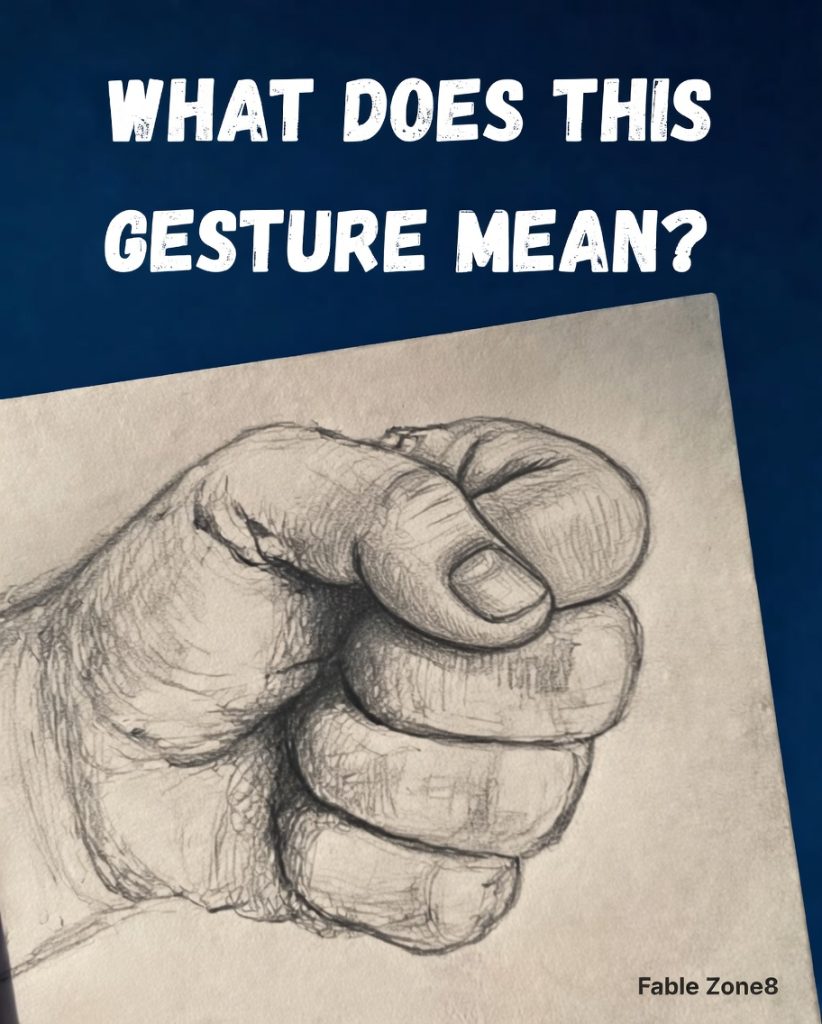
In an age where communication happens at the speed of a tap—through emojis, text messages, and instant reactions—it’s easy to forget that humans once relied on far subtler, more symbolic ways to express themselves. Long before language became standardized and long before digital shorthand dominated conversation, people used gestures to convey meaning, emotion, and intention. Among these gestures, one of the most fascinating—and largely forgotten—is the ancient “fig” sign.
At first glance, the gesture seems simple: a clenched fist with the thumb tucked between the index and middle fingers. To modern eyes, it might appear random or even meaningless. But in ancient times, this small movement carried powerful symbolism. Known in Latin as manus fica, or “fig hand,” it was a gesture layered with meaning—one that could express defiance, ward off evil, or inject humor into everyday interactions.
The origins of the fig gesture trace back thousands of years, with strong roots in ancient Mediterranean cultures. It was especially prominent in the Roman world, where gestures played a significant role in both public and private life. In a society where hierarchy and authority were deeply ingrained, not every thought could be spoken aloud. Gestures offered a way to communicate indirectly—sometimes playfully, sometimes protectively, and sometimes with quiet rebellion.
One of the most intriguing aspects of the fig gesture is its association with protection. In ancient belief systems, particularly those surrounding the concept of the “evil eye,” it was thought that envy or ill intent could bring misfortune. To counteract this, people developed a range of apotropaic practices—rituals and symbols designed to ward off harm.
The fig gesture was one such symbol. Its form, resembling a fig fruit or subtly alluding to fertility and life force, was believed to possess protective energy. By making the gesture, a person could symbolically shield themselves from negativity or redirect harmful intentions. It wasn’t uncommon for individuals to use it discreetly when passing strangers, entering unfamiliar spaces, or sensing tension.
In ancient Rome, the gesture even appeared in ritual contexts. During certain ceremonies aimed at appeasing restless spirits, symbolic actions were used to maintain balance between the living and the dead. The fig sign, with its associations of vitality and protection, became part of this symbolic language. It represented a quiet assertion of life over unseen forces—a small but meaningful act of defense.
Over time, the gesture spread beyond Rome into other parts of Europe and the Mediterranean. As it traveled, its meaning evolved. In some regions, it retained its protective qualities, while in others, it took on more social or playful roles.
By the Middle Ages, the fig gesture had become a common form of non-verbal communication in many communities. Life during this period was governed by strict social structures, and open defiance could carry serious consequences. In such environments, subtlety became a valuable skill. A gesture like the fig allowed individuals to express refusal or disagreement without attracting unwanted attention.
Imagine a crowded marketplace, where merchants negotiated prices and customers haggled over goods. A quick, discreet fig gesture—perhaps hidden behind a cloak or below a table—could signal “no” or “I refuse” without escalating the situation. It was a silent language, understood by those familiar with its meaning, yet invisible to outsiders.
This dual nature made the gesture particularly versatile. It could be used seriously or humorously, depending on the context. Among friends or family, it might serve as a playful way to tease or push back against a suggestion. Among strangers or authority figures, it became a tool of quiet resistance.
Children, too, learned the gesture as part of everyday life. In some cultures, it was taught as a harmless way to respond to teasing or minor conflicts. Rather than arguing or escalating tensions, a child could simply make the sign—a small act that conveyed defiance without aggression.
The fig gesture also carried symbolic weight in matters of fertility and life. Its shape and associations linked it to themes of creation and protection, making it a common motif in certain rituals and traditions. In weddings, for example, it could be used as a sign of good fortune, representing hopes for a fruitful and harmonious union.
In some interpretations, the gesture had a slightly risqué undertone, reflecting the earthy humor that often accompanied discussions of fertility. Yet even in these contexts, it remained more playful than offensive. Its meaning was fluid, shifting depending on who used it and how.
As centuries passed, the fig gesture continued to adapt. It appeared in art, literature, and oral traditions, sometimes as a symbol of cleverness, other times as a mark of defiance. Its presence in these cultural expressions highlights how deeply embedded it was in everyday life.
However, like many traditional forms of communication, the fig gesture began to fade as societies changed. The rise of urbanization, formal education, and standardized language reduced the need for such nuanced non-verbal cues. As people became more comfortable expressing themselves openly, the reliance on subtle gestures diminished.
Technological advancements further accelerated this shift. The invention of the printing press, followed by telecommunication technologies like the telegraph and telephone, transformed how people shared information. Communication became more direct, more immediate, and less dependent on shared cultural symbols.
By the 20th century, the fig gesture had largely disappeared from daily use in many parts of the world. It survived mainly in rural areas, where traditions tend to persist longer, and in the memories of older generations. In some regions, it remained part of folklore, passed down as a curious relic of the past.
Today, encountering the fig gesture can be a surprising experience. Without context, its meaning is not immediately obvious. Some might mistake it for a simple fist, while others might associate it with unrelated modern gestures. Its original significance has become obscured by time and cultural change.
Yet for historians and those interested in human behavior, the fig gesture offers a valuable window into the past. It reminds us that communication has always been more than words. Humans have an innate ability to convey meaning through movement, expression, and symbolism.
The gesture also highlights the creativity people have used to navigate complex social environments. In times when speaking openly could be dangerous or inappropriate, subtle actions provided a way to express individuality and autonomy. The fig sign, in its quiet defiance, embodies this ingenuity.
There is also something deeply human about its protective aspect. The desire to shield oneself from harm—whether physical, emotional, or spiritual—is universal. While modern science may not support beliefs in the evil eye, the underlying impulse remains familiar. People still seek ways to feel safe, to assert control, and to protect their well-being.
In a modern context, the fig gesture can be seen as a reminder of these enduring needs. It encourages us to look beyond the surface of communication and consider the layers of meaning that can exist in even the smallest actions.
It also invites reflection on how communication has evolved. Today, we have more tools than ever to express ourselves. We can send messages across the world in seconds, share images and ideas instantly, and connect with others in ways that were once unimaginable. Yet this abundance of communication can sometimes feel overwhelming or impersonal.
In contrast, gestures like the fig sign represent a slower, more intentional form of expression. They require shared understanding, attention to context, and a degree of subtlety that is often lost in modern exchanges. Rediscovering such gestures can deepen our appreciation for the richness of human interaction.
Moreover, the story of the fig gesture underscores the importance of cultural memory. Many traditions, once central to daily life, fade over time as new practices take their place. Preserving and exploring these traditions helps us understand where we come from and how our ways of thinking have evolved.
The fig gesture may no longer be widely used, but its legacy endures. It lives on in historical records, in artifacts, and in the stories passed down through generations. It serves as a testament to the ways humans have always sought to communicate, protect themselves, and assert their identity.
In the end, the power of the fig gesture lies not in its physical form, but in what it represents. It is a symbol of quiet strength, of resilience in the face of uncertainty, and of the creativity that defines human expression.
In a world that often values loud, immediate communication, there is something profoundly meaningful about a gesture that once spoke volumes without a single word.
It reminds us that sometimes, the most powerful messages are not the ones shouted the loudest, but the ones expressed with intention, subtlety, and a deep understanding of shared meaning.
And perhaps, in rediscovering these forgotten forms of expression, we can reconnect with a part of ourselves that values not just what we say—but how we choose to say it.