The first time I noticed my father sewing, it didn’t make sense.
He sat in the corner of the living room under a dim lamp, shoulders slightly hunched, carefully guiding fabric beneath a machine that looked older than I was. His hands—rough, calloused, used to gripping tools and tightening pipes—moved slowly, almost uncertainly, as if they were learning a new language. For a moment, I thought something had gone wrong. This wasn’t him. This wasn’t our life.
My father was a plumber. His days were long, often exhausting, and his clothes carried the faint scent of metal, water, and work that never really ended. He wasn’t someone who talked about fabrics or stitches. He fixed things. He solved problems. He kept things running when they broke.
But that night, and many nights after, he was doing something entirely different.
At the time, I didn’t know what he was making. I only noticed small details—the way he would pause to study the fabric, the way he kept certain pieces carefully folded and out of sight, the occasional bandage wrapped around his fingers. I didn’t ask many questions. After my mother passed away when I was still young, our home had become a quiet place where some things were felt more than spoken.
It had always been just the two of us after that.
We learned how to move forward in small, practical ways. He made sure there was food on the table, that I got to school on time, that the bills were paid. I learned how to take care of myself, how to stay out of the way when he came home tired, how to appreciate the little things we still had. We didn’t talk much about grief, but it was there, woven into everything.
So when prom season arrived, I tried not to make a big deal out of it.
At school, it seemed like everyone was talking about dresses, hairstyles, dates, and plans. There was an excitement in the air that I couldn’t quite connect to. I told myself it didn’t matter. I said I didn’t care about going, or about what I would wear. It was easier that way—easier than admitting that I wanted something I didn’t think we could afford.
One evening, as I casually mentioned prom in passing, my father looked up from the table and said, “Leave it to me.”
That was all.
No explanation. No discussion. Just quiet certainty.
I didn’t think much of it at first. Maybe he meant we’d find something simple, something secondhand. Maybe he was just trying to reassure me. Either way, I let it go.
But then the sewing continued.
Night after night, long after I had gone to bed, I could hear the soft, steady hum of the machine from the living room. Sometimes I would wake up and see the light still on, his silhouette moving carefully in the quiet. In the mornings, there would be traces—threads on the couch, small scraps of fabric, a needle left resting on the table.
He never mentioned it, and I never asked.
At the same time, school felt heavier than usual.
There was one class in particular that I struggled with—English. It wasn’t the subject itself, but the way it was taught. My teacher, Mrs. Tilmot, had a sharp way of speaking. Her feedback was precise, but often delivered without softness. Small mistakes felt magnified. Comments lingered longer than they should have.
“You can do better,” she would say, or “This isn’t your best work.”
Maybe she meant to push us. Maybe she believed she was helping. But for me, it had the opposite effect. I started to doubt myself in ways I hadn’t before. Each assignment felt like a test not just of my writing, but of my worth.
One evening, I sat at the kitchen table rewriting the same essay for the third time. The words blurred together, and frustration settled in my chest.
My father noticed.
He didn’t ask many questions. He simply sat across from me, watching quietly for a moment before speaking.
“Don’t let someone else decide what you’re worth,” he said gently.
I looked up, surprised.
“It’s okay to learn,” he continued, “but it’s not okay to believe you’re not enough.”
His words stayed with me long after that night. I didn’t fully believe them yet, but they lingered—quiet, steady, waiting.
A week before prom, everything changed.
He came home a little earlier than usual and called me into the living room. There was a garment bag hanging carefully on the wall, simple and unremarkable on the outside.
“I think it’s ready,” he said.
I hesitated before unzipping it, unsure of what to expect.
But when I opened it, I couldn’t breathe for a moment.
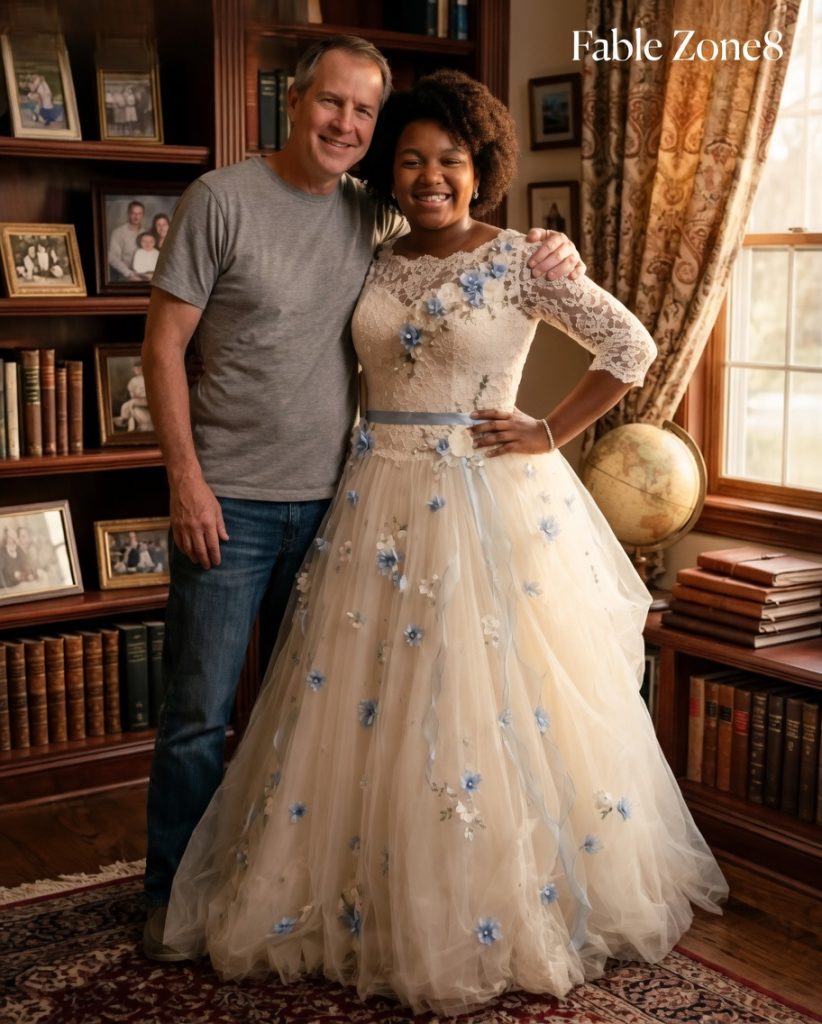
Inside was a dress—ivory, soft, and elegant in a way I had never imagined for myself. The fabric seemed to hold light, catching it gently. Delicate blue details traced along the edges, subtle but intentional. Every stitch was precise, every seam carefully placed.
It wasn’t just beautiful.
It felt alive with meaning.
“This was your mom’s,” he said quietly.
I turned to him, stunned.
Her wedding gown.
I had seen pictures of it once, years ago, tucked away in an old album. But this… this was something entirely new. He had taken something from the past—something filled with memory—and transformed it into something I could carry forward.
“How did you…?” I started, but couldn’t finish.
He shrugged slightly, a small, almost shy smile on his face.
“I figured it out.”
That was all.
No grand explanation. No need for recognition. Just a simple truth.
When I tried the dress on, something shifted inside me.
It wasn’t just about how it looked—though it fit perfectly, as if it had always been meant for me. It was about how it made me feel. For the first time in a long while, I saw myself differently. Not through the lens of doubt or comparison, but through something softer, stronger.
Through love.
My father stood quietly in the doorway, watching.
There was pride in his eyes, but also something deeper—something that felt like belief. As if he could see a version of me that I was only just beginning to recognize.
Prom night arrived faster than I expected.
As I got ready, I felt a mix of excitement and nervousness, but also something new—confidence. Not loud or overwhelming, but steady. Grounded.
When I walked into the room, conversations paused.
For a brief moment, everything felt still. Not in a way that made me uncomfortable, but in a way that felt… acknowledging. Like people were seeing me, really seeing me, perhaps for the first time.
And for once, I didn’t look away.
The night unfolded gently at first—music, laughter, familiar faces. I allowed myself to enjoy it, to be present in a way I hadn’t expected.
Then, unexpectedly, the mood shifted.
A comment was made—sharp, unnecessary, and directed in a way that drew attention. The room grew quiet in that uncomfortable way that happens when something isn’t right, but no one knows what to say.
For a split second, I felt that old doubt return.
But before it could take hold, something else happened.
A school official stepped forward, followed by a local officer. The situation, it turned out, was not as isolated as it seemed. What had been said was part of a larger pattern—something that had been noticed, documented, and finally addressed.
The tension dissolved as quickly as it had appeared.
And in its place, something unexpected emerged—not embarrassment, not discomfort, but clarity.
I stood there, in a dress made from my mother’s memory and my father’s hands, and realized something important.
The opinions of others, no matter how loud or sharp, did not define me.
The night found its rhythm again.
Music resumed. Conversations picked up. Someone asked me to dance, and I said yes without overthinking it. For the first time, I allowed myself to simply exist in the moment, without questioning whether I belonged there.
When I got home, the house was quiet again.
But this time, the quiet felt different.
My father was waiting up, sitting in his usual chair, trying to look casual but clearly eager.
“Well?” he asked.
I smiled, setting my shoes aside.
“It was good,” I said.
He studied my face, as if searching for something more.
“It wasn’t perfect,” I added, “but it didn’t need to be.”
He nodded slowly.
“I learned something,” I continued.
“What’s that?”
I paused for a moment, choosing my words carefully.
“That love matters more than anything else,” I said. “Real love. The kind that shows up, that tries, that believes in you even when you don’t.”
He looked down briefly, then back up, his expression softer than I had ever seen it.
“Yeah,” he said quietly. “It does.”
That night stayed with me—not because of the dress, or the music, or even the unexpected tension.
But because of what it revealed.
Love isn’t always loud or obvious. Sometimes, it looks like a man learning to sew in the quiet hours of the night. Sometimes, it’s found in patience, in effort, in the willingness to do something unfamiliar just to make someone else feel seen.
Strength isn’t always about standing tall in front of others. Sometimes, it’s about holding onto your sense of self when doubt tries to take it away.
And self-worth?
It doesn’t come from approval or comparison. It comes from understanding that you are already enough—just as you are.
That dress was more than fabric.
It was a reminder.
A reminder of where I came from, of what I had lost, and of what I still had. A reminder that even in the absence of one kind of love, another can rise to meet you in ways you never expected.
And most importantly, it was a reminder that the things we carry with us—our memories, our struggles, our quiet moments of courage—can be transformed into something beautiful.
All it takes is time, care, and the willingness to believe that we are worth the effort.