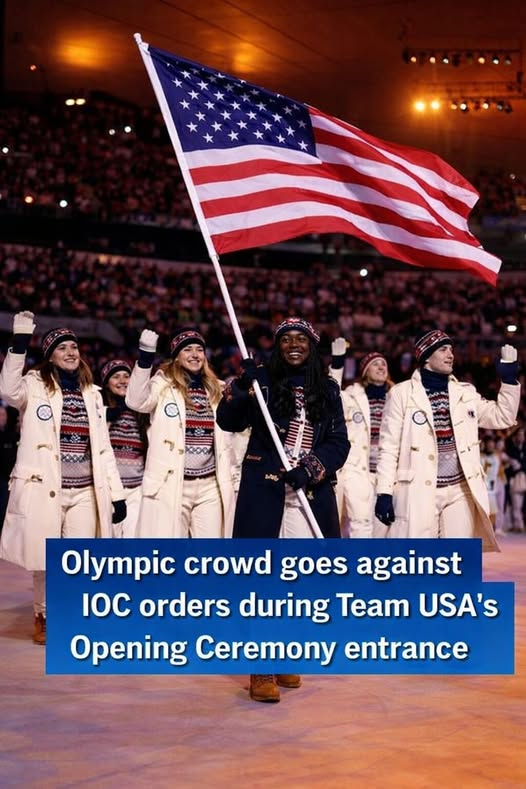
The Olympic Games have long been celebrated as a global stage for unity, sportsmanship, and the peaceful competition of nations. Yet beneath the pageantry, the vision of the Olympics as an apolitical sanctuary is continually tested by the realities of world affairs. The 2026 Winter Olympics in Milan provided a dramatic illustration of this enduring tension. What was intended to be an uplifting opening ceremony, filled with music, spectacle, and the parade of nations, was abruptly marked by a moment of discord when Team USA entered the stadium. Instead of the usual cheers, a wave of boos echoed from sections of the crowd, instantly transforming the tone of the night and igniting a worldwide conversation about the inescapable intersection of sport and politics.
The atmosphere inside San Siro Stadium was electric as the ceremony began. Performers and athletes from ninety-two nations came together under the Olympic rings, a symbol meant to represent the unity of the continents. Organizers, led by the International Olympic Committee (IOC), had repeatedly called for respect and political neutrality, hoping that the Games could offer a temporary respite from the heated debates and conflicts that dominate headlines. But as the American delegation appeared on the giant screens, segments of the audience voiced their displeasure with loud, unmistakable boos. For athletes and viewers alike, the moment was jarring—a stark reminder that the ideals of the Olympics are often at odds with the passions and frustrations of the real world.
The roots of the reaction were not difficult to trace. In the days leading up to the opening ceremony, Milan had been the scene of large protests focused on U.S. immigration enforcement policies. Activists and community groups marched through the city, denouncing what they described as unjust treatment of migrants and refugees by the U.S. government. Although Donald Trump was not present at the Games, his administration’s legacy and the ongoing debates over immigration policy cast a long shadow. Many observers quickly linked the crowd’s boos to these protests, interpreting them not as a rejection of the athletes themselves, but as an expression of political frustration directed at American government actions.
Online, the incident became an immediate flashpoint. Social media platforms exploded with commentary: some defended the athletes, insisting that they should not be held accountable for their government’s policies and had trained for years to represent their country in good faith. Others saw the boos as a legitimate, if uncomfortable, form of public expression—a reminder that international events are never fully insulated from global politics. The question of whether politics should be kept out of sport, or whether sport inevitably serves as a stage for political sentiment, was debated anew by fans, pundits, and athletes themselves.
The political undertone deepened when Gus Kenworthy, a freestyle skier competing for Team Great Britain after previously representing the U.S., spoke out against U.S. immigration enforcement shortly after the ceremony. Kenworthy’s remarks, widely shared online, reinforced the idea that the Games were taking place against a backdrop of active global debate. His comments also highlighted the growing willingness of athletes to use their platforms to address political and humanitarian issues, challenging the longstanding notion that sport and advocacy must remain separate.
Despite the tension, the ceremony pressed on. Cultural performances, music, and the traditional parade of nations offered moments of celebration and unity, reaffirming the Olympic mission to bring people together across borders. For many, these scenes were a welcome reminder of the event’s higher purpose. Yet, the image of Team USA’s entrance—marked by boos rather than cheers—remained the defining moment of the night. It was a vivid demonstration that even the most carefully orchestrated displays of international harmony are vulnerable to the divisions and grievances roiling the outside world.
In the end, the Milan Olympics’ opening night served as both a celebration and a reflection—a reminder that the Olympic ideal of unity is aspirational, not automatic. The Games exist within the world, not apart from it; they echo its conflicts, carry its hopes, and sometimes, absorb its frustrations. Yet, by bringing nations and individuals together in peaceful competition, the Olympics also offer a vision of what is possible when respect and excellence are placed above division. The challenge, as always, is to ensure that the spirit of the Games endures—and that, even in moments of tension, the torch of unity continues to burn.