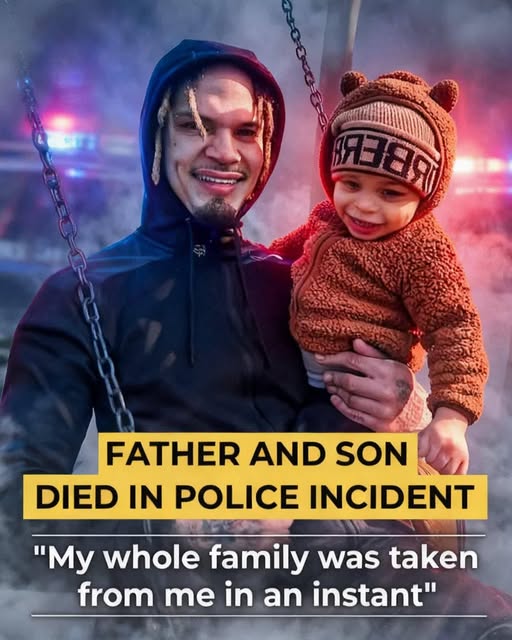
In the early hours of a quiet Las Vegas morning, tragedy struck an apartment complex near South Maryland Parkway, leaving a young child dead, a family shattered, and a community searching for answers. The incident began as a police response to a domestic dispute—a scene sadly familiar in cities across America. Yet, what unfolded in those critical seconds has become the focus of intense scrutiny, as conflicting narratives and calls for accountability threaten to engulf both the Las Vegas Metropolitan Police Department and the family of 3-year-old Kentre Baker. As investigators piece together the events that led to two lives lost—Kentre and his father, Quinton Baker—the city is left to grapple with the painful realities of grief, mistrust, and the urgent need for transparency in policing.
According to the Las Vegas Metropolitan Police Department, officers were dispatched to the apartment complex in response to reports of a serious domestic incident involving Quinton Baker and Raneka Pate, the child’s mother. Police accounts state that upon arrival, Baker exited the apartment holding his young son and failed to comply with verbal commands. In a matter of seconds, the situation escalated: officers opened fire, Baker was killed at the scene, and young Kentre was rushed to the hospital, where he later died from his injuries. The department has described the encounter as a “critical incident” that unfolded with terrifying speed—a scenario in which, according to police, the perceived threat necessitated immediate action.
But that official narrative is now under challenge. Raneka Pate, who says she was seated in a patrol vehicle nearby, insists she witnessed the encounter and disputes critical details. According to Pate, Baker was unarmed and holding their son when officers fired. She recounts pleading with police to slow down and focus on her child’s safety, arguing that there was no need for lethal force in a situation that required careful negotiation and de-escalation. Pate’s account has quickly gained traction, fueling community anger and calls for an independent review. For many, her perspective underscores a recurring fear: that the lives of Black men and children are too often lost in moments of misunderstanding or haste, and that official explanations seldom capture the full truth.
The loss has devastated the Baker and Pate families, who describe Quinton as a devoted father and Kentre as a joyful, loving child. In the days following the shooting, an outpouring of grief and support from the community has been matched by frustration and skepticism toward the police department’s handling of the case. Vigils and rallies have drawn residents demanding answers and accountability, while local leaders and activists have called for a transparent investigation—one that involves external oversight and the release of all available body camera footage. For those closest to the tragedy, nothing can bring back the lives lost, but the search for truth and justice remains a vital part of the healing process.
As the investigation continues, the stakes for the Las Vegas Metropolitan Police Department are high. Public trust in law enforcement has been tested repeatedly in recent years, with high-profile incidents across the country exposing deep rifts between police and the communities they serve. In this case, the conflicting stories and the involvement of a young child have only heightened the sense of urgency. Authorities have pledged a full review, but community advocates warn that transparency must be more than a promise—it must be demonstrated through action, open communication, and a willingness to hold officers accountable if wrongdoing is found.
For Raneka Pate, the priority is clear: she wants to understand exactly what happened in those fateful moments, and she wants assurances that the investigation will be honest, thorough, and independent. Her calls echo those of many families who have endured similar tragedies—families who have learned, sometimes painfully, that healing and accountability are inseparable. The journey ahead is uncertain, and the wounds will not heal quickly. Yet, the hope remains that through careful scrutiny, community advocacy, and genuine dialogue, some measure of justice and reform can emerge from the darkness of loss.
The tragedy of Kentre Baker’s death is a sobering reminder of how quickly lives can be changed, and how the consequences of a single moment can ripple through families, neighborhoods, and entire cities. As Las Vegas mourns, the challenge is not only to uncover the facts, but to reckon with the broader questions of trust, equity, and the role of law enforcement in a diverse and often divided society. Only through transparency, accountability, and an unwavering commitment to truth can the memory of Kentre—and the pain of his family—be honored in a way that leads toward healing and meaningful change.