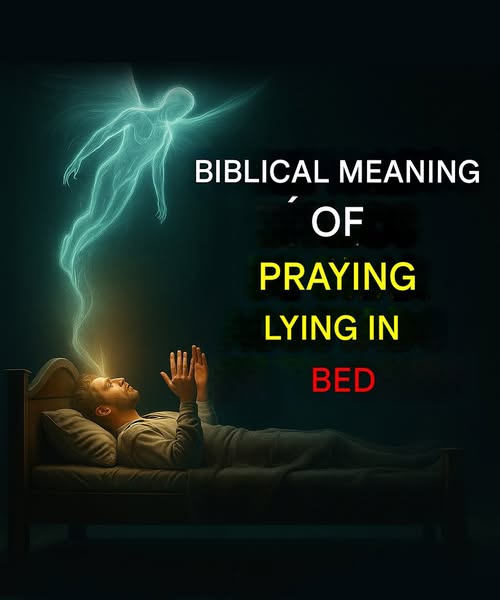
Many people carry a quiet sense of guilt when they find themselves praying while lying in bed, especially when exhaustion presses heavily on the body and eyelids grow heavy mid-sentence. There is a subtle fear that prayer offered without kneeling hands or upright posture might somehow be less respectful, less attentive, or less worthy of being heard. Yet Scripture consistently reveals a God who listens not to the position of the body but to the sincerity of the heart. The stillness of nighttime, when distractions fade and defenses lower, often becomes the most honest space for communion with God. In those moments, prayer is stripped of performance and reduced to truth. Lying in bed, breathing slowly, aware of weakness and need, many people speak to God more openly than they ever do during the day. Far from being irreverent, these prayers reflect trust—trust that God is present even when strength is gone, and that divine attention does not require physical effort but genuine presence.
Weariness is not a spiritual flaw; it is a universal human condition. The Bible never portrays fatigue as a failure of faith, but rather as a reminder of human limitation. On nights when the body can no longer hold itself upright and the mind drifts between alertness and sleep, a whispered prayer may be the only offering someone can give. Scripture affirms that such prayers are not dismissed but received with tenderness. God is portrayed repeatedly as one who understands human frailty, who “remembers that we are dust,” and who does not demand more than we are able to give. In this light, praying while lying down becomes an act of humility rather than laziness. It is an acknowledgment of dependence, a quiet confession that strength has limits and that rest itself is a gift. When words fade and sentences trail off into silence, prayer often continues without language, carried by trust rather than articulation.
Psalm 4:4 offers a striking image of spiritual reflection taking place on the bed, urging believers to meditate in their hearts during the quiet of night. This verse reveals an ancient understanding that rest and reflection are not opposites but companions. In biblical tradition, nighttime was often associated with spiritual openness, a time when external demands ceased and the inner world came forward. Without noise, crowds, or obligations, the heart became more attentive. Lying down removed the illusion of control and productivity, allowing space for listening rather than striving. The bed, in this sense, was not merely a place of sleep but a threshold between conscious effort and surrendered trust. Many psalms echo this theme, describing nights filled with remembrance, prayer, and longing for God. These passages suggest that God meets people precisely where defenses are lowered and strength is set aside.
Several of the Bible’s most transformative encounters occurred when people were lying down, exhausted, or asleep. Jacob, fleeing danger and uncertainty, collapsed onto the ground with nothing but a stone for a pillow. In that vulnerable state, he received a vision of a ladder reaching between heaven and earth, forever changing his understanding of God’s nearness. Solomon encountered God in a dream and, rather than asking for wealth or power, requested wisdom—a prayer that shaped the future of an entire nation. These moments did not happen during formal ceremonies or public worship but during rest, vulnerability, and surrender. Even David, often portrayed as a warrior and king, repeatedly described nighttime as a season of prayer, reflection, and longing. His psalms turn the bed into an altar, the darkness into a sanctuary where honesty flourished without fear of judgment.
The New Testament continues this theme, emphasizing intimacy over formality. Jesus consistently redirected attention away from public displays of spirituality and toward private, sincere connection with God. His instruction to pray in one’s room, away from performance and observation, affirms that location and posture are secondary to authenticity. A bedroom, especially at night, naturally fosters honesty. It is a place where masks fall away, where fears surface, and where the soul often speaks more freely. Even Paul and Silas, beaten and lying on a cold prison floor, prayed and sang in the darkness. Their posture was forced by suffering, yet their prayers carried power, leading to transformation far beyond their circumstances. These examples reinforce a consistent biblical message: God meets people in weakness, stillness, and confined spaces just as readily as in strength and grandeur.
Praying while lying down does not weaken faith or lessen spiritual depth; it often deepens it. Tiredness brings vulnerability, and vulnerability opens the door to sincerity. When someone falls asleep mid-prayer, it is not a sign of neglect but of trust, similar to a child falling asleep while speaking to a parent. In that quiet surrender, prayer becomes less about words and more about presence. The bed becomes a place of faith, not because of ritual, but because of relationship. Falling asleep in prayer is not failure; it is rest in God’s nearness. In those moments of quiet weakness, prayer sheds complexity and becomes simple, honest, and deeply powerful—a reminder that God is closest not when we strive hardest, but when we finally let ourselves rest.