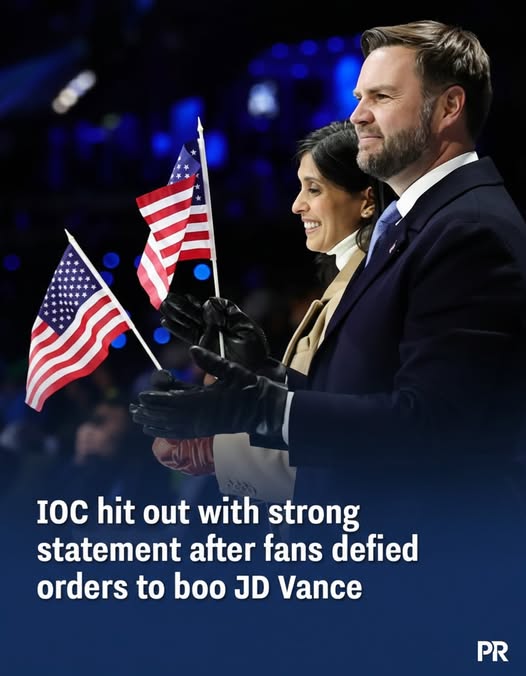
The 2026 Winter Olympics in Milan were meant to be a celebration—of athletic excellence, of unity across nations, and of the enduring promise that sport can bring the world together, if only for a few precious days. Yet, as so often happens in moments of global visibility, the ideals of the Olympic movement collided with the realities of political tension. When Vice President JD Vance led the United States delegation into San Siro Stadium during a lavish opening ceremony, he was met not with polite applause but with a chorus of sustained boos from sections of the crowd. The reaction, broadcast to millions around the world, punctured the intended atmosphere of harmony and set off a chain of responses from organizers, athletes, and observers who understand that the Games—despite their best intentions—are never fully insulated from the world’s discord.
The spectacle itself was grand, as befits an Olympic opening night. Andrea Bocelli and Mariah Carey delivered stirring performances, and ninety-two nations marched in a vibrant display of global diversity. The pageantry was underscored by the hope that, for at least a moment, the world’s eyes might focus on achievement rather than argument. But outside the stadium, and earlier that day, the streets of Milan bore witness to large-scale demonstrations protesting U.S. immigration policy—a flashpoint intensified by the absence of Donald Trump but no less potent for it. The charged atmosphere inevitably seeped into the ceremony, and when cameras lingered on Vice President Vance, the crowd’s reaction was swift and unmistakable. What was meant to be a showcase of unity became, for a moment, a mirror of the world’s divisions.
The International Olympic Committee (IOC), acutely aware of the delicate balance it must maintain, responded quickly and unequivocally. Prior to the ceremony, IOC President Kirsty Coventry had called on all participants and spectators to uphold the Olympic values of respect and mutual appreciation, urging that political tensions not overshadow the athletes’ years of preparation and sacrifice. Following the incident with Vance, IOC spokesperson Mark Adams issued a strong public statement. He reaffirmed the organization’s commitment to engaging with U.S. leadership in a spirit of cooperation, with an eye toward the upcoming Los Angeles Summer Games, and emphasized that the Olympic movement depends on collaboration between nations, not antagonism. Adams was especially clear that, regardless of political context, athletes and officials should not bear the brunt of frustrations aimed at their governments. “The Olympics,” he stressed, “rest on respect, fairness, and appreciation of excellence—regardless of nationality.”
The episode in Milan is only the latest example of a recurring tension at the heart of international sport. Athletes dedicate their lives to perfecting their craft, hoping to represent not just themselves but the best of their countries. Yet on the world stage, they often become unwitting symbols of political or social controversy, targets for public anger they did not create. The Olympics, for all their ritual and rhetoric, exist within the world, not apart from it. They reflect its hopes and its conflicts, its aspirations and its anxieties. The challenge for organizers, athletes, and fans is to preserve a space where competition can take place in an atmosphere of dignity, even when the world outside is anything but peaceful.
The IOC’s position in these moments is fraught but essential. Its leaders are tasked with upholding the ideal that the Games can be a refuge from politics, even as they acknowledge that complete neutrality is neither possible nor necessarily desirable. Previous Olympic Games have seen similar incidents—whether involving Israeli athletes, athletes from countries under sanction, or officials whose governments are embroiled in controversy. Each time, the IOC has reiterated that the Olympic movement is built on the principles of inclusion and mutual respect, and that its primary duty is to the athletes who embody those values. The Milan ceremony, with its discordant notes, is a reminder that the work of building understanding is never finished, and that vigilance is required to prevent the corrosive effects of politics from overwhelming the spirit of sport.
For athletes, the fallout from such moments can be deeply personal. Many train for years in obscurity, motivated by dreams of representing their countries and testing their limits on the world stage. To become the focus of political protest or public scorn is a burden few anticipate or deserve. Yet, in the glare of the Olympic spotlight, even the most apolitical figures can become lightning rods for larger disputes. This reality underscores the need for institutions, leaders, and fans alike to exercise restraint, to remember that the true meaning of the Games lies not in the controversies they attract but in the excellence and perseverance of those who compete.
As the Milan Games continue, the IOC’s strong response to the booing of JD Vance serves as both a warning and a hope. It is a warning that, in an increasingly fractured world, the ideals of the Olympic movement cannot be taken for granted—they must be defended, renewed, and embodied by all who participate. It is also a hope that, despite the noise and the anger, the Games can still offer a glimpse of what is possible when people choose respect over reaction, unity over division. In the end, athletic excellence must be allowed to speak louder than politics, and the Olympic stage must remain a place where the best of humanity can be seen, celebrated, and remembered.