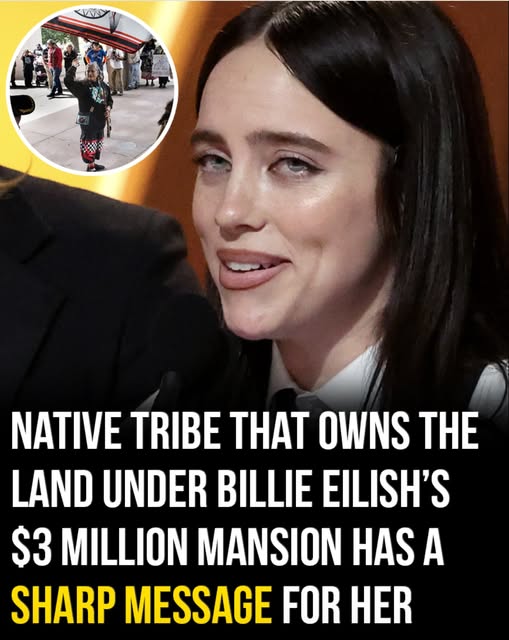
When Billie Eilish stood on the Grammy stage to accept her Song of the Year award for “Wildflower,” she knew the moment would be memorable. But few could have predicted the ripple effect her brief remarks would trigger—not just in music circles, but across American social and political discourse. “No one is illegal on stolen land,” Eilish declared, followed by a pointed rebuke of U.S. immigration enforcement: “And f**k ICE, that’s all I’m gonna say, sorry!” The lines, delivered with her signature candor, instantly reverberated online. Some heralded the speech as a bold use of platform to highlight systemic injustices tied to colonization and immigration. Others saw it as a flashpoint for controversy, questioning what it means to acknowledge “stolen land” while owning property in Los Angeles—a city whose soil, like much of California, is the ancestral home of the Gabrieleno Tongva people.
As the Grammy moment was replayed and debated, the Tongva tribe—the First People of the Los Angeles basin—chose to respond not with anger or demands, but with a statement of clarity and hope. “We appreciate the opportunity to provide clarity regarding the recent comments made by Billie Eilish,” a Tongva spokesperson said. The tribe acknowledged that Eilish’s home sits on their ancestral land, a reality shared by millions of Angelenos. While noting that Eilish had not reached out directly to the tribe, they expressed appreciation for any public figure who brings visibility to Indigenous history. “It is our hope that in future discussions, the tribe can explicitly be referenced to ensure the public understands that the greater Los Angeles basin remains Gabrieleno Tongva territory,” the spokesperson added. In a gesture of outreach, representatives for the tribe contacted Eilish’s team, signaling a willingness for dialogue and partnership rather than confrontation.
The measured tone of the Tongva’s response stood in contrast to much of the commentary that followed Eilish’s speech. On social media and in political circles, the debate grew heated. Some critics argued that if Eilish truly believed in her words, she should transfer her Los Angeles mansion to the Tongva or open it to undocumented migrants. Political figures from Governor Ron DeSantis to Senator Mike Lee took aim at what they characterized as “stolen land nonsense,” insisting that public acknowledgment should be matched by personal sacrifice. Others, including celebrities like Elon Musk, responded with sarcasm, amplifying the backlash against what they perceived as performative activism. The chorus of criticism painted Eilish—and by extension, other public figures who make similar statements—as out of touch with the practical realities and complexities of property, wealth, and historical responsibility.
Yet, for many supporters, Eilish’s remarks were an example of courageous celebrity advocacy—a willingness to use a high-profile moment to center issues of colonization, Indigenous erasure, and immigration. They pointed out that acknowledgments of “stolen land” are, by their nature, uncomfortable; they force Americans to confront a history that is often glossed over in mainstream narratives. For these advocates, the demand for celebrities to “give back” their property is a distraction from the larger conversation about systemic change, reparative justice, and ongoing relationships with Indigenous communities. Instead of individual acts of restitution, they argue for policies that recognize tribal sovereignty, expand land access, and amplify Indigenous voices in public life.
The Tongva’s response adds another layer of nuance to this debate. Rather than demanding Eilish relinquish her property or condemning her for hypocrisy, the tribe encouraged more explicit recognition in public conversations and expressed hope for continued visibility. Their approach reflects a broader trend among Indigenous communities: the push for acknowledgment, partnership, and education alongside calls for concrete action. For the Tongva and many other tribes, the goal is not simply to reclaim land parcel by parcel, but to ensure that their history, presence, and rights are woven into the fabric of civic life and policy. Their willingness to engage with Eilish’s team suggests that, for now, the priority is dialogue and awareness rather than confrontation or litigation.
The controversy also highlights a familiar tension in American culture between rhetoric and reality, especially for public figures. Eilish’s stance against ICE and her invocation of “stolen land” are consistent with her history of speaking out on social and political issues, including immigration enforcement and Indigenous rights. Yet, as her critics point out, activism from a place of privilege inevitably raises questions about personal responsibility and the limits of symbolic action. How should celebrities balance their influence, wealth, and public platforms with the substantive work of justice? What does meaningful acknowledgment require, and who gets to decide when actions match words?
These questions are not easily answered. They touch on the complexities of land, identity, and belonging in a nation built on colonization and migration. They also reflect the evolving expectations placed on celebrities in the age of social media—an era that rewards bold statements but also demands accountability. For Indigenous communities like the Tongva, the moment is an opportunity to educate, build alliances, and insist on a fuller reckoning with history. For the public, it is a chance to reflect on what acknowledgment really means: Is it a matter of personal sacrifice, systemic change, or both?
As the debate continues, Billie Eilish has not publicly expanded on her Grammy remarks. The conversation she sparked, however, is far from over. It echoes through the halls of power, in classrooms, on social feeds, and within communities wrestling with the legacy of America’s past and the demands of its future. Whether through direct action, ongoing dialogue, or the gradual reshaping of public consciousness, the story of “stolen land” and Indigenous acknowledgment in Los Angeles—and across the United States—will continue to unfold, shaped by the voices of those who have always called this place home.