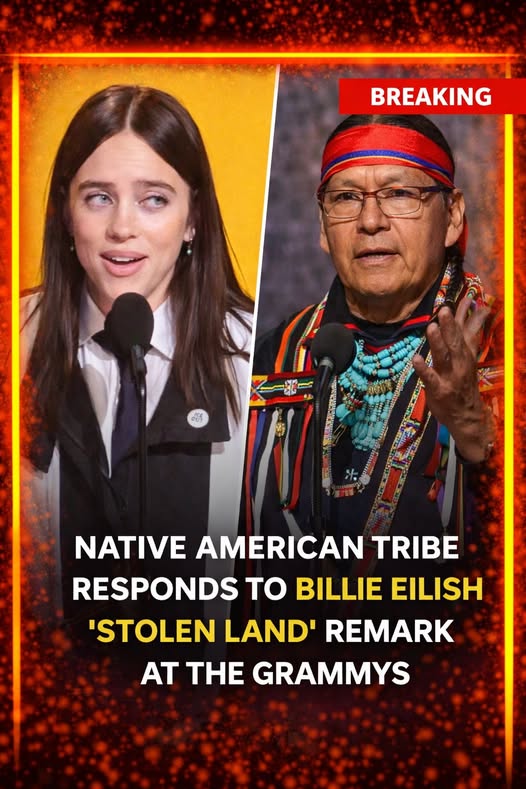
When Billie Eilish took the stage at the 2026 Grammy Awards and declared, “no one is illegal on stolen land,” her words reverberated far beyond the Crypto.com Arena. The arena responded with a standing ovation, the internet exploded with debate, and social media platforms lit up with hashtags and hot takes. But beneath the cheers, criticism, and rapid-fire reactions, there was another audience listening—a community whose history, presence, and perspective are too often left out of the national conversation. For the Tongva people, the original inhabitants of the Los Angeles Basin and the very land on which Eilish’s home sits, the moment was both a gesture of visibility and a complicated invitation. Their response, issued in the days following the Grammys, would add a layer of nuance and challenge to the conversation Billie Eilish helped ignite.
The Tongva nation’s statement, issued with both gratitude and resolve, cut through the political noise that quickly followed Eilish’s speech. While some public figures, such as Ron DeSantis, mocked the remarks, and others called for celebrities to “give back their land,” the Tongva’s response was neither a blanket endorsement nor a demand for symbolic restitution. Instead, they acknowledged Eilish’s willingness to bring Indigenous issues into the spotlight, expressing appreciation for the visibility her words provided. At the same time, they pointedly reminded the world—and Billie herself—that acknowledgment in a speech does not equate to genuine relationship or meaningful change. They noted that Eilish, who resides in Southern California, has never reached out to the Tongva or engaged directly with their community. For the Tongva, true progress requires more than a moment in the spotlight; it demands ongoing, authentic engagement and a recognition that goes beyond applause lines.
This distinction—between public acknowledgment and real partnership—lies at the heart of the Tongva nation’s message. Their statement was a call to move past performative gestures and into the realm of action: to build relationships, amplify Indigenous voices, and ensure that land acknowledgments are not just ceremonial, but a prelude to dialogue and shared future. The Tongva rejected simplistic narratives or demands for celebrities to “hand back” property. Instead, they asked for something more enduring and difficult to ignore: explicit recognition of their sovereignty, collaborative efforts to educate the public, and a commitment to ensuring that the name Tongva is as familiar and respected as any pop star’s. In doing so, they reframed the conversation, shifting it from guilt or controversy to one of responsibility and invitation.
Much of the public discourse in the aftermath of Eilish’s speech focused on the polarized reactions it provoked. Supporters celebrated her courage to speak truth to power on a global stage, while critics dismissed her remarks as out-of-touch or “virtue signaling.” The Tongva, however, sidestepped these binaries. Their response modeled a deeper kind of engagement—a willingness to accept visibility while also insisting on substance. By partnering with the Recording Academy on land acknowledgments and explicitly naming their ongoing presence (“Ekwa Shem – We are here”), the Tongva affirmed their resilience and relevance. They reminded the world that Indigenous peoples are not relics of the past, but living nations with voices, needs, and visions for the future.
For Billie Eilish, the response from the Tongva presents both an opportunity and a challenge. As one of the world’s most influential young artists, she has the platform and power to shape not only conversations, but also outcomes. The Tongva’s invitation is clear: move beyond acknowledgment to relationship, from speech to shared action. In a cultural landscape hungry for authenticity and meaningful change, the next step is not simply to recognize whose land we stand on, but to ask what it means to stand with those communities in their ongoing struggles and aspirations.
The broader implications of this exchange extend far beyond the Grammy stage. It is a mirror for the entertainment industry, for pop culture, and for a society grappling with the legacies of colonization, erasure, and the ongoing fight for Indigenous rights. Land acknowledgments, while important, are only the beginning. True justice is found in partnership, education, and the willingness to listen and learn from those who have too often been spoken about, rather than spoken with. As the Tongva nation’s statement reverberates through the headlines and social feeds, it serves as both a thank you and a challenge—a call to remember that visibility is not an end, but a door opening onto the hard and necessary work of reckoning, reconciliation, and real relationship.