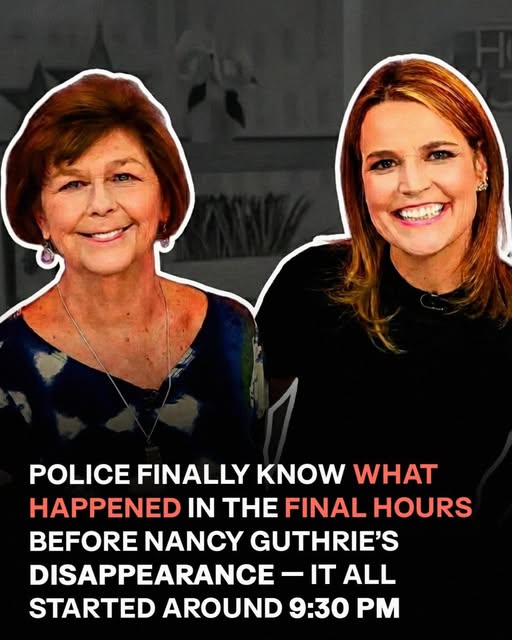

What began as a quiet Saturday evening in the Catalina Foothills of Tucson, Arizona, would soon unravel into one of the region’s most disturbing and high-profile missing persons cases in recent memory—a mystery that has since captivated the nation and left both a family and a community grasping for answers. The disappearance of 84-year-old Nancy Guthrie, mother of “Today” show anchor Savannah Guthrie, has upended the sense of security in a neighborhood long regarded as safe. Now, as investigators lay bare the details of Nancy’s final hours before she vanished, the scope of the search has shifted dramatically: what was once a routine welfare check has swiftly escalated to what authorities now acknowledge is a serious criminal investigation, with implications that reach far beyond one family’s private anguish.

The events of that fateful night seemed, at first, entirely unremarkable. Nancy Guthrie, described by loved ones as mentally sharp and fiercely independent despite her advanced age and need for daily medication, enjoyed a pleasant dinner with family. She was dropped off at home sometime between 9:30 and 9:45 p.m. by her daughter Annie, who was the last known person to see her. According to Annie and other family members, Nancy appeared in good spirits, showing no signs of distress or unusual behavior. “There were no red flags,” Pima County Sheriff Chris Nanos later explained, a sentiment echoed by everyone who interacted with Nancy that evening. For a woman whose routines were steady and whose connections to her community were deep, there was no reason to anticipate anything out of the ordinary as she settled in for the night.

It wasn’t until late the next morning that alarm bells began to sound. When Nancy failed to attend her regular Sunday church service, a concerned friend reached out to the family. Realizing that no one had heard from her, a relative placed a 911 call around midday on February 1, prompting a rapid law enforcement response. What officers found upon arrival immediately set the case apart from typical missing persons reports. Nancy was gone, but her personal belongings—her purse, phone, and medication—remained behind in her home. There were no signs of forced entry or struggle visible to the untrained eye, but veteran detectives were unsettled by subtle details they have not yet made public. The initial welfare check quickly gave way to a full-scale investigation, with homicide detectives brought in just hours after the first call—a move Sheriff Nanos later described as “highly unusual” for a case that, at least initially, lacked clear evidence of foul play.

As investigators began reconstructing the timeline, a troubling narrative emerged. The hours between 9:45 p.m. Saturday and 11 a.m. Sunday represented a critical window—one in which Nancy Guthrie vanished without a trace. The delay in discovering her absence meant that precious time was lost, complicating efforts to gather evidence and interview potential witnesses. Detectives canvassed the neighborhood, interviewed neighbors, and began combing through security and doorbell camera footage from nearby homes. The search for clues was exhaustive and urgent, especially given Nancy’s health needs and the growing conviction among investigators that she did not leave her home voluntarily. “This is an 84-year-old woman, asleep in her own home, who is taken,” Sheriff Nanos told reporters. “That should never happen.” The gravity of his words underscored the rarity—and the horror—of a case in which a vulnerable senior could be abducted from the apparent safety of her own bed.

Authorities soon confirmed that the case had moved beyond the realm of a search-and-rescue mission. “We do in fact have a crime scene. We do in fact have a crime,” Nanos announced at a subsequent press conference, making clear that all available resources were being directed toward evidence analysis and the identification of a suspect. Investigators recovered Nancy’s cellphone, combed the house for DNA and other forensic evidence, and asked neighbors to review any footage that might capture suspicious activity during the overnight hours. Search-and-rescue teams, initially deployed to canvas the surrounding desert and residential zones, were dismissed. The focus had shifted entirely to understanding who entered Nancy’s home and how they managed to spirit her away without alerting anyone. The sheriff emphasized that even a short period without her medication could put Nancy’s life at serious risk, heightening the urgency of the search for answers.

For the Guthrie family, the ordeal has been both surreal and excruciating. Nancy is the beloved matriarch of a close-knit family—mother to Savannah, Annie, and Camron Guthrie, and widow of Charles Guthrie, who died suddenly of a heart attack decades earlier. Each new revelation from law enforcement brings a fresh wave of anxiety and frustration, as the family grapples with the reality that someone as safe, sharp, and independent as Nancy could disappear so completely. Savannah Guthrie, who has temporarily stepped away from her “Today” show duties, flew to Arizona within hours of learning the news. In a brief statement to viewers, she thanked the public for their support and prayers, reiterating the family’s hope for Nancy’s safe return. The emotional weight of the crisis is compounded by Savannah’s own public profile, as the story of her mother’s disappearance becomes a national headline and a rallying point for communities concerned about the safety of older adults.

As the investigation continues, its implications have resonated far beyond the Guthrie family. The case has prompted renewed conversations about the vulnerability of seniors, the importance of community vigilance, and the challenges law enforcement faces in piecing together fragmented timelines in the critical hours after a disappearance. Advocacy groups for the elderly have pointed to Nancy’s case as a stark reminder that even those who are mentally sharp and well-supported are not immune to danger. Politicians and community leaders in Tucson have urged residents to check on their neighbors, review security footage, and report anything even remotely suspicious to authorities. The search for Nancy has galvanized a broader movement for awareness, policy reform, and improved safety measures for older Americans—a testament to her enduring influence even in the midst of crisis.

In the end, the disappearance of Nancy Guthrie remains an open wound for her family and community, as well as a haunting mystery for investigators. Each detail that emerges from the case—the ordinary dinner, the undisturbed home, the missing hours—serves as a reminder of how quickly safety can be shattered and how deeply loss can echo. For now, those who love Nancy cling to hope, drawing strength from memories of her warmth, wisdom, and encouragement. Law enforcement remains steadfast in their pursuit of the truth, determined to bring answers to a case that began with a quiet night and has since become a profound and unsettling chapter in the story of Tucson. As the search presses on, the nation watches and waits, reminded that even in the most ordinary moments, life can turn in ways that are both inexplicable and unforgettable.