I’m a single dad, not by choice, but because life veered off course the day Emma’s mom left, quietly packing a small bag and whispering something about needing “space.” She walked away when our daughter was only three. I waited, hoping she would return, but she never did. The shock and the absence left a void that was impossible to ignore. Suddenly, my world contracted into the urgent needs of my child and the crushing reality that I had to become both mother and father, protector and nurturer, cheerleader and disciplinarian, all at once. My parents stepped in whenever they could, proving that the phrase “it takes a village” was more than a platitude—it was the framework of survival.
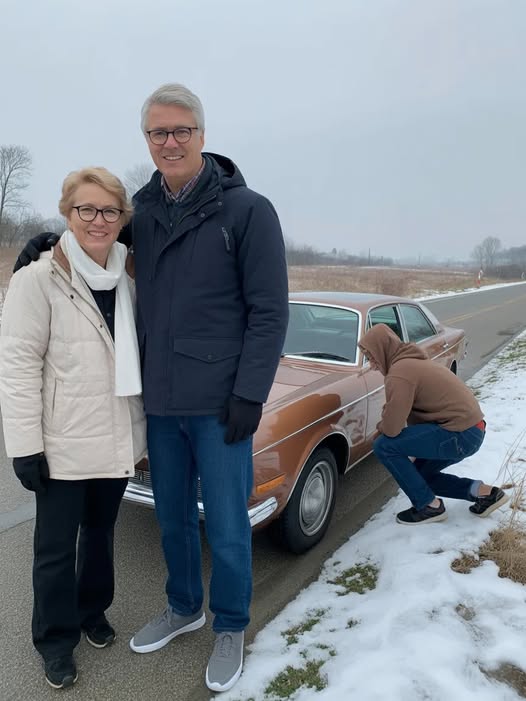
By the time Thanksgiving approached, I was running on fumes, yet determined to make it special for Emma. She sang “Jingle Bells” from the backseat as we drove through the first snow, the soft flakes settling like powdered sugar on the quiet road. Life felt heavy but ordinary in its rhythm, until an unexpected scene transformed an ordinary holiday into something unforgettable. An old sedan stood helplessly on the shoulder, tires flat, wind slicing through the thin jackets of the elderly couple beside it. The man and woman looked frozen, not just from the cold, but from the helplessness of the moment, the silent resignation of being stranded and unseen.
Without a second thought, I pulled over. “Stay in the car, sweetheart,” I told Emma, who peered curiously through the window. The couple’s relief was immediate and tangible, almost heartbreaking in its rawness. “Oh! Young man, I’m so sorry. We didn’t mean to bother anyone,” the woman said, her voice quivering. The man added quietly, “We’ve been here almost an hour… didn’t want to ruin anyone’s holiday.” I knelt beside the stubborn lug nuts, the cold seeping into my fingers as I wrestled with them. The man tried to help but grimaced. “Arthritis,” he muttered. I smiled, trying to ease the tension. “Don’t worry about it, sir. I’ve got it.”
Working together, the spare tire went on, bolts tightened, and finally, the couple’s car was ready to roll again. The gratitude they expressed felt heavier than words could carry. The man grasped my hand with both of his, his eyes shining through the chill. “You saved us,” he said, voice thick. “You and your little girl.” Emma, in her small, decisive way, gave me a proud thumbs-up from the backseat. In that instant, it seemed like nothing more than a small act of help on a cold highway—a fleeting gesture that could easily be forgotten. Yet, the warmth of the couple’s relief left an imprint on my heart that would linger long after the snow melted and Thanksgiving dinner ended.
The rest of the evening unfolded in the familiar chaos of my parents’ home—laughter, arguments over the best way to carve the turkey, the comforting aroma of cinnamon and roast filling the air. By dessert, I had almost forgotten the highway encounter, swept up in the normalcy of family life, the security of tradition. But later that night, as Emma slept soundly in the next room, I reflected on how a simple decision—to stop, to help, to connect—had created a thread of humanity running through the day. One small act of kindness had bridged generations, reminding me that even in exhaustion and struggle, compassion could transform not just lives of strangers, but our own as well.
In the days that followed, the encounter replayed in my mind. I realized that kindness often arrives disguised as inconvenience. The cold, the stress, the exhaustion—any of those could have justified driving past. But choosing to help changed everything, not just for the elderly couple, but for Emma and me. It reinforced lessons I had been trying to teach my daughter: that empathy matters, that generosity is powerful, and that our actions ripple far beyond the immediate moment. Sometimes, the simplest gestures—the tightening of a lug nut, the offer of a warm smile, the reassurance that someone is not alone—carry the deepest significance.
Looking back, I understand that life’s most profound changes often come unexpectedly, woven into ordinary days. A highway, a flat tire, a small act of courage and compassion—these were enough to shift the tone of our Thanksgiving and embed a lesson in our hearts that will endure forever. That day, Emma and I witnessed the human capacity for gratitude, connection, and mutual support, discovering that giving—even when we have so little left to give—can create a lasting impact. In helping a stranded elderly couple, we were not just lending hands or warmth; we were opening ourselves to transformation, a reminder that life is richest when it is shared, however briefly, with others in need.