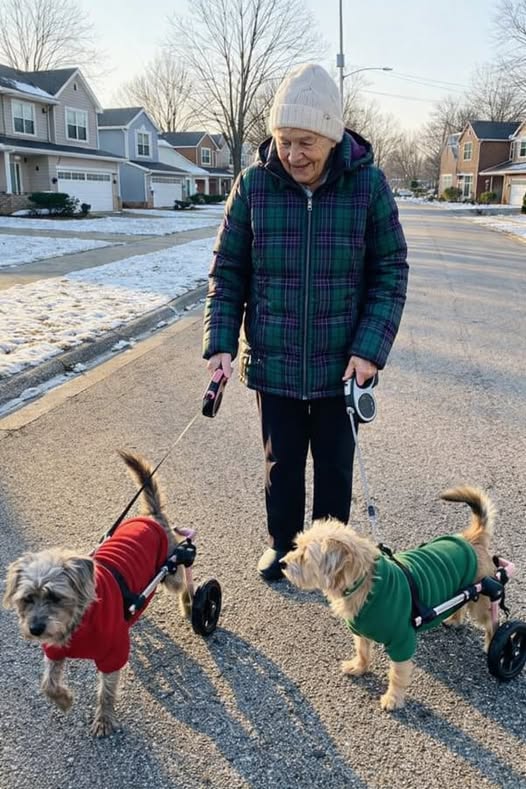
I was on my usual afternoon walk when the moment unfolded, the kind that seems small at first but later reveals itself as a turning point. At seventy-five, I no longer rush through days or dismiss uncomfortable encounters as meaningless. Life has taught me that some moments ask something of you—patience, courage, or simply the willingness to remain present. Pearl and Buddy were beside me, as they always are, rolling happily along the sidewalk on their tiny wheel carts. Their movements were smooth, practiced, joyful. They had mastered these wheels long before I mastered my own grief. Most passersby smiled when they saw them, some slowed down to ask questions, others waved as if greeting old friends. That day, however, one neighbor stopped abruptly, her face tightening with disapproval. She looked at my dogs and then at me and said, flatly, that animals like that didn’t belong on “a decent street.” She suggested, without hesitation, that I get rid of them. In that instant, I realized she hadn’t just insulted my dogs—she had underestimated the woman holding their leashes.
After my husband died, the world grew unbearably quiet. The routines we had shared for decades vanished overnight, leaving hours that felt hollow and heavy. I wasn’t looking to replace him or distract myself from grief, but I needed something to care for, something that required me to get out of bed each morning with intention. That was when rescue animals found their way into my life. Pearl came first, her back legs useless after an injury that left her abandoned and confused. Buddy followed later, older, slower, and scarred by neglect. Both had been written off by people who saw only inconvenience instead of life. Caring for them gave my days shape again. Feeding schedules, vet visits, slow walks, and quiet evenings became acts of healing for all three of us. They didn’t walk like other dogs, but they greeted the world with a joy that many able-bodied creatures never achieve. Hearing someone call them “disgusting” cut deeply, because it echoed the cruelty that had already shaped their lives. Still, I didn’t raise my voice. I stood there calmly, feeling the weight of my years steady me. I had survived loss far greater than an insult, and I knew when confrontation would only feed ugliness.
In the days that followed, I learned that the encounter hadn’t been an isolated lapse in kindness. This neighbor, it turned out, had a reputation. She filed complaints over minor inconveniences, scolded children for playing too loudly, and intimidated anyone she thought wouldn’t push back. Her power came not from authority, but from others’ desire to avoid conflict. For years, people had quietly adjusted their lives around her moods. I considered my options carefully. At my age, I had no interest in feuds or drama, but I also understood that silence can look like agreement. Pearl and Buddy depended on me not just for food and shelter, but for advocacy. Standing my ground wasn’t about winning an argument; it was about affirming that vulnerability deserves protection. I reminded myself that dignity doesn’t require shouting. Sometimes it requires nothing more than refusing to retreat.
A few days later, animal control arrived at my door. The complaint, they explained politely, alleged unsanitary conditions and improper care. I had anticipated this possibility, and instead of panicking, I invited them in. I also invited a few neighbors who had seen us on our daily walks. One by one, they spoke—not angrily, but honestly. They described Pearl and Buddy’s routine, the cleanliness of my home, and the obvious affection between us. I explained their medical needs, the veterinary care they received, and the specialized equipment that allowed them to move comfortably. The officer listened carefully, inspected everything thoroughly, and then smiled. The complaint was dismissed without hesitation. More importantly, the officer warned the neighbor that continued harassment could have consequences. For the first time, her pattern of intimidation met a clear boundary. I watched from my doorway as the officer left, feeling something unfamiliar but welcome settle in my chest: relief mixed with resolve.
What happened next was something I never could have orchestrated, even if I had tried. Notes began appearing in my mailbox—handwritten messages thanking me for “standing up” and expressing affection for Pearl and Buddy. Children from down the street asked if they could walk with us sometimes, their curiosity blooming into gentle care as they learned how the wheels worked. Neighbors adjusted their routines just to wave or say hello as we passed. Our quiet walks, once solitary, became shared moments of connection. People lingered on their porches, conversations stretched a little longer, and laughter followed us down the sidewalk. Without meaning to, Pearl and Buddy became symbols—not of disability, but of resilience. They reminded people that difference doesn’t diminish value. Watching them roll along, tails wagging, softened something in the neighborhood that had been tense for years.
That evening, I sat on my porch as the sun dipped low, Pearl curled beside me and Buddy asleep at my feet. The street felt different—warmer, more alive. I thought about how easily I could have turned back that day, avoided discomfort, and spared myself stress. But I also thought about what that would have taught my dogs, in the only way animals learn: through action. Kindness doesn’t always announce itself loudly. Sometimes it stands quietly, refuses to move, and trusts that truth will speak for itself. At seventy-five, I don’t have the energy for bitterness, but I have plenty left for conviction. Pearl and Buddy taught me that vulnerability can inspire strength, and that when one person chooses compassion over fear, it can ripple outward in unexpected ways. That neighbor underestimated me, yes—but more importantly, she underestimated the power of love practiced consistently. And in doing so, she unintentionally helped turn an ordinary street into a community.